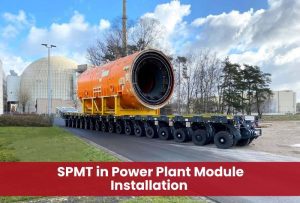
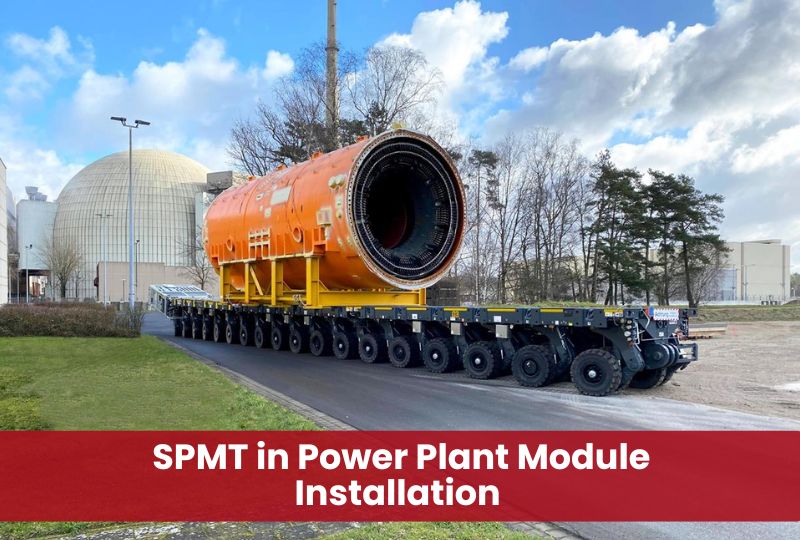
Modern power plant construction increasingly relies on prefabricated modules built off-site in a controlled fabrication environment and then transported into their final position, and SPMTs have become a key part of making that modular construction approach practical at scale.
Why Modular Construction Uses SPMTs
Building large sections of a power plant off-site, in a fabrication yard with better working conditions and quality control than an active construction site, reduces on-site labor requirements and often shortens overall construction time significantly. Once a module is complete and tested, it needs to travel from the fabrication area to its final foundation, which is exactly the kind of heavy, controlled horizontal move SPMTs are specifically designed to handle.
Handling Dense, Heavy Modules
Power plant modules, particularly those containing boilers, turbines, or heavy piping systems, can be extremely dense for their physical size compared to other types of industrial cargo. This concentrated weight requires careful axle line planning to keep ground bearing pressure within safe limits across the transport route, which we cover in more detail in our post on SPMT ground bearing pressure calculation.
Precision Placement Onto Foundations
Power plant modules often need to align precisely with anchor bolts, existing piping connections, or adjacent modules already installed in place, sometimes requiring alignment tolerances measured in millimeters rather than centimeters. SPMT crab steering and independent axle line height control, explained in our post on SPMT hydraulic steering system, allow the fine adjustments needed for this kind of precise industrial installation work.
Coordinating With EPC Project Schedules
EPC contractors typically work within tight installation windows tied to the broader project schedule, so SPMT moves need to be planned well in advance, including route surveys, axle configuration, and coordination with cranes for any modules that also require a vertical lift component. Our post on SPMT vs crane for heavy lifts looks at how the two methods work together effectively on projects like this.
Managing Multiple Modules on One Project
Large power plant construction projects often involve dozens of individual modules that need to be transported and installed over the course of the build. Coordinating the sequence in which modules are moved, particularly when later modules depend on earlier ones already being in place, adds another layer of scheduling complexity that experienced heavy transport engineers factor into the overall project plan from an early stage.
Safety Considerations in an Active Construction Environment
Power plant sites during construction are often active work environments with multiple trades and equipment operating simultaneously. SPMT moves in this context require close coordination with the overall site safety plan, including clear exclusion zones and communication protocols, which we discuss further in our post on SPMT safety standards and operator certification.
Choosing the Right Transport Partner
Given the significant value and schedule pressure involved in power plant projects, choosing a reliable SPMT provider with relevant experience matters considerably. See our post on how to choose an SPMT manufacturer in China for what to look for when evaluating potential equipment suppliers or transport partners.
Handling High Value, Sensitive Equipment
Power plant modules often contain highly engineered, expensive internal components such as turbines, control systems, or precision piping that can be sensitive to shock or vibration during transport. SPMT hydraulic suspension helps minimize the jarring movement that a conventional trailer might transmit to cargo, which is one reason SPMTs are frequently specified for modules where internal component protection is as important as simply moving the total weight safely.
Documentation and Handover to Commissioning Teams
Once a module reaches its final position, documentation of the move, including any survey data confirming alignment accuracy, is often handed over to the commissioning team responsible for connecting and testing the module’s systems. Keeping this documentation organized and accessible helps commissioning proceed smoothly, particularly on projects where multiple modules are being installed and connected in a tightly sequenced schedule.
FAQ
How far do power plant modules typically travel by SPMT?
Distances are usually short, often within the plant site itself, moving from a laydown or fabrication area to the final foundation, though the route may still be technically complex given the density of equipment and structures at an active construction site.
Is renting or owning SPMT equipment more common for power plant projects?
Both approaches are used in practice. Large EPC contractors with frequent modular projects sometimes own dedicated fleets, while others rent equipment project by project. Our post on SPMT rental vs purchase cost covers this decision in more depth.
Why are power plant modules often harder to position than other cargo types?
They frequently require alignment with existing infrastructure, such as anchor bolts or piping connections, within very tight tolerances, which demands precise control over the transporter’s final positioning movements.
How does module sequencing affect SPMT scheduling on a power plant project?
When later modules depend on earlier ones already being installed, the transport schedule needs to reflect that dependency, which can require careful coordination between the fabrication yard, the transport team, and the overall construction schedule.
Shiyun Trailer supports EPC contractors and industrial project teams with SPMT platforms suited to power plant and process module transport.