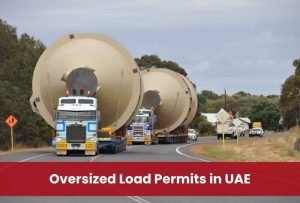
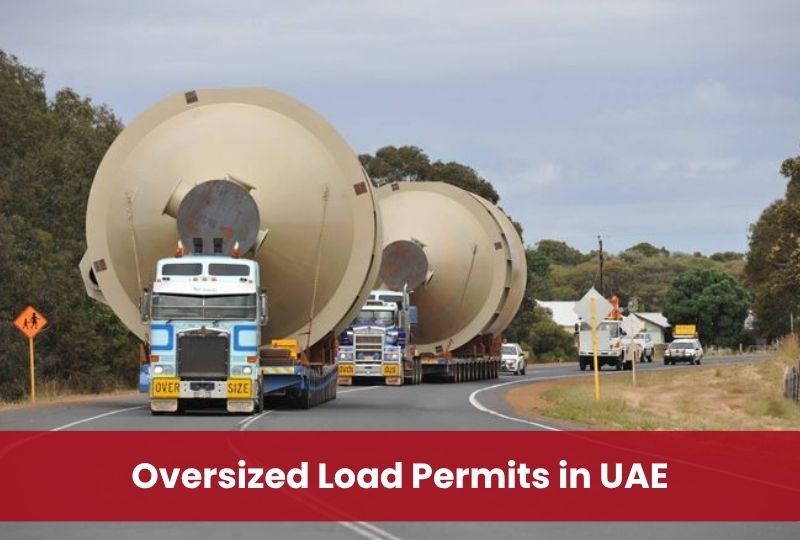
Moving an oversized load in the UAE is rarely just a matter of hitching a trailer and driving off. Fleet operators who transport cranes, transformers, modular units, or heavy construction equipment need to work within a permit system that covers weight limits, dimension limits, route approval, and in many cases, escort arrangements. Getting this wrong does not just risk a fine. It can mean a stopped convoy, a missed project deadline, or damage to a bridge or road surface that becomes the operator’s liability.
Let’s guide breaks down what counts as an oversized load in the UAE, the legal framework behind it, how the permit process works across emirates, and what fleet operators should have in place before a heavy haul leaves the yard.
What Counts as an Oversized Load in the UAE
A load is generally classed as oversized or abnormal once it goes beyond the standard weight or dimension limits set for heavy vehicles on UAE roads. This can happen in a few ways. The cargo itself may be too wide, too tall, or too long to fit within a standard trailer envelope. Or the combined weight of the vehicle and load may exceed the gross weight allowed for its axle configuration.
A key factor authorities look at is whether the load is indivisible. If cargo such as a transformer, a crane boom, or a prefabricated module cannot reasonably be broken down into smaller, compliant units without damage, delay, or unreasonable cost, it usually qualifies for special permit treatment rather than being rejected outright.
The Legal Framework Behind UAE Heavy Vehicle Rules
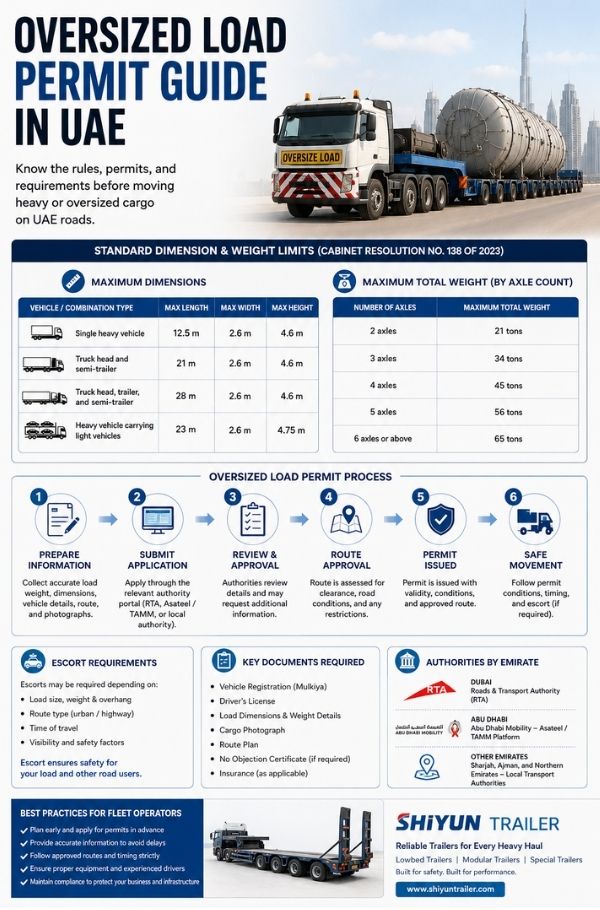
UAE Cabinet Resolution No. 138 of 2023 is the federal instrument that governs heavy vehicle weights and dimensions across the country. It sets the baseline limits for trucks and combinations, while also allowing exceptions for indivisible loads through a transportation permit issued by the relevant authority.
The resolution’s annex lays out maximum figures that fleet planners should keep close at hand:
| Vehicle or combination type | Max length | Max width | Max height |
|---|---|---|---|
| Single heavy vehicle | 12.5 m | 2.6 m | 4.6 m |
| Truck head and semi-trailer | 21 m | 2.6 m | 4.6 m |
| Truck head, trailer, and semi-trailer | 28 m | 2.6 m | 4.6 m |
| Heavy vehicle carrying light vehicles | 23 m | 2.6 m | 4.75 m |
Weight limits scale with axle count:
| Number of axles | Maximum total weight |
|---|---|
| 2 axles | 21 tons |
| 3 axles | 34 tons |
| 4 axles | 45 tons |
| 5 axles | 56 tons |
| 6 axles or above | 65 tons |
Any movement that exceeds these figures, or that carries an indivisible load close to the limits, needs to be checked against permit requirements before it is scheduled. Authorities have tied this framework to road safety and infrastructure goals, including reducing wear on roads and lowering the risk of accidents linked to overloaded or oversized vehicles.
Which Authority Issues the Permit
Permit issuance in the UAE is handled at the emirate level, so the process a fleet operator follows depends on where the movement starts, passes through, and ends.
Dubai: The Roads and Transport Authority (RTA) manages permits related to heavy vehicle movement, right-of-way use, and route approval. Operators submit applications through the RTA’s digital channels, and the process typically requires details of the vehicle, the load, and the intended route.
Abu Dhabi: Commercial transport activity, including heavy and oversized freight, runs through Abu Dhabi Mobility’s Asateel platform. In 2026, Abu Dhabi Mobility and Abu Dhabi Police introduced 24-hour permit issuance for selected heavy vehicle routes through the TAMM platform, which has made scheduling more predictable for operators who submit complete and accurate applications.
Other emirates: Sharjah, Ajman, and the northern emirates apply their own local transport and municipality procedures, generally following the same federal dimension and weight baseline.
Because oversized loads frequently cross emirate boundaries, especially between ports, industrial zones, and project sites, fleet operators should confirm permit requirements for every jurisdiction the route touches, not just the point of origin.
Information Required for a Permit Application
Permit delays are usually caused by incomplete or approximate data rather than by the load itself being difficult. Authorities and trailer operators generally ask for:
- Exact cargo weight, including any fixtures or attachments that travel with it
- Full dimensions: length, width, height, and any overhang once loaded
- Vehicle and trailer registration details, including axle configuration
- A photograph of the cargo, which several permit applications require as standard
- Pickup and delivery locations, including site access details and gate restrictions
- Proposed route and preferred movement time or date
- Whether the load is divisible or indivisible, with justification if indivisible
Submitting rounded-off or estimated figures is one of the most common reasons applications get sent back for correction. A three-centimeter difference in loaded height can be the difference between clearing a bridge and not.
Route Approval and Escort Requirements
A permit tells you that the movement is legally allowed. Route approval confirms that it is physically possible. These are related but separate checks, and both matter for oversized loads.
Route approval looks at clearance under bridges, gantries, and overhead utility lines, turning radius at roundabouts and site entrances, road surface and gradient, and any weight-sensitive sections of road. It also accounts for peak-hour restrictions and designated heavy vehicle corridors, since many oversized movements in the UAE are only permitted during off-peak hours or overnight.
Escort requirements depend on the size of the load and the route. Wider or heavier movements, and those passing through busier corridors, may require a pilot vehicle or police escort to manage traffic and protect other road users. This is assessed case by case as part of the permit and route review, so operators should raise it early rather than assuming it will or will not apply.
Fees and Timelines
Permit fees in the UAE are typically structured by load category. As a general reference point, larger loads have historically carried a lower per-vehicle fee than special loads defined by weight above 60 tons combined with height over 4 meters, which are charged at a higher rate. Fees and thresholds can be revised by the relevant authority, so operators should confirm current rates before budgeting a movement.
Timelines vary by complexity. A load close to standard limits on a familiar route may be processed quickly, particularly where authorities have introduced faster digital issuance for routine cases. A load that is significantly oversized, crosses multiple emirates, or needs escort coordination will take longer and should be planned well in advance of the movement date.
Common Compliance Mistakes Fleet Operators Should Avoid
Treating a previous approval as reusable. Every movement is assessed on its own route, timing, and load. A permit from a similar past job does not automatically cover a new one.
Underestimating loaded height. The combined height of the trailer deck and the cargo is what matters for bridge and gantry clearance, not the cargo’s height alone.
Leaving site access unchecked. A route may be approved, but a narrow gate, tight turning radius, or uneven internal road at the delivery point can stop a load just as effectively as a legal restriction.
Applying too close to the movement date. Oversized and indivisible loads, and any route needing escort planning, need lead time. Late applications are the most common cause of missed schedules.
Assuming rules are identical across emirates. Dubai, Abu Dhabi, and the other emirates each run their own systems, even though the underlying federal weight and dimension limits are shared.
Why This Matters Beyond Compliance
Permit and route planning is not only a legal box to tick. It protects the equipment being moved, the driver, and other road users, and it protects the project timeline. A convoy that is stopped mid-route because of an incomplete permit can delay a crane lift, a shutdown window, or a site handover by days. For fleet operators moving heavy trailers, transporters, or modular equipment across the UAE, building permit and route checks into the planning stage, rather than treating them as a formality before dispatch, is what keeps a heavy haul on schedule.
For operators sourcing the trailers themselves, choosing equipment built for accurate axle load distribution, such as the modular and lowbed trailers built by Shiyun Trailer, also makes it easier to stay within permit-friendly weight limits from the start.
FAQs
What is considered an oversized load in the UAE?
A load is generally considered oversized when it exceeds the federal weight or dimension limits set for heavy vehicles, or when it cannot be divided into smaller, compliant loads without damage or excessive cost.
Who issues oversized load permits in the UAE?
Permits are issued at the emirate level. In Dubai, the RTA manages the process. In Abu Dhabi, commercial and heavy vehicle movement runs through the Asateel platform and, for certain routes, TAMM. Other emirates have their own local transport authorities.
Do all oversized loads need a police escort?
Not always. Escort requirements depend on the size of the load, the route, and traffic conditions, and are assessed as part of the permit and route approval process rather than applied automatically to every movement.
How far in advance should a permit be applied for?
This depends on the complexity of the load and route. Straightforward movements close to standard limits can sometimes be processed quickly, but significantly oversized loads, cross multiple emirates, or need escort coordination should be planned well ahead of the intended movement date.
What happens if a load moves without the correct permit?
The movement can be stopped, rerouted, delayed, or fined, and there is added safety risk if the vehicle travels on roads or through sites that were never checked for clearance and load capacity.