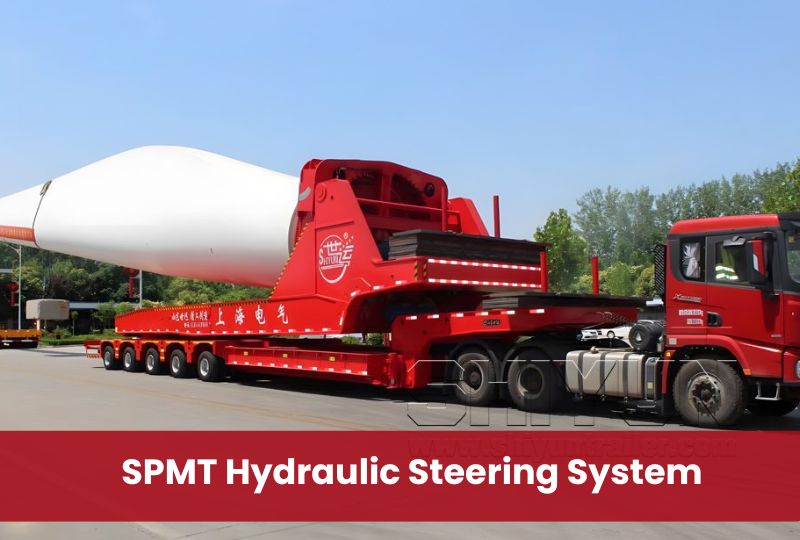
One of the main reasons SPMTs can move heavy cargo through tight construction sites, congested yards, and narrow access points is the steering system built into every axle line. Unlike a standard trailer, where wheels are fixed or steer only in a limited pattern, every wheel on an SPMT can be steered independently and coordinated as part of one platform-wide movement.
Independent Wheel Steering
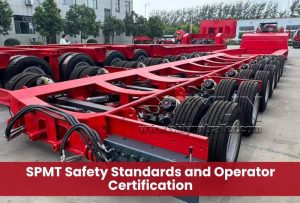
Each axle line is fitted with its own hydraulic steering cylinders connected directly to the wheels on that line. The control system coordinates every axle line on the platform together, so the whole transporter can turn as a single unit even though each individual wheel is technically steering on its own command. This independent control is what allows an SPMT to execute movements that would be impossible for a rigid, fixed axle trailer.
Crab Steering Explained
Crab steering means every wheel on the platform points in the same direction at the same angle, allowing the entire transporter to move sideways rather than turning around a center point. This capability is particularly useful when a load needs to shift laterally into its final position, such as sliding a bridge girder onto its supports or aligning a module precisely with anchor bolts on a foundation without needing a wide turning radius to get there.
Coordinated Turning
For standard turns, the steering system angles each wheel differently depending on its position on the platform, similar in concept to how a car’s steering geometry works, but applied simultaneously across dozens of wheels spread over a large area. This coordination lets the transporter make tight turns without dragging the tires sideways or placing unnecessary stress on any single axle line during the maneuver.
Combined Steering Modes
Many SPMT control systems allow operators to switch between steering modes during a single move, using standard coordinated turning to navigate a route and then switching to crab steering for the final positioning phase. Some systems also support a rotation mode, where the platform pivots around a fixed center point, useful in especially confined spaces where neither straight crab movement nor a wide turn is possible.
Why This Matters for Site Access
Construction sites, shipyards, and industrial plants rarely offer wide, open roads suited to large equipment. Independent steering allows an SPMT to navigate around obstacles, pass through gates with limited clearance, and reach tight final positioning spots that a conventional trailer simply cannot access. This flexibility is part of why SPMTs are frequently chosen over cranes for certain heavy positioning tasks, a comparison we cover in our post on SPMT vs crane for heavy lifts.
Steering and the PPU
The hydraulic pressure that drives the steering cylinders on every axle line comes from the power pack unit. Without sufficient hydraulic pressure and a properly synchronized control system, coordinated steering across dozens of wheels would not be possible. To understand how that power is generated and distributed across the platform, see our post on the SPMT power pack unit.
Steering and Load Distribution
Turning, particularly tight turns or crab steering maneuvers, can briefly shift load between axle lines as the platform changes direction. This is one of the dynamic factors engineers account for when calculating both overall load capacity and ground bearing pressure, since a line that briefly carries more weight during a turn needs to stay within its rated limit even in that moment, not just while the platform is traveling in a straight line.
Operator Skill and Steering Precision
While the hydraulic system does the physical work, precise steering still depends heavily on operator skill and clear communication between the person controlling the remote and any support staff observing clearances around the load. Training on steering mode selection and situational awareness is typically part of broader SPMT operator certification, which we discuss further in our post on SPMT safety standards and operator certification.
Steering Redundancy and Fail Safe Design
Given how much the safety of a move depends on steering behaving predictably, most SPMT control systems include fail-safe features that stop the platform or lock steering in place if a communication error or hydraulic fault is detected, rather than allowing wheels to move unpredictably. This kind of built-in redundancy is a standard expectation in modern SPMT design, and buyers evaluating equipment should ask manufacturers directly how their control system handles a lost signal or partial hydraulic failure during a move.
Steering System Calibration
Over time, steering cylinders and sensors can drift slightly out of calibration, which can show up as uneven turning response between axle lines even when each line appears to be functioning individually. Periodic calibration checks, usually carried out as part of routine maintenance, help catch this kind of drift before it becomes noticeable during an actual project move, which is one more reason steering system checks are typically included alongside hydraulic and axle line inspections.
Frequently Asked Questions
Can SPMT steering be adjusted mid-move?
Yes, the operator can change steering mode during a move, switching between crab steering, coordinated turning, and in some systems a rotation mode as the route and final positioning requirements change.
Does hydraulic steering affect ground bearing pressure?
Turning and crab steering can shift load between wheels briefly, which is one of the dynamic factors engineers account for when calculating SPMT ground bearing pressure.
Is crab steering used on every project?
No, crab steering is used selectively, typically during final positioning phases where lateral movement is needed. Many moves rely primarily on coordinated turning for the bulk of the route.
Does every axle line steer the same way at the same time?
Not necessarily. During coordinated turning, each line’s wheels are angled differently based on their position on the platform, even though all lines are working together as part of one synchronized movement.
Shiyun Trailer’s modular transporters use hydraulic steering systems designed for the tight access conditions common on infrastructure and industrial projects.