+ 86 15153217198
info@shiyuntrailer.com
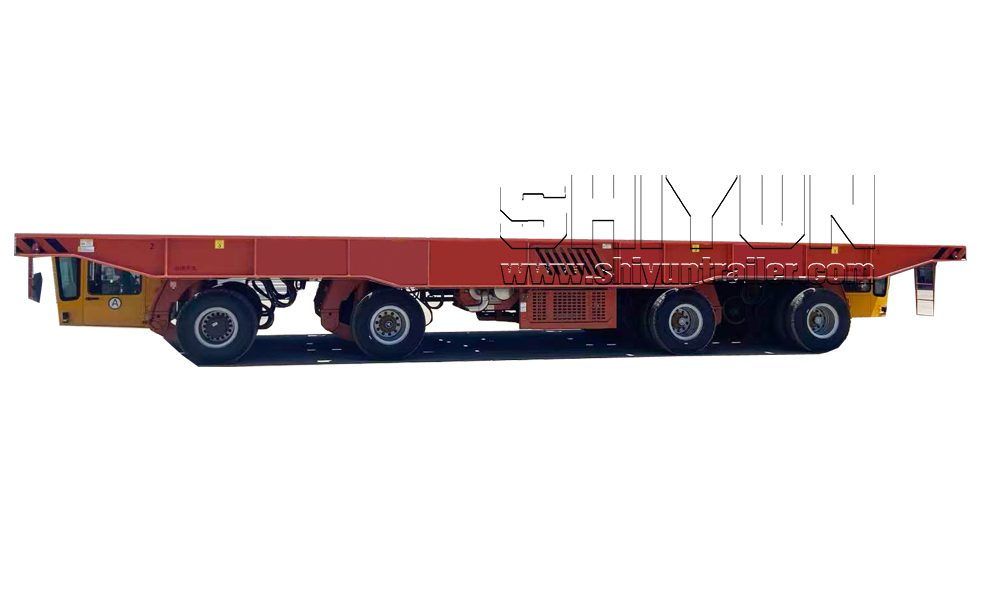
The Shipyard Transporter is a self-propelled hydraulic platform vehicle built for in-plant transfer inside shipyards, marine industrial parks, and heavy industrial zones. It moves on a low deck with hydraulic lifting and leveling, controlled from an onboard cab or by wireless remote, and is sized for dockyard floors rather than public roads.
It is used for transferring hull sections, complete hull blocks, bow and stern components, ship superstructures, and other large steel modules between workshop bays and the dock during ship erection and repair. The same platform also handles heavy pressure vessels and offshore engineering equipment where floor-level loading and precise positioning matter more than road speed.
Capacity ranges from 35 to 1000 tons depending on axle count and configuration, with multiple units able to synchronize for oversized blocks that exceed a single platform.
1. Heavy-duty platform sized for shipyard blocks:
35 to 1000 ton capacity on a high-strength one-piece frame, built to resist bending and torsion under hull section loads.
2. Ultra-low deck with hydraulic lifting for dock access:
Ground-level travel height for easy dock and ramp access. Hydraulic lift stroke adjusts to different dock block heights for precise positioning.
3. Multi-axle hydraulic suspension for load-accurate transport:
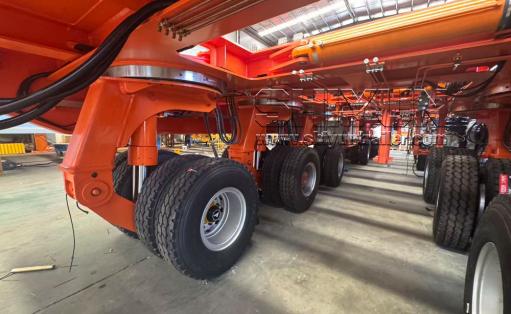
4, 6, 8, or 16 axle configurations with independent hydraulic suspension and automatic leveling, holding hull accuracy to millimeter-level positioning.
4. Multi-mode servo steering for confined dock spaces:
Electro-hydraulic servo steering supports straight-line, diagonal, crab, and 360° in-place rotation for docking in narrow berths.
5. Dual-engine redundancy for continuous operation:
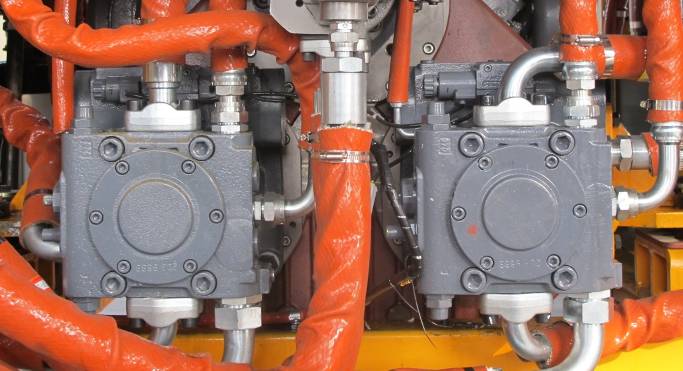
Dual engine and dual-pump confluence hydraulic system. If one engine fails, the other keeps the transporter running, supporting continuous shipyard transfer schedules.
6. Extendable deck for long hull sections:
Standard long platform with optional dual telescopic beams extending to 12 meters, for long hull sections and superstructures.
7. Dual cab with wireless remote for operator safety:
Front and rear driving cabs plus wireless remote control, for safe long-distance operation in docks and confined spaces.
8. Salt-fog resistant construction for coastal shipyards:
Shot-blasted frame with heavy-duty anti-corrosion coating and marine-grade electrical and hydraulic components, for service life in high-salt coastal environments.
9. One-piece flatbed for direct loading:
Integrated single platform with no assembly required, for direct loading and unloading of hull blocks and faster turnaround on frequent shipyard transfers.
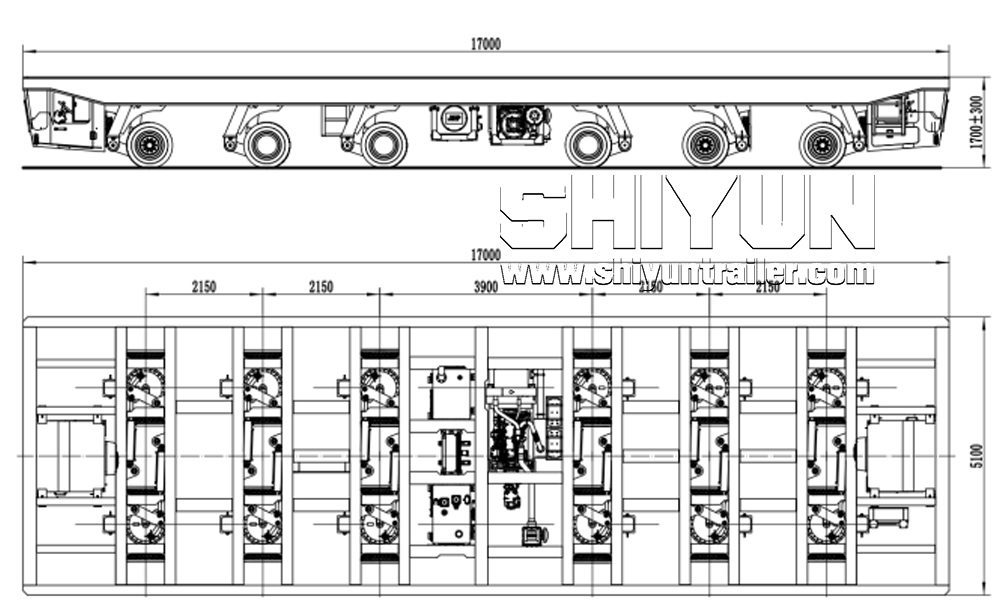
The flatbed vehicle is a self-lifting, self-propelled tyre-type special transport vehicle for hull sections and other heavy structural components. It serves as a transportation device linking various working procedures in modern shipbuilding processes. The flatbed vehicle consists of a frame platform, drive suspension, driven suspension, engine power unit, hydraulic lifting system, hydraulic drive system, hydraulic steering system, hydraulic oil supply unit, braking system, vehicle electrical system and micro-electronic control system.
The power system is mainly composed of an engine, elastic coupling, variable displacement pump, hydraulic oil tank, fuel tank and auxiliary devices, arranged beneath the vehicle frame. The engine model is reasonably selected according to the rated load capacity and operational requirements, with its power output capable of meeting the grade-climbing requirement under full-load conditions and long-term continuous operation demand. The engine throttle is controlled by an electric foot-operated throttle system.
Frame Structure and Platform Cover Plate:
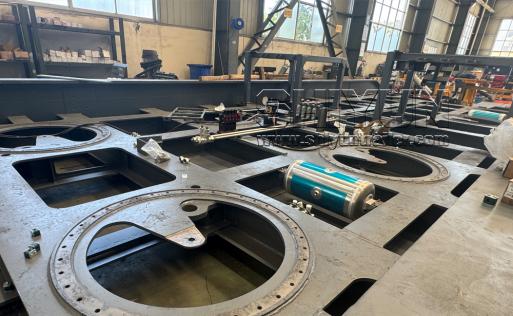
The main material of the frame is high-strength Q345B steel, featuring strong bending resistance and good flexibility under torsional load. The vehicle has sufficient margin in overall strength and rigidity to bear uniform loads. Warning signs such as “Caution: Risk of Scalding” near the engine exhaust pipe and “Caution: Pinch Hazard” around cab doors and windows are installed. Lifting lugs are fitted on the steel body, with their specific positions marked on the outer side of longitudinal beams. All components suspended under the frame (cab, cooling oil tank, hydraulic oil tank, cooling water tank, electric control box, intercooler, diesel tank) shall be equipped with shock-absorbing devices. Removable grid-type steel cover plates are fitted on the lifting platform, with an actual thickness of no less than 5 mm.
Hydraulic Drive System:
Equipped with a hydrostatic drive system, the flatbed vehicle ensures smooth acceleration and travel. The rotational speed of the diesel engine and vehicle travelling speed are controlled by a foot accelerator, enabling stepless speed regulation within the range of 0–12 km/h to fully utilise engine power. The diesel engine is connected to the hydraulic pump via a torque damper. The variable displacement pump transmits power through a closed pipeline system to the variable hydraulic motors integrated inside drive axles. The hydraulic motors deliver driving force to planetary drive gearboxes, propelling the whole vehicle to travel in preset modes.
Hydraulic Suspension
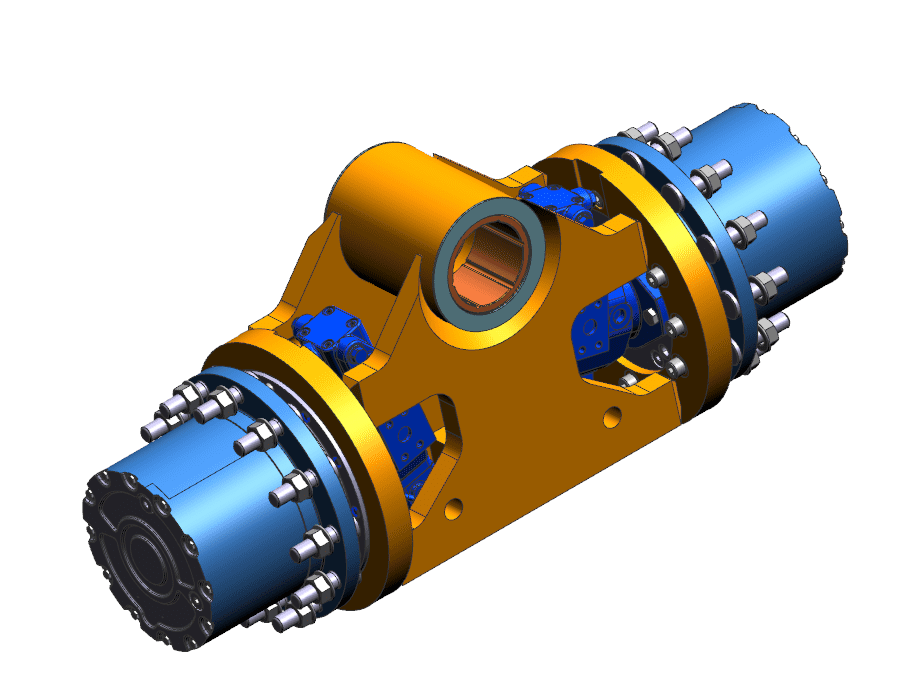
Hydraulic suspension is divided into drive suspension and brake suspension, mainly composed of a suspension bracket, balance arm, suspension cylinder, drive axle, brake axle or follow-up axle, wheel rim, tire, and other components. The wheel axle enables the whole vehicle to have a vertical adjustment range of ±300 mm through the expansion and contraction of suspension cylinders. A reducer and motor are installed on the drive suspension to realize vehicle travelling function. The brake suspension is equipped with brake axles with brake air chambers to provide service braking and parking braking of the vehicle.
A single-row ball slewing bearing is adopted. Both the inner and outer races of the slewing bearing are forged from high-quality alloy steel, delivering strong load-bearing capacity.
Tire Specification:
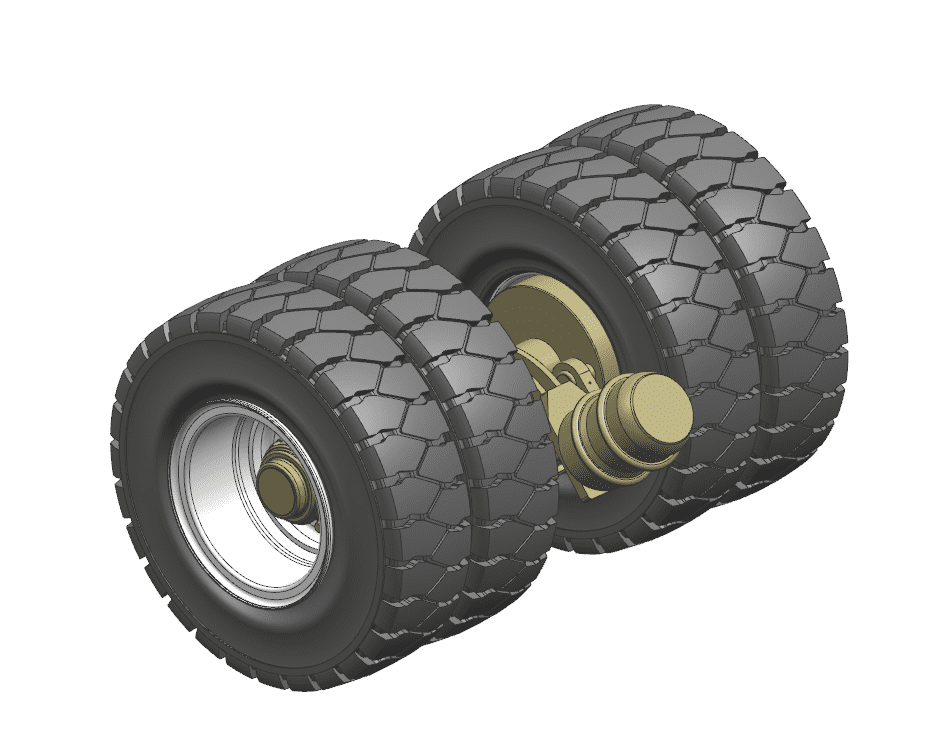
The tire specification of the flatbed vehicle is 8.25-16.
Hydraulic Steering System
The flatbed vehicle adopts electronically controlled-hydraulic steering to realize multi-mode steering.
Drive Axle
The wheel set is driven by a hydraulic motor directly mounted on it through a wheel-side reducer, and can swing to adapt to cross-slope conditions.
Brake Axle
Braking System
The flatbed vehicle adopts a pneumatic braking system. The equipment can be braked at any time as required during movement, with reliable braking performance. The vehicle is also equipped with a parking brake. When the vehicle is out of service for a long time, the hand brake valve and parking relay valve cut off the braking air of dual brake wheel cylinders, enabling the parking springs to clamp the wheel sets tightly.
The pneumatic braking system is supplied with air by the engine-built air compressor. Air is cooled via heat-dissipating pipes, then filtered and dehumidified by an air dryer. Afterwards, the air flows to a four-circuit protection valve, which keeps the dual pipelines separated to prevent air backflow and leakage
Hydraulic Oil Cooler and Hydraulic Oil Tank:
Heat dissipation of hydraulic oil is implemented in two separate circuits. One hydraulic cooling system separately cools the return oil from the hydraulic drive system before returning it to the hydraulic oil tank. The other hydraulic cooling system draws hydraulic oil from the tank via a hydraulic pump and feeds it into the cooler for cooling, after which the cooled hydraulic oil flows directly back into the tank.
Cab:
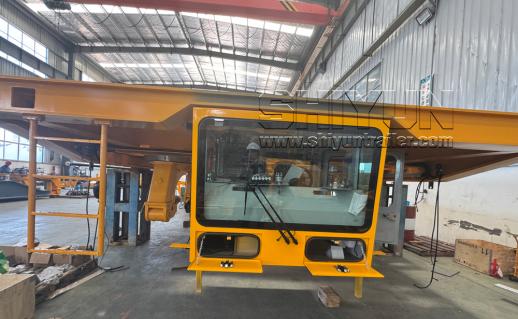
One control cabin is installed below each longitudinal end of the load-bearing platform. Each cabin is equipped with a 360-degree industrial-grade camera and display monitor.
Every control cabin features good ventilation, windscreen wipers and cleaning devices. The seat is adjustable forward and backward with a reclinable backrest. Both cabins are fitted with independently temperature-adjustable air-conditioning units and fans with external units. Air-conditioning outlets are reasonably arranged with concealed pipelines. The air conditioners are electrically powered (independently installed, not driven by diesel engines) and only available when the cabin enters the operating mode.
Cab doors are rear-hinged, fitted with sliding glass panes. Door and window glass is safety glass, providing the operator with good forward and lateral visibility. Each cabin is equipped with a fire extinguisher, two rear-view mirrors and sun visors. Control switches, equipment displays and gauges are rationally arranged to ensure easy operation and safe monitoring of the flatbed vehicle.
A shipyard transporter is a self-propelled hydraulic platform vehicle used to move hull sections, hull blocks, and other large ship components inside a shipyard or dockyard, from the workshop to the assembly or launch area.
Capacity typically ranges from 35 to 1000 tons per unit, depending on axle count and frame configuration. Multiple units can be linked to move loads beyond a single platform’s rated capacity.
Yes. The same hydraulic platform design is used for heavy pressure vessels, offshore engineering equipment, and other oversized cargo in heavy industrial plants, not only in shipbuilding.
Both use hydraulic suspension and self-propulsion, but a shipyard transporter is built for low-deck, in-plant dock work, while an SPMT is generally configured for broader modular transport, including road and site work outside the shipyard. See our SPMT page for that configuration.
Electro-hydraulic servo steering supports straight-line travel, diagonal movement, crab steering, and 360° in-place rotation, which allows precise docking in narrow berths and confined workshop aisles.