Choosing between an SPMT and a crane depends heavily on what a project actually needs from its equipment, whether that is moving cargo horizontally across a site, lifting it vertically into place, or some combination of both. Rather than one option being universally better, each method has clear strengths that make it the right choice under different conditions.
What SPMTs Do Best
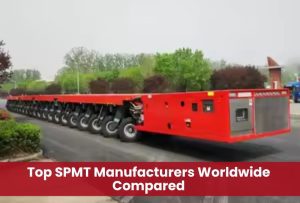
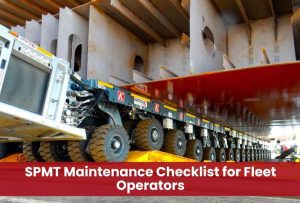
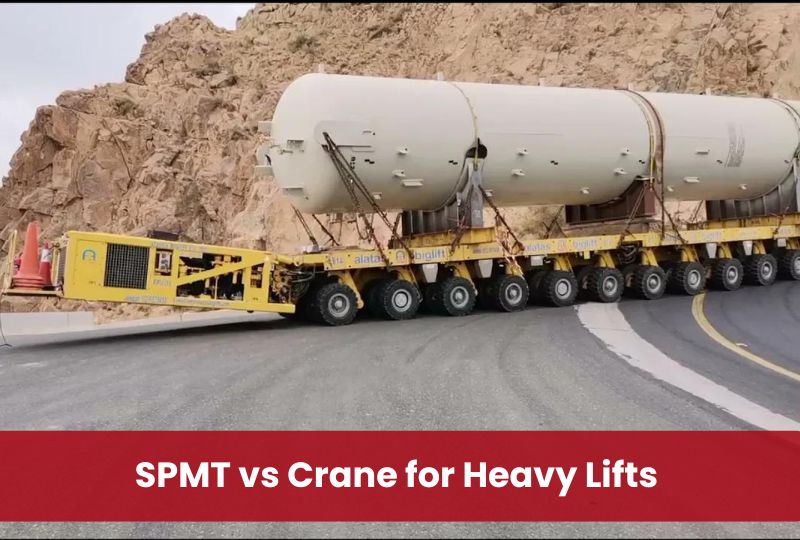
An SPMT is built for moving heavy, oversized cargo across the ground, whether that distance is a few hundred meters within a fabrication yard or several kilometers along a planned transport route. It excels at moving modules, bridge sections, and large industrial equipment from a fabrication area to a final installation point, especially when the route includes turns, tight clearances, or ground that would not support a crane setup. The distributed weight across many axle lines also means SPMTs can travel across surfaces that would be unsuitable for concentrated point loads.
What Cranes Do Best
A crane is built for vertical lift, raising cargo up and over obstacles or placing it precisely at height. For tasks like setting a module onto elevated supports, lifting equipment onto a rooftop, or placing a component where no ground-level path exists, a crane’s reach and lifting height are difficult to replace with ground-based transport alone. Cranes also tend to offer more flexibility for lifts requiring significant vertical movement in a confined footprint.
Combining Both Methods on the Same Project
On many large projects, SPMTs and cranes are used together rather than as competing options for the same task. An SPMT might move a module most of the way to its final position on the ground, after which a crane completes the final vertical placement onto supports or foundations that the SPMT cannot reach directly. This combination is especially common in bridge girder launching, which we cover separately in our post on SPMT applications in bridge girder launching, and in wind turbine installation, discussed in our post on SPMT in wind turbine component transport.
SPMT vs Crane: Cost Comparison
Crane rental and mobilization costs typically scale with lift height, boom length, and the counterweight required for the job, while SPMT costs scale more directly with total weight, travel distance, and the number of axle lines required for the configuration. For very heavy, primarily horizontal moves, SPMTs are often more cost-effective than attempting the same move with a series of smaller lifts. For jobs requiring significant height, a crane may be unavoidable regardless of cost. Our post on SPMT rental vs purchase cost has more detail on how transporter costs are structured.
Site Access and Ground Conditions
Cranes need a stable, leveled pad to set up on, and their outriggers apply concentrated point loads to the ground beneath them, which often requires ground improvement or matting on softer sites. SPMTs distribute weight across many wheels spread over a wide area and can travel across the site rather than remaining fixed in one position, which makes them a better fit for projects where the final position is far from any spot a crane could safely and economically set up.
Project Timeline Considerations
Mobilizing a large crane, including transport, assembly, and disassembly of the boom, can take considerably longer than preparing an SPMT platform, particularly for very large cranes used on heavy lift projects. For projects with tight schedules where equipment needs to be operational quickly, this mobilization time difference is often a meaningful factor in the decision.
Making the Right Choice for Your Project
The right choice ultimately comes down to the specific combination of weight, distance, vertical lift requirement, and site conditions involved. Many experienced heavy transport engineers begin by mapping out exactly what vertical and horizontal movement the cargo needs, then select equipment, or a combination of equipment, based on that map rather than defaulting to whichever method is more familiar.
Crew and Equipment Requirements Compared
A large crane project typically requires a bigger dedicated crew for assembly, rigging, and operation, along with specialized transport just to bring the crane and its counterweights to site. An SPMT project generally needs a smaller crew, since much of the platform’s positioning capability is built into the equipment itself rather than depending on rigging skill. This difference in crew size and setup complexity is worth factoring into any cost comparison alongside the equipment rental or ownership figures themselves.
Environmental and Site Disruption Factors
Crane assembly and operation can involve more disruption to an active site, including exclusion zones during lifts and the physical footprint needed for the crane and its counterweights. SPMT moves, by contrast, tend to have a smaller operational footprint at any single moment, since the platform is moving through the site rather than occupying one fixed position for an extended period. On active sites with multiple trades working simultaneously, this can be a meaningful practical advantage.
Frequently Asked Questions
Is an SPMT cheaper than a crane?
It depends on the job. For long horizontal moves of very heavy cargo, SPMTs are usually more economical. For lifts requiring significant vertical height, cranes are often necessary regardless of cost considerations.
Can SPMTs lift cargo the way a crane does?
Not in the traditional sense. SPMTs can raise and lower their deck a limited amount using hydraulic suspension, which is useful for leveling and fine positioning, but this is not equivalent to the vertical lifting height a crane provides.
Do most large heavy transport projects use both SPMTs and cranes?
Many do, particularly infrastructure and industrial projects where cargo needs to travel a distance on the ground before a final vertical placement is required.
Which option requires less ground preparation?
SPMTs generally require less concentrated ground preparation than a crane pad, since their weight is spread across many axle lines rather than a small number of outrigger points.
Shiyun Trailer supplies SPMT platforms suited to horizontal heavy transport and can advise on whether your project needs a transporter, a crane, or both.