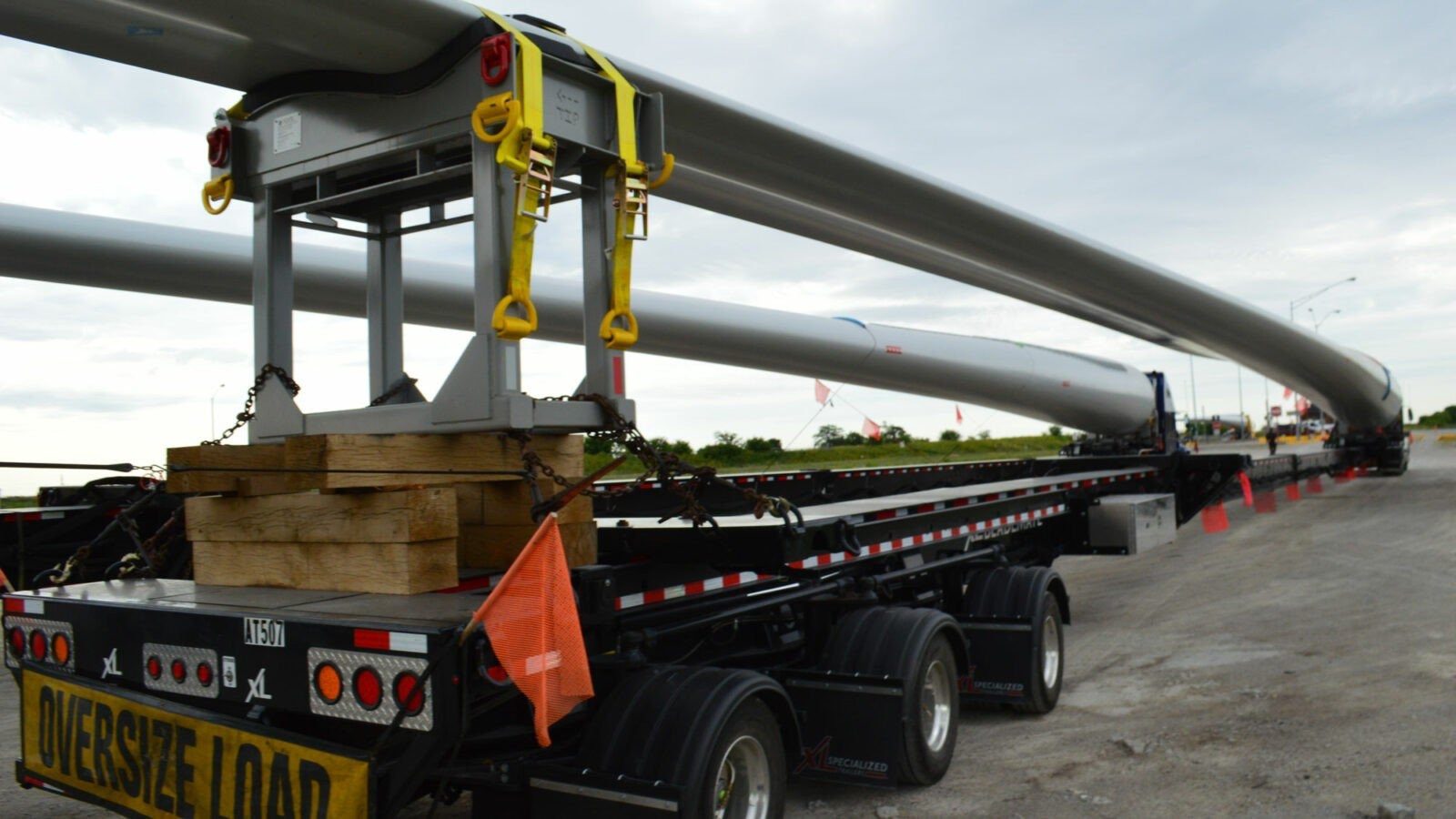
Transporting a modern wind turbine blade is not simply a matter of selecting a trailer with enough payload capacity. The extreme length of the blade can make road geometry one of the most important factors in determining whether a transport route is practical. A wind blade trailer must negotiate intersections, roundabouts, bends, switchbacks, narrow access roads, and other constrained sections while maintaining adequate clearance around the blade and transport equipment.
The turning radius is therefore only one part of the problem. Operators and route engineers also need to consider the trailer’s steering behavior, blade overhang, swept path, road width, curve geometry, ground conditions, and nearby obstacles. Just as importantly, safe operation depends on properly trained personnel who understand steering controls, hydraulic systems, load stability, and emergency procedures. These principles are also relevant to spmt safety standards and operator certification, where operator competency and adherence to established safety procedures are essential for managing complex heavy transport equipment. Specialized blade transport equipment can reduce the space required for some maneuvers, but the actual route still needs to be evaluated for the specific trailer and blade combination.
Why Turning Radius Matters in Wind Blade Transport
A conventional truck and trailer can generally follow the road within a relatively predictable envelope. A wind turbine blade creates a much larger and more complicated movement envelope because the blade extends far beyond the trailer structure.
When the vehicle enters a curve, several things happen simultaneously:
- The trailer follows a different path from the tractor.
- The rear portion can move toward the inside of the curve.
- The blade tip can sweep toward the outside of the curve.
- The blade may extend beyond the trailer’s physical dimensions.
- Nearby obstacles can become clearance restrictions.
- Steering articulation changes the position of the rear equipment.
This means that a road that appears wide enough for the truck may still be unsuitable for the complete transport combination.
For wind turbine projects, route planning therefore needs to examine the complete swept path, rather than relying only on the nominal road width.
What Is the Turning Radius of a Wind Blade Trailer?
The turning radius is the radius of the curved path followed by a particular point of the vehicle or transport combination during a turn.
However, there is no single turning-radius figure that applies to every wind turbine blade trailer.
The required radius depends on several variables, including:
| Factor | Effect on Turning |
| Blade length | Longer blades generally create a larger swept envelope |
| Trailer length | A longer chassis can increase maneuvering requirements |
| Axle configuration | Influences how the trailer follows the tractor |
| Steering system | Determines how accurately the trailer can follow a desired path |
| Blade mounting point | Changes the blade’s movement relative to the vehicle |
| Rear steering | Can reduce cut-in and improve maneuverability |
| Curve geometry | Determines how much road space is available |
| Road width | Limits the available maneuvering corridor |
| Blade orientation | Changes clearance around obstacles |
| Adapter or lifting system | Can alter blade position during difficult sections |
For this reason, a published minimum radius should not automatically be treated as a universal specification. The actual transport configuration and route should be evaluated together.
Turning Radius vs Swept Path
These terms are related but should not be treated as identical.
Turning radius describes the geometry of a vehicle’s movement around a curve.
Swept path describes the larger area occupied by the vehicle and load as they negotiate that movement.
For wind turbine blade transport, swept path can be particularly important because the blade may extend significantly beyond the trailer.
A route engineer may therefore need to examine:
- Inner wheel path
- Outer wheel path
- Trailer body envelope
- Blade tip movement
- Blade root movement
- Front overhang
- Rear overhang
- Roadside clearance
- Overhead obstacles
- Available recovery space
A route can have an apparently acceptable curve radius but still fail a swept-path assessment because the blade crosses the available road corridor.
What Is Off-Tracking?
Off-tracking describes the difference between the path of the towing vehicle and the path followed by the trailer during a turn.
For a conventional combination vehicle, the trailer’s wheels generally track toward the inside of the tractor’s path. With an extremely long wind turbine blade, however, the complete movement becomes more complex because the blade itself can extend outside the trailer and sweep across a different area.
This is why operators cannot simply follow the tractor’s wheel path when judging whether a curve is safe.
Specialized rear-steering systems can help control trailer movement and reduce the amount of cut-in during turns. Technical guidance for wind projects specifically considers automatic rear steering when evaluating the swept path of blade transport combinations.
How Trailer Steering Helps on Tight Curves
Steering capability is one of the most important characteristics of specialized blade transport equipment.
A steerable rear axle or rear dolly can change its orientation relative to the trailer and help the equipment follow the intended route.
This can provide several benefits:
- Better tracking through curves
- Reduced rear-axle cut-in
- Improved maneuverability
- Greater control at intersections
- Reduced need for excessive road widening
- Better positioning of the blade during difficult turns
Some specialized systems combine trailer steering with hydraulic lifting or blade positioning. This allows the transport configuration to respond to both horizontal and vertical restrictions.
The actual performance depends on the equipment design, steering limits, blade dimensions, and operating conditions.
How Operators Plan a Tight Curve
A difficult curve should be assessed before the transport arrives at the location.
A typical planning process includes several stages.
1. Survey the Existing Road
The route team first collects information about the road geometry.
Important measurements may include:
- Curve radius
- Road width
- Shoulder width
- Roadside obstacles
- Elevation changes
- Intersection dimensions
- Drainage structures
- Utility poles
- Signs
- Guardrails
- Buildings
- Trees
The objective is to understand the physical constraints before selecting the final transport path.
2. Identify Critical Curves
Not every curve creates the same level of difficulty.
Particular attention should be given to:
- Hairpin bends
- Switchbacks
- 90-degree intersections
- Small roundabouts
- Consecutive curves
- Curves near bridges
- Curves combined with steep grades
- Narrow curves bordered by fixed obstacles
A route may be straightforward for most of its length but become impractical because of one or two critical locations.
3. Perform Swept-Path Analysis
Swept-path analysis can be used to model how the transport combination moves through the curve.
The analysis should consider the actual:
- Tractor
- Trailer
- Steering configuration
- Blade
- Blade mounting position
- Steering angles
- Road geometry
Modern route-planning methods use swept-path calculations to identify the corridor required by the blade and transport vehicle.
4. Check the Inner Clearance
The inside of the curve is important because the trailer wheels and other lower components can move toward the inside edge.
Engineers should check for:
- Curbs
- Guardrails
- Drainage channels
- Road signs
- Embankments
- Utility structures
- Temporary barriers
The available space should be sufficient for the actual wheel and trailer path, not merely the visible vehicle width.
5. Check the Outer Blade Sweep
The opposite side of the curve creates another challenge.
As the blade changes direction, its tip and other sections can sweep beyond the path of the trailer.
This is why a road may appear clear from the driver’s position while still presenting a collision risk farther along the blade.
A proper route assessment therefore examines both the inner and outer boundaries of the swept envelope.
Why Road Width Changes With Curve Radius
A tighter curve generally requires more usable road space for a long transport combination.
As the curve becomes sharper:
- Trailer cut-in can increase.
- Blade sweep can extend farther outside the road.
- Steering angles become more significant.
- Additional maneuvering space may be required.
Wind-turbine transport guidance recognizes that tighter curvature can require additional road width and that the exact requirement depends on the transport combination and curve geometry.
This is one reason why route planners may need to use temporary road widening, removable roadside objects, or other approved modifications at critical locations.
Roundabouts and Intersections Need Special Attention
Roundabouts can be particularly challenging because the transport combination must follow a continuously changing path.
The team may need to evaluate:
- Entry radius
- Circulating roadway width
- Central island clearance
- Exit geometry
- Blade sweep
- Traffic islands
- Signs and lighting
- Traffic-management requirements
A conventional vehicle may pass comfortably through a roundabout while a long blade transport combination requires additional space.
Intersections can create a similar problem. The tractor may need to move toward the opposite side of the available roadway while the trailer and blade follow different paths.
Switchbacks and Mountain Roads
Wind farms are frequently located in areas where roads include steep grades, narrow sections, and switchbacks.
A switchback combines several difficult conditions:
- A sharp horizontal curve
- A change in direction
- Potentially significant gradient
- Limited roadside space
- Possible elevation changes between the trailer and blade
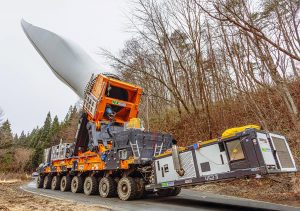
In these locations, specialized blade transport equipment can provide additional maneuverability.
Some blade transport systems use lifting and rotating mechanisms that allow the blade to change its orientation while moving. Research and specialist transport systems describe combinations of blade pitch, horizontal rotation, and rear steering to negotiate constrained routes.
When a Wind Blade Adapter Can Help
A wind blade adapter can provide another option when the transport route has difficult geometry.
Instead of treating the blade as a completely fixed extension of the trailer, an adapter system can allow controlled changes in blade position.
Depending on the equipment design, this may involve:
- Hydraulic lifting
- Blade rotation
- Controlled pitch adjustment
- Slewing
- Specialized mounting
- Rear support steering
These capabilities can help the transport team position the blade around obstacles and through difficult curves.
Some specialized adapter systems are designed specifically for narrow or mountainous routes and combine lifting and rotational movement with a transport chassis.
However, an adapter does not eliminate the need for route engineering. Its allowable movement, structural limits, operating procedures, and environmental conditions must still be considered.
Blade Lifter vs Conventional Wind Blade Trailer
A conventional trailer configuration may keep the blade closer to a fixed horizontal orientation, while a blade-lifter system can change the blade’s vertical position.
The difference becomes important on routes with:
- Tight bends
- Trees
- Buildings
- Utility lines
- Steep terrain
- Limited road width
Blade-lifter technology can raise the blade during particularly difficult sections, reducing the horizontal envelope in some situations. Iberdrola describes blade-lifter systems that use hydraulic lifting and rotation to negotiate sharp bends and constrained roads.
The decision between systems should be based on the actual route rather than blade length alone.
Other Factors That Affect Tight-Curve Operations
Turning radius is only one part of route feasibility.
Road Gradient
A sharp curve combined with a steep gradient can create traction and braking challenges.
Cross Slope
A significant cross slope can affect vehicle stability and the way the trailer and blade move through a curve.
Ground Conditions
Soft shoulders or weak ground can limit how far the transport combination can move outside the paved surface.
Overhead Clearance
The blade may interact with power lines, signs, bridges, trees, or other overhead structures.
Weather
Strong winds can make a large rotor blade more difficult to control, particularly when the blade is elevated or rotated.
Traffic
Temporary traffic control may be necessary when the transport combination occupies multiple lanes during a maneuver.
Practical Wind Blade Trailer Route-Planning Checklist
Before moving a blade through a tight curve, the project team should verify:
- Blade length and geometry
- Trailer dimensions
- Trailer steering configuration
- Rear steering limits
- Blade mounting position
- Curve radius
- Available road width
- Inner swept path
- Outer blade sweep
- Intersection geometry
- Roundabout dimensions
- Road gradient
- Cross slope
- Ground conditions
- Fixed roadside obstacles
- Overhead clearance
- Required traffic controls
- Applicable special-transport permissions
- Weather conditions
- Emergency stopping or recovery locations
How to Reduce Problems at Difficult Curves
If the initial route assessment identifies a difficult section, several solutions may be considered.
Use a More Maneuverable Trailer Configuration
A steerable rear axle or specialized dolly can improve the vehicle’s ability to follow tight curves.
Modify the Route
Sometimes a slightly longer route with larger curve radii is more practical than modifying a difficult road section.
Temporarily Remove Obstacles
Where legally and technically permitted, signs, barriers, or other removable roadside objects may be temporarily relocated.
Improve the Road Geometry
Temporary widening or reinforcement may be considered where the existing road cannot accommodate the transport.
Use Specialized Blade Positioning Equipment
For particularly constrained routes, a blade adapter or blade-lifter system may provide additional maneuvering capability.
The appropriate solution depends on engineering analysis, project cost, local requirements, and the specific transport equipment.
What Should Engineers Ask a Wind Blade Trailer Supplier?
When evaluating a specialized trailer, buyers should look beyond rated capacity.
Useful questions include:
- What is the trailer’s steering configuration?
- What is the maximum steering angle?
- How is the rear axle or dolly controlled?
- What blade lengths can the system accommodate?
- Is a blade adapter available?
- Can the blade be lifted or rotated?
- What are the hydraulic system limits?
- What is the trailer’s minimum practical turning radius?
- What information is available for route simulation?
- What maintenance is required for steering and hydraulic components?
- Can the configuration be customized for a specific turbine model?
The supplier should ideally provide technical information that allows the transport planner to model the actual vehicle and load combination.
Wind Blade Trailer Turning Radius: Key Takeaways
The turning radius of a wind blade trailer should never be evaluated as an isolated number. The actual route requirement depends on the blade, trailer, steering system, mounting configuration, road geometry, and surrounding obstacles.
For difficult routes, the most useful approach is to combine:
- Accurate route surveying
- Swept-path analysis
- Trailer steering analysis
- Blade clearance assessment
- Ground and road evaluation
- Overhead obstacle checks
- Operational planning
Specialized steering, blade adapters, and lifting systems can improve maneuverability, but they do not replace proper route assessment.
For manufacturers and engineering teams such as Luke Chemicals this kind of equipment-focused technical planning also demonstrates an important principle in industrial transportation: equipment selection should be based on the complete operating environment rather than a single specification.
FAQs
What determines the turning radius of a wind blade trailer?
It depends on the trailer dimensions, axle configuration, steering system, blade length, blade mounting position, and the geometry of the transport combination. There is no universal turning radius for every blade trailer.
Why is swept path important for wind turbine blade transport?
Swept path shows the area occupied by the complete transport combination while turning. It accounts for factors such as trailer movement, blade overhang, and the difference between inner and outer paths.
Can a wind blade trailer handle tight mountain roads?
Some specialized systems are designed for difficult mountain routes, particularly those equipped with steerable rear axles, blade adapters, or lifting and rotating mechanisms. Suitability must be verified through route-specific analysis.
Does a longer blade always require a larger turning radius?
Not necessarily. Blade length is an important factor, but trailer steering, blade mounting geometry, adapter systems, and the actual route configuration can significantly influence maneuverability.
What is a wind blade adapter used for?
A wind blade adapter connects the blade to specialized transport equipment and may allow controlled lifting, rotation, or positioning. This can help the blade negotiate certain constrained road sections.
How do operators check whether a curve is suitable?
They typically examine the route geometry and perform a swept-path assessment using the actual trailer, steering configuration, blade dimensions, and mounting arrangement.
Can road modifications reduce turning problems?
Yes. Depending on local approvals and engineering requirements, temporary widening, removal of obstacles, traffic controls, or other route modifications can sometimes make a difficult curve feasible.