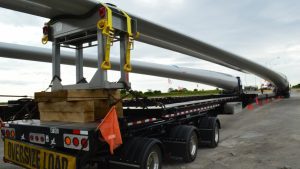
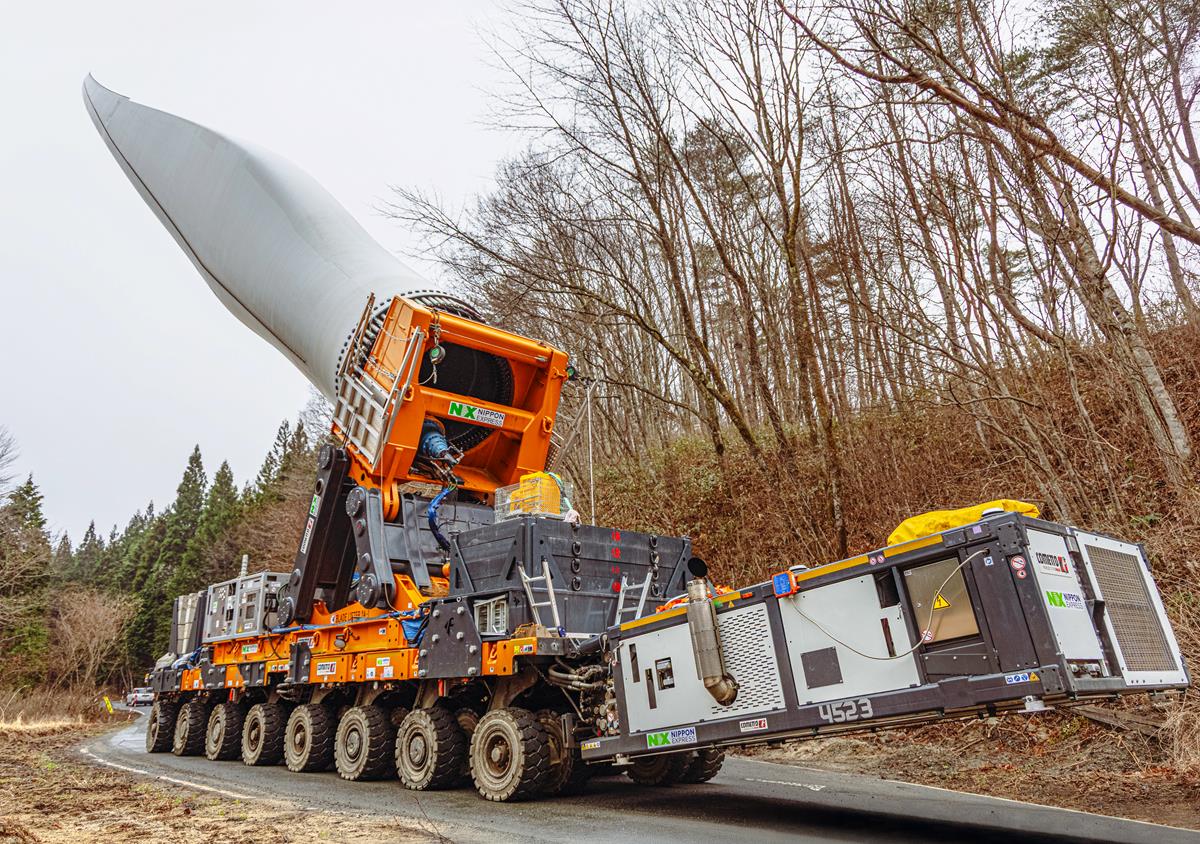
Modern wind turbine blades are becoming longer and more sophisticated as turbine manufacturers increase rotor size and energy output. Transporting these components from the manufacturing facility to a wind farm therefore requires more than a conventional trailer. The connection between the blade and transport equipment must provide sufficient structural support while allowing the transport combination to handle different road conditions, clearances, and route restrictions.
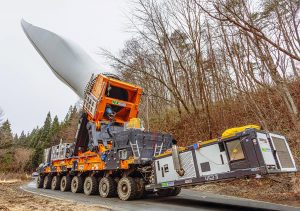
A wind blade adapter serves as the interface between a turbine blade and its transport equipment. Depending on the system design, the adapter can provide controlled mounting, lifting, rotation, or positioning of the blade during transportation. This makes adapter technology particularly important when a wind turbine blade trailer needs to negotiate curves, narrow roads, steep sections, or other challenging parts of a transport route.
Understanding how these systems work can help wind-farm developers, heavy-haul contractors, engineers, and equipment buyers select a suitable transport configuration for different turbine models.
What Is a Wind Blade Adapter?
A wind blade adapter is a specialized mechanical structure used to connect a wind turbine blade to a transport vehicle or trailer.
The adapter transfers loads between the blade and the transport equipment while maintaining the required blade position during movement. Advanced systems may also provide hydraulic movement that allows the blade to be raised, rotated, or adjusted when the transport vehicle encounters difficult route conditions.
The exact design depends on:
- Blade length
- Blade weight
- Blade root design
- Turbine model
- Blade geometry
- Transport trailer
- Required steering capability
- Route restrictions
- Required blade movement
The adapter should therefore be considered part of the complete transport system rather than an independent accessory.
Why Are Blade Adapters Needed?
A wind turbine blade is not a simple rectangular cargo item. Its aerodynamic shape, length, weight distribution, and structural design create unique transportation requirements.
A conventional flat platform may support the blade, but it does not necessarily provide the movement or positioning capability required for a difficult route.
A specialized adapter can help address problems such as:
- Limited road width
- Sharp curves
- Low overhead clearance
- Steep terrain
- Obstacles beside the road
- Long blade overhang
- Different blade mounting requirements
- Changing turbine designs
The goal is not simply to carry the blade. The goal is to transport it while maintaining appropriate structural support and sufficient clearance throughout the route.
How Does a Wind Blade Adapter Work?
The basic operating principle is relatively straightforward.
The blade is secured to the adapter at an engineered connection point, usually around the blade root or another approved support location. The adapter is then connected to the trailer or transport chassis.
During normal travel, the system maintains the blade in its required transport position.
On more difficult sections, a hydraulic or mechanical system may allow controlled movement.
Depending on the equipment, this can include:
- Blade lifting
- Blade lowering
- Horizontal rotation
- Vertical positioning
- Pitch adjustment
- Controlled slewing
The available movements vary significantly between adapter designs.
For this reason, transport planners should not assume that every blade adapter provides the same range of motion.
Main Components of a Wind Blade Adapter System
A specialized adapter may contain several major components.
Adapter Frame
The frame provides the main structural connection between the blade and transport equipment.
It must be designed to handle the expected loads generated during transportation, including dynamic effects caused by road movement.
Blade Connection
The blade connection provides the interface between the adapter and the blade.
The exact connection arrangement depends on the blade design and manufacturer requirements.
Hydraulic Actuators
Some advanced systems use hydraulic cylinders to control blade movement.
Hydraulic actuation can provide controlled movement while allowing the operator to make adjustments during specific sections of the route.
Rotation Mechanism
A rotation mechanism may allow the blade to change its orientation relative to the trailer.
This can be useful when negotiating certain obstacles or restricted road sections.
Control System
Where hydraulic movement is available, the system normally requires appropriate controls and monitoring.
The operator needs to know the position of the blade and the limits of the equipment during movement.
Fixed vs Adjustable Wind Blade Adapters
Not every project requires a highly complex adapter.
A basic transport configuration may use a relatively fixed connection where the blade remains in a predetermined position throughout most of the journey.
An adjustable system provides additional movement capability.
| Feature | Fixed Adapter | Adjustable Adapter |
| Blade positioning | Limited | Controlled adjustment |
| Mechanical complexity | Lower | Higher |
| Hydraulic components | Limited or none | Often included |
| Difficult routes | More restrictive | Better suited to certain constraints |
| Maintenance requirements | Generally lower | Generally higher |
| Initial equipment complexity | Lower | Higher |
| Route flexibility | More limited | Greater |
The appropriate option depends on the project route and blade design. More sophisticated equipment is not automatically better for every transport operation.
How Adapters Accommodate Different Turbine Models
One of the biggest challenges in wind-energy logistics is that turbine manufacturers do not use a single universal blade design.
Different turbine models can have differences in:
- Blade length
- Blade mass
- Root diameter
- Root connection
- Center of gravity
- Blade profile
- Structural characteristics
- Required transport orientation
This means a wind turbine blade transport trailer may require different adapter arrangements depending on the blade being transported.
Some transport systems are designed around a specific blade family, while others provide adjustable interfaces or interchangeable components.
Before selecting an adapter, engineers should confirm compatibility with the exact blade model rather than relying only on general blade dimensions.
Blade Root Compatibility
The blade root is one of the most important connection areas in blade transportation.
It connects the blade to the turbine hub during operation and must therefore meet specific structural and dimensional requirements.
For transport, the adapter must provide an appropriate interface without introducing unacceptable loads into the blade structure.
Important considerations can include:
- Bolt pattern
- Connection diameter
- Interface geometry
- Fastener requirements
- Load capacity
- Structural limitations
- Manufacturer-approved connection methods
The transport team should follow the blade manufacturer’s technical requirements when designing or selecting the connection arrangement.
Hydraulic Blade Positioning
Hydraulic positioning is one of the major features found on advanced blade transport systems.
Instead of keeping the blade completely fixed, hydraulic equipment can allow controlled changes in its position.
For example, when approaching a difficult section, the blade may be raised to improve clearance from roadside obstacles or adjusted to alter its swept path.
The exact movement depends on the adapter and transport vehicle.
Hydraulic positioning can be useful for:
- Sharp curves
- Narrow roads
- Trees near the road
- Utility infrastructure
- Uneven terrain
- Mountain access roads
- Restricted intersections
However, hydraulic movement must always remain within the manufacturer’s specified operating limits.
Blade Rotation and Difficult Curves
Long blades create a large swept envelope when the transport combination turns.
A fixed blade position can make certain curves difficult or impossible to negotiate.
A rotating adapter can provide additional flexibility by changing the blade’s orientation during the maneuver.
This can potentially help the transport team:
- Reduce interference with roadside obstacles
- Manage blade overhang
- Navigate tighter curves
- Improve clearance
- Adapt to changing road geometry
The benefit depends on the complete vehicle and blade configuration.
The adapter itself does not eliminate the need for a route survey or swept-path analysis.
Wind Blade Adapter and Swept Path
Swept path is one of the most important concepts when planning wind turbine blade transportation.
The swept path represents the area occupied by the transport combination while moving through a curve.
A blade can create a much larger envelope than the trailer itself because its tip and other sections may move outside the trailer’s wheel path.
An adjustable wind blade adapter can influence this envelope by changing the blade’s position.
Route engineers may therefore evaluate several configurations, such as:
- Normal transport position
- Maximum blade rotation
- Raised position
- Lowered position
- Maximum steering angle
- Tightest curve condition
This helps determine whether the proposed transport equipment is suitable for the route.
How Blade Length Affects Adapter Requirements
Longer blades generally create greater transportation challenges.
As blade length increases, planners may face:
- Larger swept paths
- Greater overhang
- More difficult curves
- Increased clearance requirements
- More complex route planning
- Greater sensitivity to roadside obstacles
However, blade length alone does not determine adapter requirements.
Two blades of similar length can have different:
- Mass
- Center of gravity
- Root geometry
- Structural characteristics
- Transport restrictions
Therefore, the complete blade specification must be considered.
Wind Blade Adapter vs Conventional Blade Support
A conventional support system may primarily provide a fixed structural connection.
A specialized adapter can provide additional functions.
| Characteristic | Conventional Support | Specialized Adapter |
| Basic blade support | Yes | Yes |
| Adjustable positioning | Limited | Possible |
| Hydraulic movement | Usually limited | Common on advanced systems |
| Blade rotation | Limited | Possible |
| Tight-route capability | More restricted | Greater flexibility |
| System complexity | Lower | Higher |
| Route adaptation | Limited | Better suited to complex routes |
The right choice depends on whether the route actually requires additional blade movement.
Choosing an Adapter for a Wind Turbine Blade Trailer
When purchasing or specifying an adapter, buyers should evaluate the complete transport application.
1. Confirm Blade Specifications
Start with the exact turbine and blade model.
Check:
- Overall blade length
- Blade weight
- Root dimensions
- Center of gravity
- Approved lifting/support points
- Manufacturer’s transport requirements
2. Check Trailer Compatibility
The adapter must be compatible with the selected trailer or transport chassis.
Important factors include:
- Mounting interface
- Hydraulic connections
- Structural capacity
- Steering configuration
- Electrical/control connections
- Available deck space
3. Evaluate Required Movement
Do not pay for movement capabilities that the project does not need.
Instead, identify the actual route challenges.
Does the project require:
- Lifting?
- Rotation?
- Pitch adjustment?
- Increased ground clearance?
- Reduced swept path?
The answer should guide the equipment specification.
4. Analyze the Route
A route survey should identify critical locations before equipment selection is finalized.
Check:
- Curve radius
- Road width
- Overhead clearance
- Utility lines
- Trees
- Bridges
- Roundabouts
- Intersections
- Gradients
- Ground conditions
5. Consider Maintenance
Hydraulic adapters contain additional components that require inspection and maintenance.
The project team should consider:
- Hydraulic hoses
- Cylinders
- Valves
- Pins
- Bearings
- Structural connections
- Control systems
- Sensors
Maintenance requirements should be included in the overall operating plan.
Important Safety Considerations
Wind blade transport involves large components and specialized equipment, so adapter operation should be controlled carefully.
Before transportation, teams should verify:
- Correct blade attachment
- Fastener condition
- Hydraulic system condition
- Adapter locking mechanisms
- Maximum allowable movement
- Trailer steering limits
- Blade clearance
- Weather conditions
- Communication procedures
- Emergency procedures
Operators should never move the blade beyond the adapter’s specified operating range.
The transport plan should also account for wind conditions because a large blade can present a significant aerodynamic surface, particularly when it is elevated or rotated.
Common Mistakes When Selecting a Wind Blade Adapter
Choosing Based Only on Blade Length
Blade length is important, but it does not provide enough information to select an adapter.
Weight, root connection, center of gravity, and route conditions also matter.
Ignoring the Trailer Interface
A compatible blade connection is not enough. The adapter must also integrate correctly with the trailer and its hydraulic and control systems.
Failing to Consider Future Turbine Models
Transport companies working on multiple wind projects may benefit from systems that can accommodate a range of approved blade configurations.
Assuming More Movement Is Always Better
Additional hydraulic movement can increase system complexity and maintenance requirements.
The equipment should provide the movement actually required by the project.
Skipping Route Simulation
An adapter may look technically suitable but still fail to solve a particular route constraint.
Swept-path and clearance analysis should be performed using the actual equipment and blade.
Applications of Wind Blade Adapter Systems
Wind blade adapters can be used in several specialized transport situations.
Onshore Wind Farms
Onshore wind projects frequently involve road transportation from ports, manufacturing plants, or staging areas to remote wind-farm locations.
Mountainous Wind Projects
Mountain roads can include sharp curves, steep gradients, and limited clearance.
Adjustable blade transport systems can provide additional flexibility in these conditions.
Long-Distance Heavy Transport
Large blades may travel significant distances through a combination of highways and smaller local roads.
The transport equipment must therefore balance highway stability with low-speed maneuverability.
Restricted Access Routes
Some wind farms have access roads where conventional transport equipment cannot easily maneuver.
Specialized adapters and blade transport systems can be evaluated for these routes.
Future Trends in Wind Blade Transport
The continuing development of larger wind turbines is increasing the importance of specialized transportation technology.
Future transport systems are likely to place greater emphasis on:
- Greater blade-length compatibility
- More flexible adapter interfaces
- Automated hydraulic control
- Improved steering coordination
- Digital route simulation
- Real-time equipment monitoring
- Reduced setup time
- Higher transport efficiency
As turbine blades continue to evolve, transport equipment manufacturers will need to consider not only payload capacity but also adaptability.
Wind Blade Adapter Selection Checklist
Before finalizing a system, project teams can use the following checklist:
- Confirm exact turbine model
- Confirm blade length
- Confirm blade weight
- Verify blade root dimensions
- Check approved connection method
- Confirm center-of-gravity information
- Check trailer compatibility
- Determine required hydraulic movement
- Evaluate rotation requirements
- Perform swept-path analysis
- Check overhead clearance
- Check roadside clearance
- Review road gradients
- Evaluate ground conditions
- Confirm hydraulic capacity
- Review maintenance requirements
- Verify operating limits
- Prepare emergency procedures
Conclusion
A wind blade adapter is an important part of a specialized blade transportation system because it provides the connection between the turbine blade and the transport equipment. Depending on its design, it can also provide controlled lifting, rotation, or positioning that helps a wind turbine blade trailer handle challenging route conditions.
The best adapter is not necessarily the most complex or the one with the greatest range of movement. It is the system that matches the blade specifications, trailer configuration, route geometry, operating conditions, and project requirements.
For manufacturers and heavy-transport professionals, the key is to evaluate the blade, adapter, trailer, and route as one integrated system. This approach can improve equipment compatibility, simplify transport planning, and reduce unexpected problems during actual wind turbine blade movements.
FAQs
What is a wind blade adapter?
A wind blade adapter is a specialized interface that connects a wind turbine blade to a transport trailer or vehicle. Depending on its design, it may also allow controlled lifting, rotation, or positioning of the blade.
Can one adapter fit different wind turbine blades?
Some adapter systems can accommodate multiple approved blade configurations, while others are designed for specific blade models. Compatibility should always be confirmed using the blade and adapter manufacturer’s technical specifications.
Why is hydraulic movement useful for blade transportation?
Hydraulic movement can allow controlled changes in blade position. Depending on the equipment, this may improve clearance around obstacles and help the transport combination negotiate difficult sections of a route.
Does a wind blade adapter reduce the turning radius?
An adapter does not automatically reduce the physical turning radius of the trailer. However, systems capable of controlled blade rotation or positioning can help manage the blade’s swept path when negotiating certain curves.
What information is required to select a blade adapter?
Important information includes blade length, weight, root dimensions, center of gravity, connection requirements, trailer configuration, required blade movement, and the characteristics of the transport route.
Is a wind blade adapter necessary for every blade trailer?
No. Some transport projects can use a relatively fixed support system. A specialized adjustable adapter becomes more valuable when the route or blade dimensions create additional maneuvering and clearance challenges.
What should be checked before operating a blade adapter?
The team should verify the blade connection, structural components, hydraulic system, control system, locking mechanisms, operating limits, clearance, weather conditions, and the approved transport procedure.