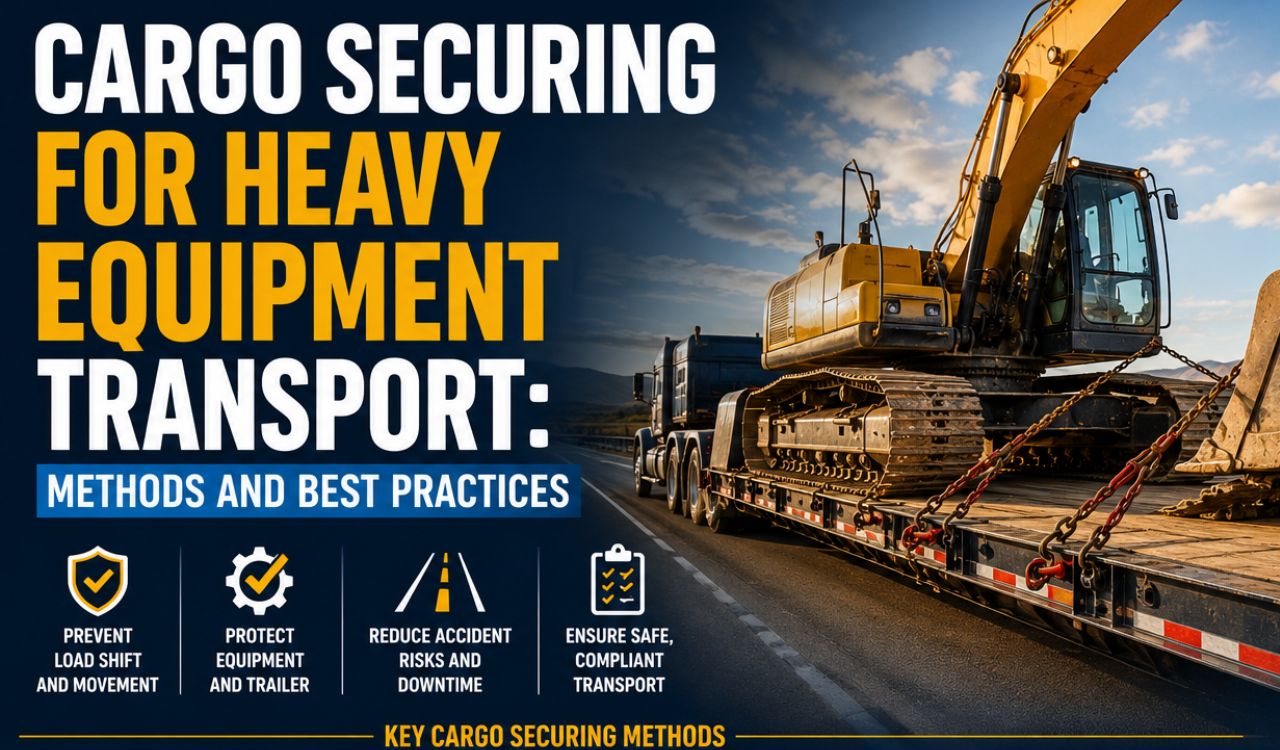
Heavy equipment transportation requires more than selecting a trailer with sufficient capacity. The cargo must also be properly positioned, secured, and monitored throughout the journey. Excavators, loaders, generators, construction machinery, industrial components, and other heavy equipment can create significant forces during braking, acceleration, turning, and uneven-road travel. Proper cargo securing helps prevent movement, equipment damage, trailer instability, and transportation accidents. Operators should also consider the Gross Vehicle Weight (GVW), which represents the combined weight of the vehicle, trailer, cargo, and applicable equipment, to ensure the complete transport combination remains within permitted limits.
For companies involved in specialized transportation, understanding effective cargo securing methods is an important part of safe and efficient heavy-haul operations. The right approach depends on the cargo’s weight, dimensions, center of gravity, shape, mounting points, and trailer configuration. When using a lowbed trailer to transport heavy machinery, proper load positioning and securement are especially important because the equipment’s size, weight distribution, and deck height can affect overall stability and axle loading.
Why Proper Cargo Securing Matters
Heavy equipment can weigh several tons, but its weight alone does not guarantee stability. A machine can shift if it is not adequately restrained, particularly when the trailer brakes suddenly, changes direction, or travels over uneven surfaces.
Cargo movement can affect the load distribution between axle groups and may increase the risk of trailer instability. It can also damage the equipment itself, including hydraulic components, tracks, tires, attachments, frames, and other vulnerable parts.
A properly secured load should remain stable throughout normal transportation conditions. The securing system should control movement in multiple directions rather than simply preventing the cargo from sliding backward or forward.
Factors to Consider Before Securing Heavy Equipment
Before selecting chains, straps, blocks, or other restraints, transport operators should evaluate several characteristics of the load.
Cargo Weight
The total weight determines the required capacity of the trailer and influences the number and type of securing devices needed. Heavier equipment generally requires a stronger and more carefully engineered restraint system.
Cargo Dimensions
Length, width, and height affect how the equipment can be positioned on the trailer. Oversized machinery may require specialized positioning to maintain appropriate axle loading and clearance.
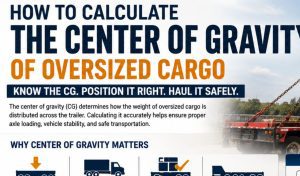
Center of Gravity
The location of the equipment’s center of gravity is particularly important. A high or uneven center of gravity can make a load more susceptible to tipping or instability during transportation.
Available Securement Points
Heavy equipment may have designated tie-down or lifting points. These should be used whenever appropriate rather than attaching restraints to components that could be damaged.
Trailer Configuration
A flatbed, lowbed, RGN, modular trailer, or other specialized trailer may require different securing arrangements. The trailer deck, tie-down points, ramps, and structural configuration all influence the final securement plan.
Common Cargo Securing Methods
Several methods can be used to secure heavy equipment, often in combination.
Chains and Binders
Chains are widely used for securing heavy machinery because they can provide substantial restraint when correctly selected and installed. Binders are used to tension the chains and maintain the required restraint.
Operators should select chains and binders with appropriate working load limits for the specific cargo and application. The restraint system should not exceed the rated capacity of its components.
Heavy-Duty Straps
Web straps can be suitable for certain equipment and applications. They can provide effective restraint while reducing the risk of scratching or damaging painted surfaces.
However, straps are not automatically suitable for every heavy load. Their working load limit, condition, attachment method, and compatibility with the cargo must be evaluated before use.
Blocking and Chocking
Blocking can help prevent equipment from moving across the trailer deck. Chocks or other suitable devices can also help control movement of wheels or tracked equipment.
Blocking should complement, rather than replace, an appropriate tie-down system when additional restraint is required.
Direct Tie-Down
With direct tie-down, the securing device connects the cargo directly to an appropriate anchor point on the trailer. This can provide strong directional restraint when properly configured.
The attachment points on both the cargo and trailer should be suitable for the forces generated during transportation.
Indirect Tie-Down
Indirect tie-down systems restrain the cargo by passing securing devices around or over suitable parts of the equipment. The arrangement should be designed so that the restraints remain effective throughout the journey.
Positioning Heavy Equipment Before Securing
Cargo securing begins before the first chain or strap is installed.
The equipment should be positioned so that the overall load remains within the trailer’s allowable weight and axle-load limits. Operators should consider the location of the equipment’s center of gravity and how its weight is distributed across the trailer.
Heavy machinery should also be positioned to maintain appropriate clearance from the tractor, trailer components, road surface, bridges, overhead structures, and other obstacles.
For wheeled equipment, parking brakes should be applied when appropriate. For tracked machinery, the equipment should be positioned securely on the deck and restrained against movement.
Attachments such as buckets, booms, blades, or arms may need to be lowered, folded, blocked, or separately secured depending on their design and the transportation requirements.
Best Practices for Securing Heavy Machinery
Use Properly Rated Securement Equipment
Every chain, strap, binder, anchor point, and related component should have an appropriate working load limit. Never assume that a visually strong component is automatically suitable for a particular load.
Inspect Equipment Before Use
Chains should be checked for excessive wear, deformation, cracks, corrosion, or other damage. Straps should be inspected for cuts, tears, burns, chemical damage, and excessive wear.
Damaged securing equipment should be removed from service rather than used for a critical heavy-haul load.
Protect Vulnerable Components
Securement devices should not be attached to hydraulic lines, fragile body panels, exhaust components, electrical components, or other parts that were not designed to withstand restraint forces.
Prevent Equipment Movement
The objective is not simply to attach restraints but to control cargo movement. The complete securement arrangement should account for forward, rearward, lateral, and vertical movement as applicable.
Check Tension After Loading
The operator should verify that restraints remain properly tensioned before departure. Components can settle after loading, so the system should be rechecked after the vehicle has traveled a short distance.
Reinspect During Long-Distance Transport
Long-distance heavy equipment transportation can involve changes in road conditions, vibration, temperature, and weather. Cargo restraints should be inspected periodically and adjusted when necessary.
Common Cargo Securing Mistakes
Several mistakes can compromise an otherwise suitable transportation setup.
One common problem is using too few securing devices for the cargo. Another is attaching chains or straps to unsuitable parts of the equipment. Using damaged restraints, ignoring the center of gravity, failing to inspect the load after departure, and relying entirely on parking brakes are also potential problems.
Operators should also avoid assuming that cargo weight alone determines the securement method. The shape, dimensions, stability, attachment points, and expected transportation conditions all matter.
Heavy Equipment Securement and Route Planning
Cargo securing should be considered together with route planning. A heavy machine that is stable on a smooth industrial road may experience very different forces on steep grades, sharp turns, rough surfaces, or construction-site access roads.
Before transportation begins, operators should understand the planned route and identify conditions that could affect load stability. This can include steep inclines, sharp curves, rough pavement, restricted clearances, and road surfaces with unusual conditions.
Final Inspection Before Departure
A final inspection should confirm that:
- The cargo is correctly positioned on the trailer.
- Axle and overall weight requirements have been considered.
- Appropriate chains, straps, binders, or other restraints are installed.
- Securement points are suitable and undamaged.
- Restraints are properly tensioned.
- Wheels, tracks, and movable components are adequately controlled.
- Attachments are separately secured where necessary.
- No securing equipment is contacting vulnerable components.
- Required inspections have been completed.
Conclusion
Cargo securing is a fundamental part of heavy equipment transportation. Choosing the correct trailer is only one part of the process; the load must also be positioned correctly and restrained using suitable equipment.
Chains, binders, straps, blocking, chocks, and direct or indirect tie-down methods can all play a role depending on the cargo and transportation conditions. By evaluating weight, dimensions, center of gravity, securement points, trailer configuration, and route conditions, operators can develop a more reliable cargo-securing plan.
For heavy-haul projects involving large machinery or oversized industrial equipment, professional load planning and proper securement procedures are essential for protecting the cargo, trailer, and everyone involved in the transportation process.
FAQs
What is cargo securing in heavy equipment transportation?
Cargo securing is the process of using appropriate restraints and positioning methods to prevent heavy machinery from shifting, sliding, tipping, or moving during transportation.
What is commonly used to secure heavy equipment?
Common securement equipment includes chains, binders, heavy-duty straps, blocking, chocks, and suitable trailer anchor points. The appropriate combination depends on the equipment and transportation conditions.
How many tie-downs are needed for heavy equipment?
The required number depends on factors such as cargo weight, dimensions, equipment type, securement method, and applicable regulations. Operators should follow the requirements applicable to the specific load and route rather than using a fixed number for every shipment.