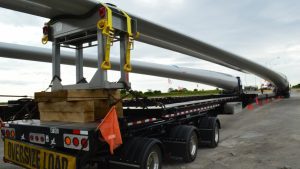
The center of gravity is one of the most important factors to consider when transporting oversized and heavy cargo. It determines how the weight of the load is distributed across the trailer and can directly affect vehicle stability, axle loading, cargo positioning, and transportation safety. Understanding the center of gravity is particularly important when moving transformers, industrial machinery, construction equipment, generators, pressure vessels, and other large loads.
For heavy-haul operators, calculating the center of gravity before transportation helps determine where the cargo should be positioned on the trailer. A properly positioned load can improve weight distribution and reduce the risk of excessive loading on individual axle groups.
What Is the Center of Gravity?
The center of gravity, often abbreviated as CG, is the theoretical point where the entire weight of an object can be considered to act.
For a simple and evenly shaped object, the center of gravity may be close to its geometric center. However, oversized cargo is often irregularly shaped and may contain components with significantly different weights.
For example, a large industrial machine may have a heavy motor on one side and lighter structural components on the other. In this situation, the center of gravity will not necessarily be located at the physical center of the machine.
Knowing the actual CG is important when positioning the cargo on a heavy-haul trailer. This is also an important consideration when comparing a Lowbed Trailer vs Modular Trailer, as the trailer type, deck configuration, axle arrangement, and load distribution can influence how oversized cargo is positioned and transported.
Why Center of Gravity Matters in Heavy Haul Transportation
The location of the center of gravity affects several aspects of transportation.
Axle Load Distribution
A cargo load must be distributed appropriately across the trailer’s axle groups. If the center of gravity is too far forward or backward, one axle group may carry significantly more weight than another.
This can create axle-load problems even when the total cargo weight is within the trailer’s overall capacity.
Vehicle Stability
A high center of gravity can increase the risk of instability when a vehicle travels around curves, changes direction, or operates on uneven terrain.
A lower center of gravity generally provides better stability because the load’s weight acts closer to the supporting surface.
Cargo Positioning
Knowing the CG helps operators determine where the cargo should sit on the trailer deck. The objective is to position the load so that the resulting axle loads remain within applicable limits.
Trailer Selection
The center of gravity can also influence trailer selection. Some heavy or unusually shaped cargo may require specialized equipment with a low deck height, additional axle lines, hydraulic suspension, or other features.
Basic Center of Gravity Calculation
For a load consisting of several components, the horizontal center of gravity can be calculated using a weighted-average formula.
The basic formula is:
CG = Σ(W × D) ÷ ΣW
Where:
- CG = center of gravity location
- W = weight of each component
- D = distance of each component from the chosen reference point
- Σ(W × D) = sum of each component’s weight multiplied by its distance
- ΣW = total weight
The reference point can be one end of the cargo or another clearly defined location.
Simple Example of Center of Gravity
Suppose an oversized machine contains three major components:
| Component | Weight | Distance from Reference |
| Component A | 10,000 kg | 2 m |
| Component B | 20,000 kg | 5 m |
| Component C | 10,000 kg | 8 m |
First, multiply each component’s weight by its distance:
10,000 × 2 = 20,000 kg·m
20,000 × 5 = 100,000 kg·m
10,000 × 8 = 80,000 kg·m
Add the moments:
20,000 + 100,000 + 80,000 = 200,000 kg·m
Then calculate the total weight:
10,000 + 20,000 + 10,000 = 40,000 kg
Finally:
CG = 200,000 ÷ 40,000
CG = 5 m
Therefore, the combined center of gravity is located 5 meters from the selected reference point.
Calculating Center of Gravity Along the Trailer
When transporting oversized cargo, the CG calculation becomes particularly useful when deciding where to position the load.
Consider a trailer with multiple axle groups. The cargo’s center of gravity should be considered relative to the trailer’s axle configuration and the location of its support points.
If the CG is positioned too close to one end, that axle group may receive a disproportionate share of the cargo weight.
Moving the cargo changes the distance between its CG and the axle groups. This changes the resulting reactions at the support points.
For this reason, heavy-haul load planning should consider both the cargo center of gravity and the trailer axle configuration.
Center of Gravity in Two Dimensions
Some oversized loads require more than a simple front-to-back calculation.
The center of gravity can also be calculated laterally.
For example, if a machine is significantly heavier on its left side, its lateral CG will shift toward that side.
A basic lateral calculation uses the same weighted-average principle:
CGₓ = Σ(W × X) ÷ ΣW
Where X represents the horizontal position of each component.
This calculation helps determine whether the cargo is likely to create an uneven left-to-right loading condition.
Calculating Vertical Center of Gravity
The vertical position of the CG is also important for heavy equipment.
A load with a high vertical center of gravity can be more sensitive to lateral forces during cornering and maneuvering.
The vertical CG can be estimated using the same weighted-average concept:
CGᵧ = Σ(W × H) ÷ ΣW
Where:
- W = component weight
- H = height of the component’s center of mass
- ΣW = total weight
For complex industrial equipment, accurate vertical CG information may need to come from engineering drawings, manufacturer data, measurements, or a professional engineering assessment.
Example of Vertical Center of Gravity
Suppose a machine consists of two major sections:
- Lower frame: 30,000 kg with a CG height of 1 m
- Upper machinery: 10,000 kg with a CG height of 3 m
Calculate the combined vertical CG:
CG = [(30,000 × 1) + (10,000 × 3)] ÷ 40,000
CG = (30,000 + 30,000) ÷ 40,000
CG = 1.5 m
The combined vertical center of gravity is therefore approximately 1.5 meters above the selected reference surface.
Center of Gravity vs Geometric Center
The geometric center and center of gravity are not necessarily the same.
A perfectly uniform rectangular load may have its CG close to its geometric center. But industrial equipment frequently contains motors, tanks, engines, generators, steel structures, electrical systems, and other components with different weights.
As a result, the CG can be significantly offset from the physical center.
This is why operators should not simply assume that the midpoint of an oversized load represents its center of gravity.
How to Find the Center of Gravity of Unknown Cargo
Sometimes the manufacturer does not provide complete CG information.
In such cases, determining the CG may require engineering calculations, weighing procedures, or specialized measurement techniques.
One practical approach is to obtain individual component weights and locations and calculate the combined CG using the weighted-average method.
For complex machinery, however, the load may have three-dimensional geometry and an irregular weight distribution. Professional engineering analysis may therefore be necessary.
Center of Gravity and Axle Load Planning
Calculating the CG is only one part of heavy-haul load planning.
Once the CG is known, operators can evaluate how the cargo’s weight will be transferred to the trailer’s support points and axle groups.
For a simplified two-support system, the reactions can be estimated using static equilibrium principles.
If:
- W = total cargo weight
- L = distance between the two support points
- x = distance from the front support to the CG
Then the approximate rear support reaction is:
R₂ = W × x ÷ L
The front support reaction is:
R₁ = W − R₂
These calculations provide a simplified model of load distribution. Real heavy-haul systems can involve multiple axle groups, suspension characteristics, uneven surfaces, and dynamic forces, so detailed transport planning may require more advanced calculations.
Common Center of Gravity Mistakes
Several mistakes can lead to inaccurate load planning.
Assuming the CG Is at the Center
The physical midpoint of a machine is not necessarily its CG.
Ignoring Vertical CG
Operators sometimes focus only on front-to-back weight distribution while overlooking the height of the center of gravity.
Using Incorrect Component Weights
An inaccurate component weight will affect the entire CG calculation.
Forgetting Attachments
Buckets, booms, counterweights, tanks, tools, and other attachments can significantly change the overall center of gravity.
Failing to Update the Calculation
If equipment is modified, partially dismantled, or transported with additional components, the original CG information may no longer be accurate.
How to Improve CG Accuracy
For critical heavy-haul projects, operators should obtain reliable information before loading.
Useful sources can include:
- Manufacturer specifications
- Engineering drawings
- Equipment weight reports
- Component weight data
- Load measurement records
- Professional engineering calculations
The more irregular and heavy the cargo is, the more important accurate CG information becomes.
Center of Gravity and Trailer Selection
The CG of the cargo should be considered when selecting transportation equipment.
A very heavy load with a low CG may have different trailer requirements from a tall machine with a high CG. Similarly, an unevenly weighted machine may require a different axle arrangement or loading position than a uniformly distributed load.
Depending on the application, specialized trailers may provide features such as multiple axle lines, hydraulic suspension, adjustable deck configurations, or other systems designed for heavy and oversized cargo.
Final Checklist for Center of Gravity Calculations
Before transporting oversized cargo, verify:
- Total cargo weight is known.
- Major component weights are identified.
- Component locations are measured from a defined reference point.
- Front-to-back CG has been calculated.
- Left-to-right CG has been considered where necessary.
- Vertical CG has been evaluated for tall or top-heavy loads.
- Attachments and accessories are included.
- Trailer axle configuration has been considered.
- Expected axle loads have been checked.
- Cargo positioning is compatible with the trailer and transportation plan.
Conclusion
Calculating the center of gravity of oversized cargo is an important part of heavy-haul planning. The CG determines how the load’s weight is distributed and helps operators make better decisions about cargo positioning, axle loading, trailer selection, and transportation stability.
The basic weighted-average formula provides a useful starting point for calculating the CG of loads made up of multiple components. However, large industrial equipment can have complex three-dimensional weight distributions, making accurate engineering data particularly important.
For demanding heavy-haul projects, center-of-gravity calculations should be combined with axle-load analysis, trailer specifications, route conditions, cargo securement, and applicable transportation requirements. A well-planned load is easier to transport safely and helps reduce unnecessary operational and equipment risks.
FAQs
What is the center of gravity of oversized cargo?
The center of gravity is the point where the total weight of an oversized load can be considered to act. It helps determine how cargo weight should be distributed on a trailer.
Why is center of gravity important in heavy-haul transportation?
Center of gravity affects load stability, axle weight distribution, cargo positioning, and trailer selection. Accurate CG information helps operators plan safer and more balanced transportation.
How do you calculate the center of gravity?
For multiple components, use the weighted-average formula:
CG = Σ(W × D) ÷ ΣW
Here, W represents the weight of each component and D represents its distance from the selected reference point.
Does the center of gravity always equal the center of the cargo?
No. The center of gravity may differ significantly from the physical center when a load has an uneven distribution of weight.
How does center of gravity affect trailer axle loads?
The position of the CG determines how much of the cargo’s weight is transferred to different axle groups. Moving the cargo forward or backward can change the resulting axle loads.
Does the height of the center of gravity matter?
Yes. A higher center of gravity can increase the risk of instability during turns, maneuvering, and travel on uneven surfaces.
How do you calculate the vertical center of gravity?
The vertical CG can be estimated using a weighted-average calculation based on the weight and height of each major component.
What information is needed to calculate cargo center of gravity?
You generally need the weight and position of the major cargo components, including their longitudinal, lateral, and, where necessary, vertical locations.
Can the center of gravity change during transportation?
The CG itself normally does not change if the cargo remains intact and its components do not move. However, modifications, dismantling, added equipment, or repositioning can change the calculated CG.