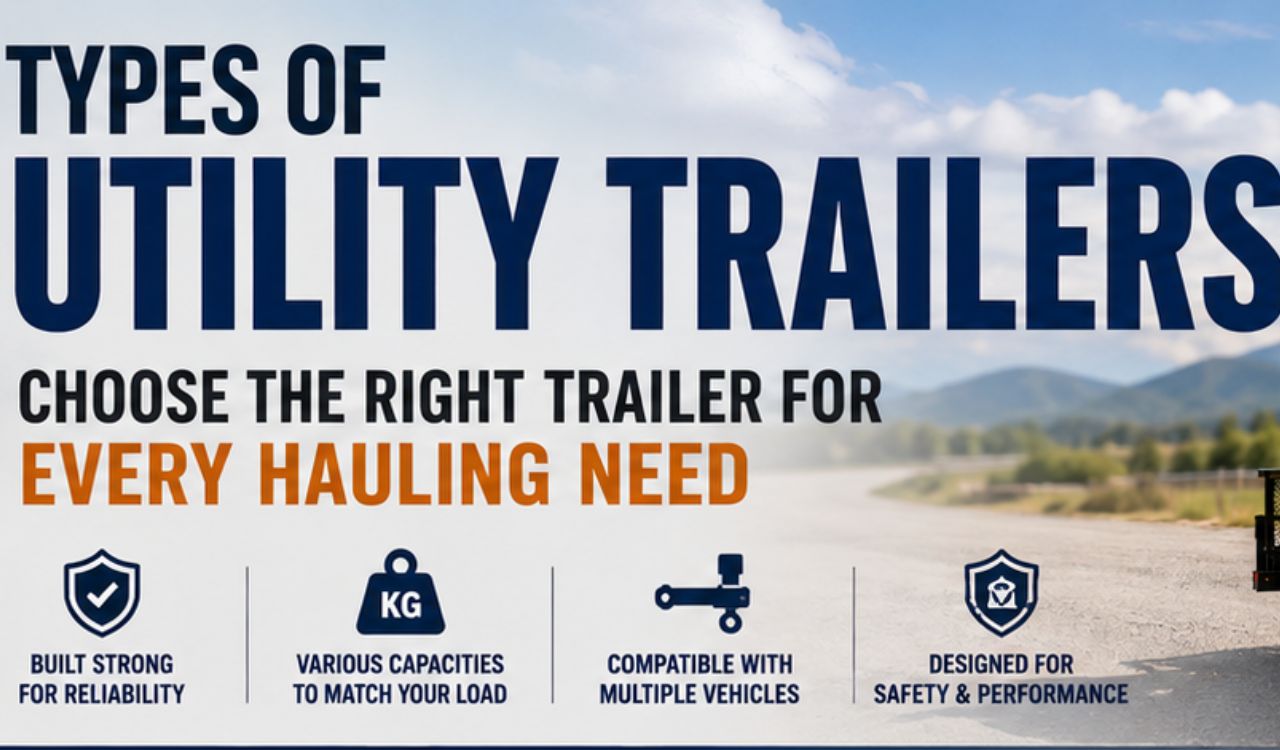
Utility trailers are versatile transportation solutions designed to carry equipment, tools, construction materials, landscaping supplies, machinery, and other types of cargo. Because hauling requirements vary between industries and applications, utility trailers are available in many different configurations.
The main differences between utility trailer types can include axle configuration, dimensions, deck design, load capacity, side rails, ramps, gates, flooring, and other equipment. Some trailers are designed for lightweight general hauling, while others are built to transport heavier equipment and commercial loads. When selecting a trailer for commercial or heavy-duty transportation, understanding semi-trailer weight limits is also important, as legal weight restrictions can affect the type of trailer, cargo, and towing setup required.
Understanding the different types of utility trailers can help buyers identify the configuration that best matches their cargo, towing requirements, and intended application. Considering factors such as trailer capacity, vehicle compatibility, and applicable semi-trailer weight limits can also help ensure safer and more efficient hauling.
What Are the Different Types of Utility Trailers?
Utility trailers can be categorized according to their axle configuration, construction, intended application, and available features. Common options include single-axle trailers, tandem-axle trailers, landscape trailers, equipment trailers, ramp-equipped trailers, side-rail trailers, and custom utility trailers.
The right configuration depends on factors such as cargo weight, cargo dimensions, loading method, frequency of use, towing vehicle, and operating environment.
Single-Axle Utility Trailers
Single-axle utility trailers use one axle and are commonly selected for lighter hauling applications. Their relatively simple design can make them easy to maneuver and suitable for users who do not regularly transport heavy equipment.
These trailers may be used for landscaping equipment, lawn-care tools, household materials, small construction equipment, recreational equipment, and general-purpose cargo.
A single-axle design can also be practical for users who frequently operate in residential areas or locations where maneuverability is important. However, buyers should always check the manufacturer’s weight ratings before loading cargo.
Tandem-Axle Utility Trailers
Tandem-axle utility trailers use two axles and are generally designed for higher load capacities and greater load distribution than smaller single-axle configurations.
They can be suitable for transporting construction equipment, larger landscaping machinery, heavier materials, and other commercial loads. The additional axle can help distribute weight across the trailer and may provide greater stability for certain applications.
Buyers should still consider the complete trailer specifications, including axle ratings, suspension, GVWR, payload capacity, and towing requirements, rather than assuming that every tandem-axle trailer has the same capacity.
Landscape Utility Trailers
Landscape utility trailers are designed specifically around common lawn-care and landscaping requirements. Their open construction provides convenient access for loading equipment and materials.
A landscape trailer may include side rails, a rear gate, loading ramp, equipment storage, and tie-down points. These features can make it easier to transport lawnmowers, trimmers, gardening tools, plants, soil, mulch, and other landscaping materials.
For landscaping businesses, trailer organization can be particularly important because multiple pieces of equipment may need to be transported together. The appropriate trailer size and configuration should therefore be based on the equipment and materials typically carried.
Equipment Utility Trailers
Equipment utility trailers are designed for transporting heavier machinery and equipment. Compared with lighter general-purpose trailers, they may feature reinforced frames, higher-capacity axles, durable flooring, loading ramps, and additional cargo tie-down points.
Contractors, equipment operators, construction businesses, and maintenance companies may use these trailers to move machinery between job sites.
When selecting an equipment utility trailer, buyers should pay particular attention to the weight and dimensions of the equipment being transported. The trailer should have sufficient capacity and loading features for the intended machinery.
Utility Trailers With Loading Ramps
Loading ramps are useful when cargo can be driven, rolled, or wheeled directly onto the trailer. This feature can reduce the need to manually lift heavy equipment and can make loading and unloading more efficient.
Ramp-equipped utility trailers can be used for mowers, generators, motorcycles, compact machinery, small equipment, and other wheeled loads.
Ramp design is an important consideration. Buyers should evaluate the ramp’s dimensions, construction, weight rating, angle, and attachment method to ensure that it is suitable for the equipment being loaded.
Utility Trailers With Side Rails
Side rails provide additional containment around the trailer deck and can be useful for transporting certain types of cargo.
They may help contain landscaping materials, tools, construction supplies, equipment, and other loads that could shift or move during transportation. Side rails can also provide additional structure for organizing cargo.
Different applications may require different rail heights and designs. Buyers should consider what type of cargo they normally transport before selecting a particular side-rail configuration.
Utility Trailers With Fold-Down Gates
Fold-down gates can serve multiple purposes. When raised, the gate can help contain cargo at the rear of the trailer. When lowered, it may function as a loading surface for certain types of wheeled equipment.
This design can be particularly useful for landscaping and equipment transportation. Mowers and other machinery can potentially be driven onto the trailer when the gate is designed for that purpose.
The gate’s construction and weight rating should be appropriate for the equipment being loaded. Buyers should also consider how easily the gate can be opened, closed, and secured during transportation.
Custom Utility Trailers
Custom utility trailers are designed around specific customer requirements rather than relying entirely on standard configurations.
Customization can involve trailer length, width, deck material, axle configuration, side rails, ramps, gates, storage compartments, tie-down points, lighting, braking systems, and other features.
Custom trailers can be particularly useful for businesses with specialized transportation needs. For example, a contractor may require specific equipment tie-down points, while a landscaping company may need a particular combination of ramps, side rails, and storage.
Working with a manufacturer that offers flexible fabrication and customization can help businesses develop a trailer configuration that better matches their daily operations.
Steel vs. Aluminum Utility Trailers
The construction material is another important difference between utility trailers. Steel and aluminum are both commonly used, but they offer different characteristics.
Steel utility trailers are often selected for their strength, structural durability, and suitability for demanding applications. They can be a practical choice when heavy-duty construction is a priority.
Aluminum utility trailers generally offer a lighter construction, which can be beneficial when reducing trailer weight is important. Lower trailer weight may also be useful for certain towing and payload requirements.
Neither material is automatically the best choice for every application. Buyers should consider cargo weight, towing vehicle capacity, operating environment, maintenance requirements, budget, and intended frequency of use.
Open Utility Trailers vs. Enclosed Trailers
Another useful distinction is whether the trailer has an open or enclosed design.
Open utility trailers provide easy access from the sides and rear, making them convenient for equipment, landscaping materials, machinery, and larger cargo. They can also simplify loading and unloading.
Enclosed trailers provide greater protection from weather and can offer additional security and storage space. However, they may have different weight, cost, access, and maintenance considerations.
The right choice depends on whether cargo needs weather protection, security, easy side access, or an open loading area.
How to Choose the Right Utility Trailer Type
Choosing the right utility trailer begins with understanding how it will be used. Buyers should consider the type and weight of the cargo, the dimensions of the equipment, loading requirements, towing vehicle, and frequency of use.
For lighter general-purpose hauling, a single-axle trailer may be sufficient. Heavier commercial loads may require a tandem-axle or equipment-oriented configuration. Landscaping businesses may benefit from side rails, ramps, and specialized storage features.
Buyers should also determine whether a standard trailer meets their needs or whether customization would provide better functionality.
What Specifications Should You Compare?
Before purchasing a utility trailer, compare important specifications rather than relying only on the trailer’s appearance.
Key specifications include:
- Trailer dimensions
- GVWR
- Payload capacity
- Axle rating
- Trailer weight
- Suspension system
- Braking system
- Deck material
- Side-rail height
- Ramp capacity
- Gate design
- Tie-down points
These specifications can help buyers determine whether a particular trailer is appropriate for their cargo and towing setup.
When Should You Choose a Custom Utility Trailer?
A custom utility trailer may be worth considering when standard models cannot meet your operational requirements.
Businesses transporting specialized machinery, unusual cargo, or specific equipment combinations may benefit from customized dimensions and features. Customization can also improve workflow by positioning ramps, storage, tie-down points, and other components where they are most useful.
However, customization can affect manufacturing costs and production time. Buyers should therefore clearly define their requirements before requesting a custom configuration.
Final Thoughts
There is no single utility trailer design that works for every application. Single-axle, tandem-axle, landscape, equipment, ramp-equipped, side-rail, fold-down-gate, and custom utility trailers are designed to address different transportation requirements.
The right choice depends on cargo type, weight, dimensions, loading method, towing capacity, frequency of use, and operating conditions.
Understanding these differences before contacting a utility trailer manufacturing company can help buyers communicate their requirements more clearly and select a trailer that provides the right combination of capacity, functionality, durability, and long-term value.
Frequently Asked Questions
What are the most common types of utility trailers?
Common types include single-axle utility trailers, tandem-axle utility trailers, landscape trailers, equipment trailers, ramp-equipped trailers, side-rail trailers, and custom utility trailers.
What is a single-axle utility trailer used for?
Single-axle utility trailers are commonly used for lighter loads such as landscaping equipment, lawn-care tools, household materials, small construction equipment, and general-purpose cargo.
Are tandem-axle utility trailers better for heavy loads?
Tandem-axle trailers are generally designed for higher load capacities and improved weight distribution compared with many single-axle configurations. However, buyers should always verify the manufacturer’s specific weight ratings.
What is a landscape utility trailer?
A landscape utility trailer is designed around lawn-care and landscaping applications. It may include an open deck, side rails, rear gate, ramp, tie-down points, and other features for transporting landscaping equipment and materials.
What is an equipment utility trailer used for?
Equipment utility trailers are designed to transport machinery and heavier equipment. They may include reinforced frames, higher-capacity axles, durable flooring, ramps, and additional tie-down points.
Why would I need a utility trailer with a ramp?
A ramp makes it easier to load wheeled equipment such as lawnmowers, motorcycles, generators, and compact machinery. It can reduce manual lifting and make loading and unloading more efficient.
Are side rails useful on utility trailers?
Yes. Side rails can help contain certain types of cargo and may be useful when transporting landscaping materials, tools, construction supplies, and equipment.
What is a custom utility trailer?
A custom utility trailer is manufactured according to specific customer requirements. Features such as dimensions, axles, ramps, gates, flooring, storage, lighting, and tie-down points can potentially be customized.
Is steel or aluminum better for a utility trailer?
Both materials have advantages. Steel is often chosen for strength and durability, while aluminum can provide a lighter trailer design. The best option depends on the intended application, load requirements, towing vehicle, budget, and operating environment.
How do I choose the right utility trailer?
Start by determining the type, weight, and dimensions of the cargo. Then consider the required load capacity, axle configuration, loading method, towing vehicle, trailer material, and features such as ramps, side rails, gates, and tie-down points.
What is the difference between an open and enclosed utility trailer?
An open trailer provides easy access and is commonly used for equipment and materials. An enclosed trailer provides greater protection from weather and can offer additional security and storage. The appropriate option depends on the cargo and intended use.