Heavy haulage projects often come down to one early decision. Do you need a self-propelled modular transporter, or will a conventional modular trailer pulled by a tractor unit get the job done? The two systems look similar at first glance because both use modular axle lines and hydraulic suspension. Underneath that similarity, they solve different problems, and picking the wrong one can slow down a project or push costs well past budget.
This guide breaks down how each system works, where they diverge, and how fleet buyers and project engineers typically choose between them.
What Is a Self-Propelled Modular Transporter (SPMT)
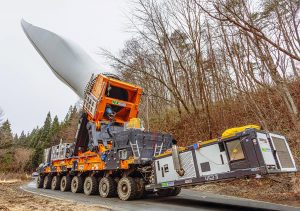
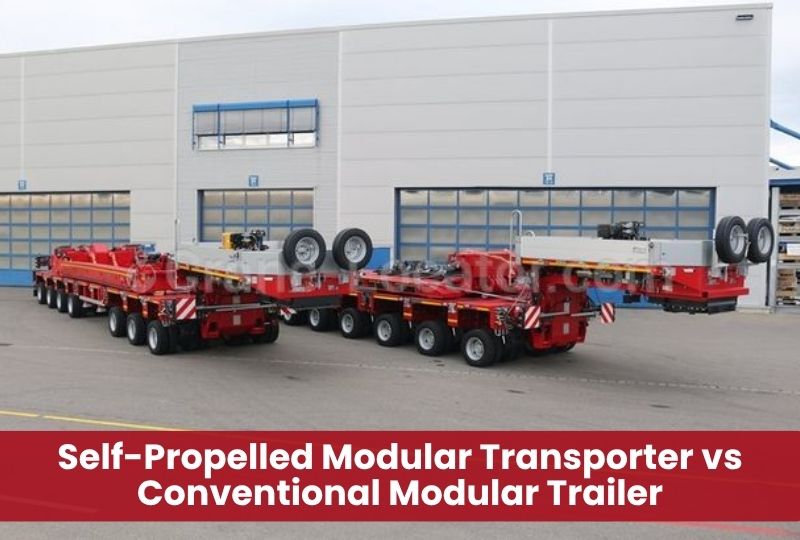
A self-propelled modular transporter is a multi-axle platform that moves under its own power. Instead of relying on a tractor unit for traction, an SPMT uses a power pack unit, commonly called a PPU, mounted on the platform or coupled to a string of modules. The PPU supplies hydraulic power for steering, drive, and suspension through each axle line.
Every axle line on an SPMT can steer independently. That gives the platform the ability to crab sideways, turn on the spot, or follow a curved path without swinging a long trailer body around a corner. Deck height can also be raised or lowered hydraulically, which lets operators level a load across uneven ground or lift cargo directly onto a foundation or ship deck.
SPMTs are built in modules of four, five, six, or eight axle lines, and modules can be linked lengthwise or side by side to carry heavier and wider loads. This scalability is why SPMTs show up on projects moving bridge girders, refinery vessels, offshore modules, and entire building sections.
What Is a Conventional Modular Trailer
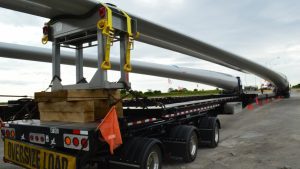
A conventional modular trailer, sometimes called a hydraulic modular trailer, shares the same axle line and hydraulic suspension concept but has no engine of its own. It is towed by a separate tractor unit, often a ballast tractor that adds weight over the drive axles for extra traction on grades.
Because it depends on a prime mover, a conventional modular trailer generally travels faster than an SPMT and suits longer road transport routes better. Axle counts vary from two to eight lines per module, and units can be coupled front to back or side by side to spread heavier loads across more wheels. Payload capacity per axle line typically ranges up to around 45 tons, depending on the manufacturer and configuration.
Where SPMTs are built for tight, controlled movement over short distances, conventional modular trailers are built for distance. They are the standard choice for transporting wind turbine components, transformers, precast concrete elements, and other oversized cargo between sites or ports.
Key Differences Between SPMT and Modular Trailers
The clearest way to compare the two is by how they move, not just what they carry.
Power source. An SPMT carries its own hydraulic power pack and does not need a tractor. A conventional modular trailer always needs a separate prime mover to generate motion.
Steering and maneuverability. SPMT axle lines steer independently through a computer-controlled system, allowing 360-degree rotation and sideways movement. Conventional modular trailers steer through a hitch and a smaller range of hydraulic steering, which limits how tightly they can turn.
Typical speed. SPMTs move slowly, often under a few kilometers per hour, since precision matters more than speed during placement. Conventional modular trailers move closer to normal road speeds when paired with a suitable tractor.
Best use case. SPMTs excel at short-distance, high-precision movement inside yards, shipyards, plants, and construction sites. Conventional modular trailers are better suited to longer hauls on public roads between a factory and a project site or port.
Deck height adjustment. Most SPMTs offer greater hydraulic lift range, useful for loading and unloading without cranes. Conventional modular trailers offer some adjustment but generally less travel than SPMT decks.
How Axle Lines and Load Capacity Compare
Both systems are described by axle line count rather than a single weight rating, because capacity scales with how many lines and modules are coupled together. A single SPMT or trailer axle line commonly handles somewhere between 18 and 45 tons, so a six line configuration can carry a very different load than a two line unit.
For projects in China or for buyers sourcing Chinese made equipment, axle and structural components are usually built around GB 1589-2016 dimension and weight standards, while the specific load rating still depends on axle brand, steel grade, and hydraulic system design. Buyers exporting equipment to markets outside China should confirm local axle load and permit limits separately, since regulations differ by country.
Choosing Between SPMT and Modular Trailer for Your Project
The decision usually comes down to distance and precision. If cargo needs to travel a long distance on public roads, a conventional modular trailer paired with the right tractor is more efficient and cost-effective. If the load needs to be positioned precisely inside a plant, shipyard, or construction site, an SPMT justifies its higher operating cost through control and maneuverability.
Some projects use both. A conventional modular trailer moves the load across long distances, then an SPMT takes over for the final positioning stage. <a href=”https://shiyuntrailer.com”>Shiyun Trailer</a> manufactures both SPMT platforms and modular lowbed trailers, which makes matching equipment to each phase of a heavy haul project more straightforward for fleet buyers.
Industries That Rely on These Transport Systems
Construction, shipbuilding, oil and gas, power generation, and port logistics are the heaviest users of both systems. SPMTs are common in shipyards for hull section transport and in plant construction for module installation. Conventional modular trailers are more common in wind energy logistics, precast construction, and general heavy haulage between fabrication yards and job sites.
Frequently Asked Questions
Can a conventional modular trailer be converted into an SPMT?
Some manufacturers offer upgrade kits that add a power pack unit and steering control to an existing hydraulic modular trailer, effectively converting it into a self-propelled unit. This depends on the trailer’s original axle and frame design.
Is an SPMT allowed on public roads?
SPMTs are built for controlled, low speed movement and are typically restricted to yards, ports, and short site to site transfers rather than open highway travel. Long-distance road transport is normally handled by a conventional modular trailer instead.
How many axle lines does a typical SPMT module have?
Most SPMT modules are built with four, five, six, or eight axle lines, and multiple modules can be linked together to increase total load capacity and deck size.
What is a power pack unit (PPU)?
A power pack unit is the diesel or electric engine and hydraulic system that drives an SPMT’s steering, suspension, and propulsion, removing the need for a separate tractor unit.