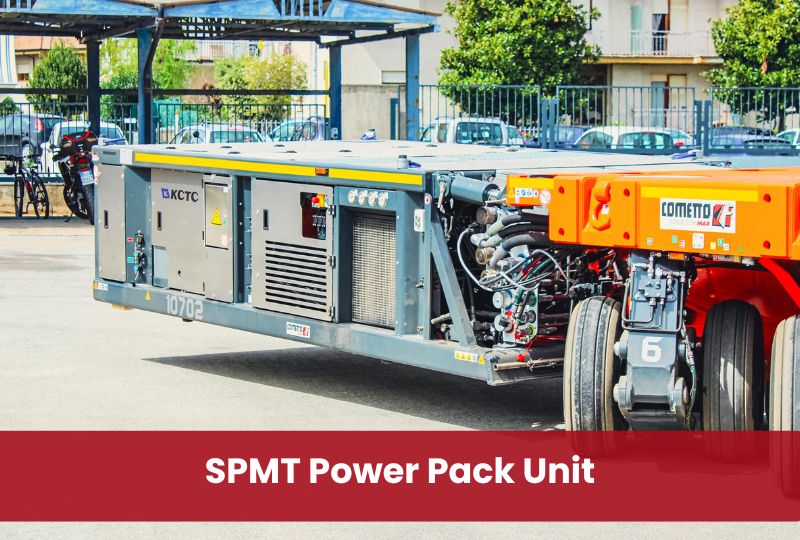
The power pack unit, almost always shortened to PPU in the heavy transport industry, is the engine and hydraulic power source that drives an SPMT. Without it, the axle lines have no way to steer, lift, level, or move at all. Understanding what the PPU does and how it connects to the rest of the platform helps explain why SPMTs in China can be operated with such precision by a small crew despite carrying enormous loads.
What the PPU Contains
A PPU typically houses a diesel engine, one or more hydraulic pumps, a fuel tank, and a control system that connects to the axle lines through a network of hydraulic hoses and electrical cabling. Unlike the engine on a conventional truck, the PPU’s engine exists purely to generate hydraulic power rather than to directly drive wheels through a mechanical transmission. The PPU itself sits on its own set of axle lines and can be positioned almost anywhere along the platform, depending on how the project layout and cargo shape require the weight to be arranged.
How Power Reaches the Axle Lines
The SPMT power pack unit (PPU) generates hydraulic pressure that is distributed through a network of hoses to each axle line’s cylinders and drive motors. This hydraulic distribution is what allows every wheel on the platform to adjust height independently, since each cylinder receives pressure it can use on its own rather than sharing a single mechanical linkage with the rest of the platform. The same hydraulic system also powers steering at each axle line and the drive motors that move the wheels forward or in reverse.
Remote Control Operation
Most SPMT systems are operated using a wireless remote control unit carried by the operator, who typically walks alongside the load during a move rather than sitting inside a cab. The remote sends commands to the PPU’s control system, which then adjusts hydraulic pressure across every connected axle line in real time to execute steering, height adjustment, and drive commands. This setup allows a small crew to control a platform carrying hundreds or even thousands of tonnes with a level of precision that would be very difficult to achieve from an enclosed cab with limited visibility of the load and its surroundings.
One PPU or Multiple PPUs
Smaller projects, involving a single file of axle lines or a modest total weight, can often run on a single PPU. Larger platforms, particularly wide configurations built from several files coupled together, frequently use two or more PPUs working in tandem. These units are synchronized through the shared control system so that steering, drive, and lift commands stay coordinated across the full width and length of the transporter, even though the hydraulic power is technically coming from more than one source. This synchronization is also central to how multiple SPMT platforms are joined together entirely, which we cover in our post on coupling multiple SPMT units
PPU Placement and Project Planning
Deciding where to position the PPU on a given project is not arbitrary. Engineers consider the cargo’s shape, where loading and unloading will occur, and how the PPU’s own weight affects the overall load distribution across the platform. In some cases, the PPU is placed at one end of the platform where it will not interfere with the cargo footprint. In others, particularly wide or unusually shaped loads, more than one PPU may be positioned at different points around the platform to balance both power distribution and weight.
Fuel and Endurance Considerations
Because the SMPT PPU’s engine runs continuously during a move to maintain hydraulic pressure, fuel capacity and consumption are practical considerations on longer projects. Operators typically plan refueling stops or use PPUs with larger fuel tanks for extended moves, particularly on projects that involve travel over long distances rather than short on site repositioning.
Maintenance Considerations
Because the PPU carries the engine and hydraulic pumps, it needs regular servicing separate from the axle lines themselves. Fuel systems, hydraulic fluid condition, filters, and pump performance are common maintenance points that directly affect how reliably the entire platform performs. We cover a full checklist in our post on SPMT maintenance for fleet operators
Noise, Emissions, and Site Restrictions
Because the PPU runs a diesel engine continuously during operation, some project sites, particularly those in urban areas or near sensitive facilities, place restrictions on noise levels or emissions during working hours. This is worth checking early in the planning process, since it can affect scheduling or require a PPU model with lower emissions output. Some newer PPU designs are built with reduced noise enclosures or cleaner burning engines specifically to meet stricter site requirements found on certain infrastructure and urban construction projects.
Backup and Redundancy Planning
On projects where a stalled move would be especially costly or disruptive, some operators plan for backup PPU capacity, either through a spare unit on standby or through a coupled configuration where the loss of one PPU does not fully halt the platform. This kind of redundancy planning is more common on very large or schedule-sensitive projects, where the cost of an unplanned delay far outweighs the cost of having backup capacity available on site.
FAQ
Can an SPMT operate without a PPU?
No. The axle lines have no independent power source of their own, so a functioning PPU is required for any steering, lifting, or drive function on the platform.
How is the PPU positioned on a project?
Engineers decide PPU placement based on cargo shape, weight distribution, and where loading and unloading will occur, often placing it at one end or the side of the platform where it will not interfere with the cargo footprint.
Do all SPMT projects need more than one PPU?
No, many smaller projects run comfortably on a single PPU. Multiple PPUs are typically used on wider or heavier configurations that require more hydraulic power than one unit can efficiently supply.
How long can a PPU run continuously during a move?
This depends on fuel tank capacity and consumption rate, which varies by PPU model and how demanding the move is. Longer projects are usually planned with refueling stops built into the schedule.
To plan the right PPU and axle line combination for your cargo, talk to Shiyun Trailer’s transport engineering team about your project weight and route conditions.