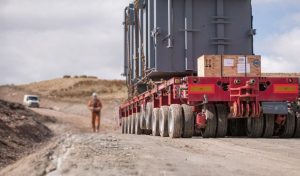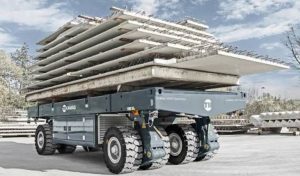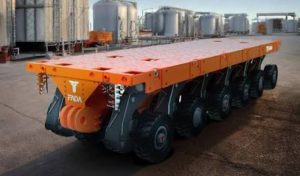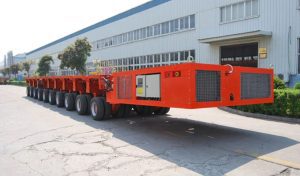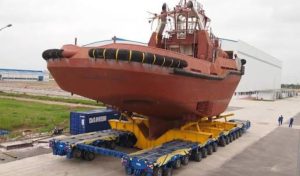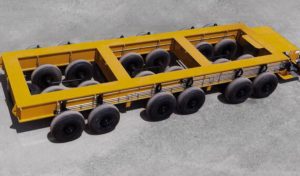
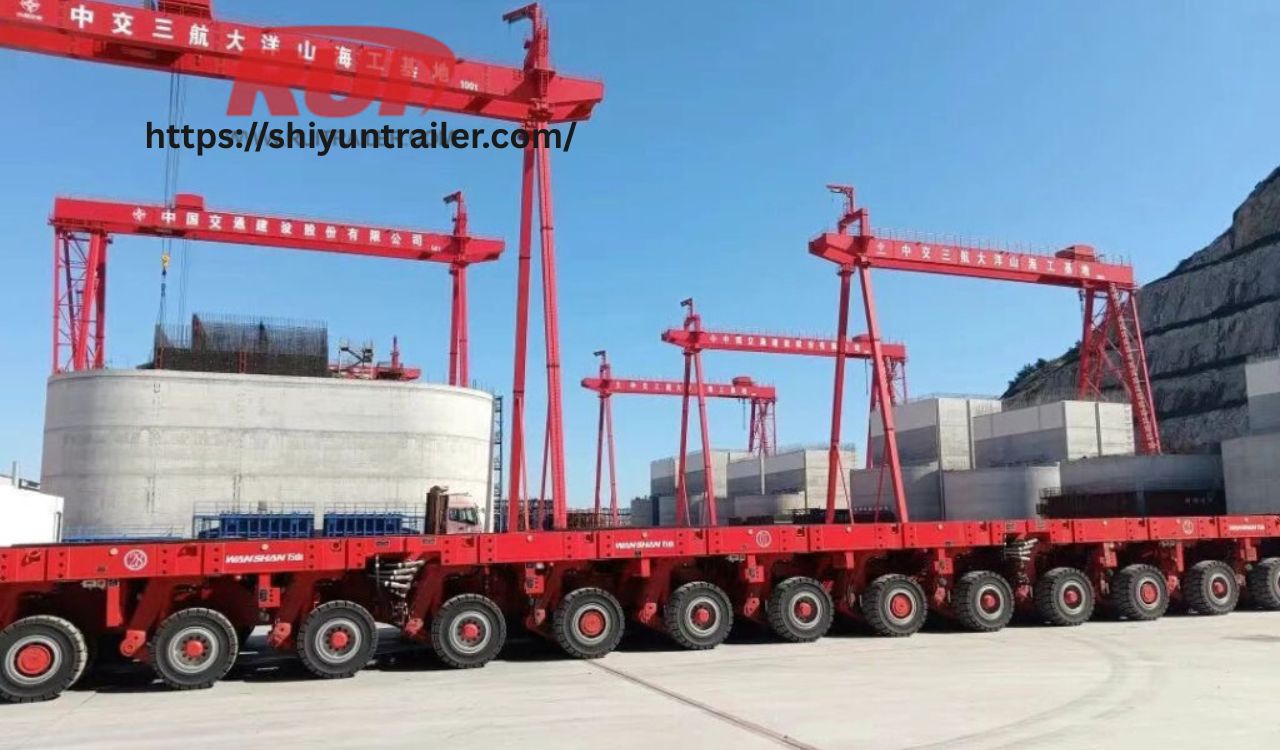
Self-Propelled Modular Transporters (SPMTs) are designed to move extremely heavy and oversized cargo through environments where conventional trailers may have difficulty operating. Their ability to steer individual axle lines and combine multiple modules gives them a high level of maneuverability. This makes them particularly useful for industrial plants, construction sites, ports, shipyards, power projects, and other locations where large loads must be positioned accurately.
Unlike conventional trailers that primarily follow the path of a towing vehicle, an SPMT can be controlled independently through its hydraulic steering system. This allows the transporter to perform different steering movements, including forward and reverse travel, turning, and lateral or diagonal positioning. Understanding SPMT turning radius and maneuverability is therefore important when planning routes for oversized and heavy cargo. Route planning should also consider oversized load permit requirements, as the permitted route, road restrictions, clearances, and local transportation regulations can influence how an SPMT and its cargo are moved safely through public or restricted areas.
What Is the Turning Radius of an SPMT?
The turning radius describes the space required for an SPMT to change its direction while moving. It is not a single fixed measurement because the actual turning path depends on the configuration of the transporter, steering angle, number of axle lines, module arrangement, load dimensions, and operating conditions. For comparison, a girder trailer used to transport long structural components may follow a more conventional movement path, while an SPMT can provide greater flexibility when complex maneuvering is required.
An SPMT with a smaller configuration may be able to operate in tighter areas than a larger interconnected configuration. Similarly, the dimensions and center of gravity of the transported load can affect how much space is required for safe movement. This becomes particularly important when transporting long and oversized structures, such as bridge girders, where the load length can significantly influence the overall swept path.
For this reason, engineers normally evaluate the complete transporter-and-load combination rather than considering the SPMT alone when assessing turning requirements. The selected transportation solution, whether an SPMT or a girder trailer, should be matched to the cargo dimensions, route geometry, available maneuvering space, and positioning requirements.
How SPMT Steering Improves Maneuverability
The main advantage of an SPMT is its electronically or hydraulically coordinated steering system. Each axle line can be controlled so that the wheels follow a predetermined steering angle and movement pattern.
Depending on the equipment and control system, an SPMT can support several movement modes, such as:
- Conventional forward or reverse steering
- Transverse movement
- Diagonal movement
- Rotation or pivoting
- Crab steering
- Coordinated turning
These movement capabilities allow operators to position large loads in areas where traditional transport equipment may require extensive space for turning or repositioning.
Factors That Affect SPMT Turning Radius
Several technical and operational factors influence the maneuverability of an SPMT.
Number of Axle Lines
The number of axle lines and the overall transporter length can affect the geometry of the turning path. Larger configurations generally require more careful route planning, particularly when moving through confined areas.
Module Configuration
SPMT modules can be connected in different arrangements to create a transporter suitable for a specific load. A longer or wider configuration changes the dimensions of the moving system and can affect its turning behavior.
Steering Angle
The maximum steering angle available at the axle lines directly influences the movement capability of the transporter. Greater steering flexibility can allow the SPMT to negotiate tighter paths, subject to equipment limitations and site conditions.
Cargo Dimensions
The cargo is an important part of the overall turning envelope. A load that extends significantly beyond the transporter deck may require additional clearance from buildings, equipment, columns, roads, and other obstacles.
Load Center of Gravity
The location of the load’s center of gravity also needs to be considered. During turning, changes in the load path and forces acting through the transporter can influence stability requirements.
Ground Conditions
The surface on which the SPMT operates can affect steering and maneuverability. Engineers may need to consider pavement strength, surface levelness, gradients, friction, drainage, and potential ground deformation before approving a route.
SPMT Movement in Confined Areas
One of the strongest advantages of SPMTs is their ability to operate in restricted industrial environments. Large equipment may need to move between buildings, around structural columns, through plant areas, or into precise installation positions.
In such situations, the transporter may not simply follow a curved road. Instead, operators can use coordinated steering modes to adjust the position of the load while maintaining control over the entire transporter.
For example, a large transformer may need to be moved through a plant and then aligned with a foundation. The SPMT can use controlled steering movements to approach the installation area and make small positional adjustments without requiring a conventional truck-and-trailer turning maneuver.
SPMT Turning Radius vs. Conventional Trailer Maneuverability
Conventional trailers generally depend on the tractor or towing vehicle to determine their direction of travel. Their movement is therefore strongly influenced by the articulation point between the tractor and trailer.
An SPMT operates differently. Its axle lines can be coordinated through the steering control system, allowing the transporter to move in multiple directions and follow more complex paths.
This does not mean that an SPMT can move without spatial limitations. The actual maneuvering space still depends on the transporter configuration, load dimensions, steering capability, ground conditions, and surrounding obstacles. However, its independent steering capability provides considerably more flexibility for complex heavy-haul movements.
Planning the Turning Path Before Transport
Turning requirements should be assessed before the load begins moving. A route survey can identify obstacles and determine whether sufficient clearance exists throughout the planned movement.
Engineers may evaluate:
- Road and access-way width
- Inside and outside turning clearances
- Building and equipment locations
- Overhead obstructions
- Ground-bearing capacity
- Gradients and changes in elevation
- Transporter configuration
- Cargo overhang
- Required installation position
For complex projects, digital route planning and engineering simulations can help visualize the movement before the actual operation begins.
Why Load Clearance Matters
The SPMT may have enough space for its own wheels while the transported cargo requires a much larger movement envelope. Wide or long loads can extend beyond the transporter and create significant swept-path requirements during a turn.
Engineers therefore need to consider the complete swept path of both the transporter and cargo. Clearance should be checked against fixed structures, temporary equipment, pipelines, barriers, electrical infrastructure, and other potential obstructions.
This is particularly important in operating plants where available space can be limited.
Maneuverability During Reverse Movement
Reverse movement can be more demanding because the operator must maintain awareness of the complete transporter configuration and cargo position. Visibility may also be restricted by the load itself or nearby structures.
SPMT control systems can assist operators by coordinating axle-line steering and providing centralized control. However, the movement still requires proper planning, communication, site supervision, and appropriate safety procedures.
Where necessary, spotters and communication systems can be used to help monitor clearances and identify potential obstacles.
SPMT Maneuverability for Precision Positioning
SPMTs are not only used to transport heavy loads from one location to another. They are also frequently used when a load must be positioned accurately.
This can include positioning:
- Industrial modules
- Transformers
- Pressure vessels
- Bridge components
- Ship sections
- Heavy machinery
- Construction structures
The ability to make controlled directional movements can reduce the need for additional lifting or repositioning equipment in some applications. This can make the final positioning stage more efficient when the equipment and site conditions are properly planned.
Engineering Considerations for Complex Routes
Before selecting an SPMT configuration, engineers should understand the complete movement requirements. The transporter must have sufficient capacity, but capacity alone does not determine whether a route is practical.
A suitable engineering assessment may consider the transporter dimensions, axle configuration, steering capability, cargo geometry, load distribution, ground conditions, turning envelope, and installation requirements.
The route should also be checked for temporary restrictions. Construction barriers, stored materials, cranes, scaffolding, and other temporary structures can reduce the available maneuvering space.
Limitations of SPMT Maneuverability
Although SPMTs provide exceptional steering flexibility, they still have practical limitations. Very large transporter configurations can require substantial space, and the transported load may create a larger swept path than the transporter itself.
Ground conditions can also restrict operations. A route that appears sufficiently wide may not be suitable if the supporting surface cannot safely carry the combined transporter and cargo load.
Steering capability should therefore never be considered independently from load stability, ground conditions, structural clearances, and overall transport planning.
Best Practices for SPMT Route Planning
A successful SPMT movement starts with detailed preparation. Before transportation begins, the project team should understand the cargo dimensions, weight, center of gravity, transporter configuration, route geometry, and final positioning requirements.
Useful practices include:
- Conducting a detailed route survey
- Checking the complete transporter and cargo swept path
- Confirming ground-bearing requirements
- Reviewing steering and movement modes
- Identifying fixed and temporary obstacles
- Establishing communication procedures
- Performing movement simulations where appropriate
- Confirming the final positioning sequence
- Conducting site inspections before transport
These steps help reduce unexpected problems during the actual movement.
Conclusion
SPMT turning radius and maneuverability are important considerations when transporting oversized and heavy cargo through complex routes. The ability to independently coordinate axle-line steering gives SPMTs greater movement flexibility than many conventional trailer systems, particularly in confined industrial and construction environments.
However, maneuverability depends on more than steering capability. Transporter configuration, cargo dimensions, steering angles, ground conditions, load distribution, and available clearance all influence the practical turning path. Careful route surveying and engineering planning allow operators to use SPMT capabilities effectively while maintaining control and stability throughout the movement.
Frequently Asked Questions
What determines the turning radius of an SPMT?
The turning path depends on factors such as the number of axle lines, module configuration, steering angle, transporter dimensions, cargo size, and operating conditions. There is therefore no single turning radius that applies to every SPMT configuration.
Can an SPMT move sideways?
Yes. Depending on the transporter and steering system, SPMTs can use coordinated steering modes to perform transverse, diagonal, or crab movements. These capabilities are particularly useful in confined areas and precision positioning operations.
Why is SPMT maneuverability important?
High maneuverability allows heavy and oversized loads to be moved through restricted areas and positioned accurately around buildings, equipment, structures, and other obstacles.
Does the cargo affect the SPMT turning path?
Yes. Large or unusually shaped cargo can extend beyond the transporter and create a larger swept path. Engineers must consider the dimensions and overhang of the cargo when planning turns.
Can SPMTs operate in narrow industrial areas?
SPMTs are well suited to many confined industrial environments because of their flexible steering and movement capabilities. However, the actual route must still provide sufficient clearance and suitable ground conditions.
Is turning radius the only factor in SPMT route planning?
No. Route planning should also consider ground-bearing capacity, gradients, cargo dimensions, load distribution, overhead clearance, obstacles, steering capability, and the final positioning requirements.
How can SPMT movement be planned before transport?
Engineers can conduct route surveys, evaluate the transporter and cargo swept path, review ground conditions, and use digital planning or movement simulations where appropriate. This helps identify potential restrictions before the operation begins.