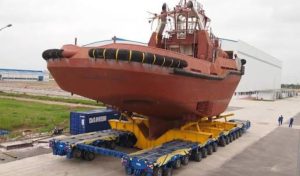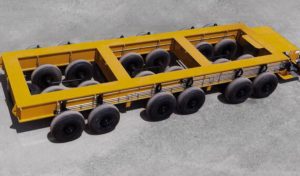
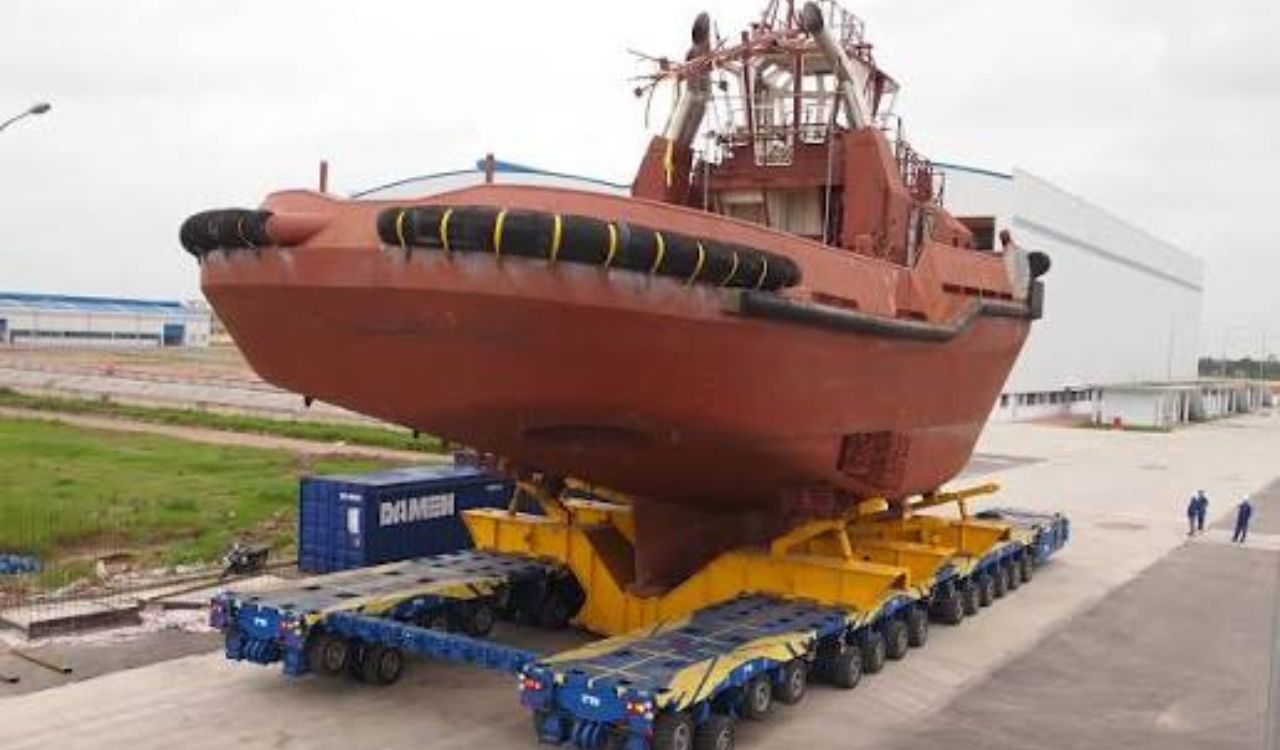
Moving extremely heavy or oversized cargo requires transportation equipment that can manage high loads, complex dimensions, and demanding site conditions. Two systems commonly considered for specialized heavy transport are the multiwheeler and the Self-Propelled Modular Transporter (SPMT).
Although both systems use multiple axle lines and are designed to distribute heavy loads, their operating principles are different. A multiwheeler is generally used as a heavy-duty trailer that works with a suitable prime mover, while an SPMT is a self-propelled modular transport system equipped with its own power and control systems.
Understanding the differences between a multiwheeler and an SPMT helps engineers, contractors, transport operators, and industrial project planners select equipment according to cargo requirements, route conditions, maneuverability, and project objectives.
What Is a Multiwheeler?
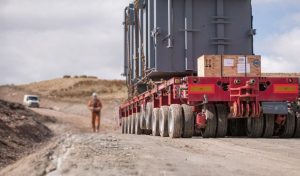
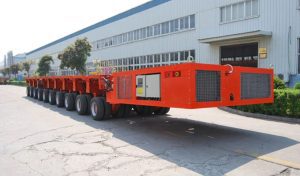
A multiwheeler is a heavy-duty transportation platform that uses multiple axle lines and wheels to distribute large cargo loads. It can be configured with different axle arrangements, suspension systems, and steering mechanisms and is typically connected to a suitable prime mover.
Multiwheelers are used for heavy machinery, industrial equipment, transformers, structural components, and girder transport, with a girder trailer providing specialized support for long and heavy bridge girders.
What Is an SPMT?
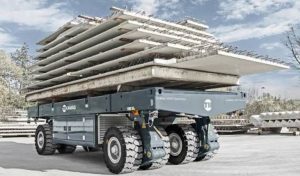
An SPMT, or Self-Propelled Modular Transporter, is a modular heavy transport system designed to move large and heavy loads using its own propulsion system.
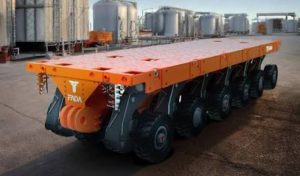
An SPMT typically consists of multiple axle-line modules, hydraulic suspension, steering systems, electronic controls, and a Power Pack Unit (PPU).
Unlike a conventional heavy haulage trailer, an SPMT does not depend on a road tractor to provide its primary propulsion.
Its modular construction allows individual units to be connected longitudinally or side by side to create a transportation platform suited to different cargo sizes and weights.
Multiwheeler vs SPMT: Basic Difference
The most important difference is how the transportation system is powered and controlled.
A conventional multiwheeler is normally towed by a prime mover. An SPMT contains a dedicated propulsion and control system that allows the transporter itself to move.
This difference affects how each system operates, where it can be used, and how much control the operator has over the transporter.
| Feature | Multiwheeler | SPMT |
| Propulsion | Usually provided by a tractor | Integrated power system |
| Basic design | Heavy-duty trailer | Modular self-propelled transporter |
| Power Pack Unit | Usually not integrated | Typically uses a PPU |
| Axle configuration | Multiple axle lines | Modular axle-line units |
| Steering | Depends on trailer design | Multi-mode hydraulic/electronic steering |
| Deck configuration | Fixed or configurable | Highly modular |
| Maneuverability | Depends on configuration and tractor | Very high for specialized applications |
| Typical environment | Road and heavy-haul routes | Industrial sites, infrastructure and specialized routes |
| Configuration flexibility | Moderate to high | Very high |
| Operator control | Trailer and tractor combination | Integrated transport control system |
The exact specifications vary between manufacturers and models, so equipment selection should always be based on the actual project requirements.
How Does a Multiwheeler Work?
A multiwheeler transfers the cargo load through its deck, suspension, and axle system.
The tractor provides the pulling force, while the trailer supports the cargo and distributes its weight across multiple axle lines.
During transportation, several systems work together:
- Trailer structure supports the cargo.
- Axle lines carry and distribute the load.
- Suspension manages vertical movement.
- Steering controls the trailer’s direction.
- Braking systems manage deceleration.
- The tractor provides propulsion and towing capacity.
The complete tractor-trailer combination must therefore be evaluated as a transportation system rather than looking at the trailer alone.
How Does an SPMT Work?
An SPMT uses a combination of hydraulic, mechanical, electrical, and electronic systems.
The PPU supplies power for the hydraulic and propulsion systems. Hydraulic cylinders support the load and provide suspension movement, while the steering system controls the orientation of the axle lines.
An operator uses a control system to manage movement, steering, braking, and other functions.
Because the individual modules can be connected in different arrangements, an SPMT can be configured to support unusually large loads or cargo with complex dimensions.
Propulsion: Towed Trailer vs Self-Propelled System
Propulsion is one of the clearest differences between the two systems.
Multiwheeler Propulsion
A conventional multiwheeler generally requires a tractor or suitable prime mover.
The tractor supplies the pulling force while the trailer carries the cargo.
This arrangement can work effectively for road-based heavy haulage where the route is suitable for a tractor-trailer combination.
SPMT Propulsion
An SPMT uses its own power system.
The PPU supplies the energy required for the hydraulic and driving systems, allowing the transporter to move without a conventional tractor providing the primary propulsion.
This makes the SPMT particularly useful for controlled industrial movements where independent movement and precise positioning are important.
Steering and Maneuverability
Steering behavior is another major distinction.
A conventional multiwheeler’s maneuverability depends on the trailer’s steering arrangement, tractor configuration, axle geometry, and route.
An SPMT can provide multiple steering modes because its axle modules are controlled through an integrated system.
Depending on the equipment, steering modes can support:
- Straight movement
- Transverse movement
- Sideways positioning
- Diagonal movement
- Rotation or controlled turning
- Crab steering
These capabilities can be valuable when moving heavy equipment through industrial facilities or confined project sites.
Load Distribution
Both systems are designed to distribute heavy loads across multiple axle lines, but their configuration methods differ.
A multiwheeler may use a fixed or semi-configurable axle arrangement. The correct setup depends on the trailer’s rated capacity and the cargo’s weight distribution.
SPMT modules can be combined to create different axle configurations according to the cargo requirements.
Engineers must consider:
- Total cargo weight
- Transporter weight
- Number of axle lines
- Individual axle capacity
- Cargo support points
- Center of gravity
- Ground conditions
- Road or surface limitations
Increasing the number of axles does not automatically make every configuration suitable. The complete load path and supporting surface must be evaluated.
Configuration Flexibility
A multiwheeler can be available in different configurations, including extended or specialized heavy-haul trailer arrangements.
However, SPMTs are specifically designed around modularity.
Individual modules can be connected longitudinally or transversely to create wider or longer platforms.
This makes an SPMT useful for cargo such as large industrial modules, bridge structures, refinery equipment, power-generation components, and other loads whose dimensions do not fit a conventional trailer platform.
Multiwheeler vs SPMT for Road Transportation
For transportation primarily taking place on established roads, a conventional multiwheeler and tractor combination may provide a practical solution when the cargo and route fit the equipment.
The transport team must consider road width, bridge capacity, turning areas, gradients, clearance, axle loads, and applicable regulations.
An SPMT can also be used for road or semi-road environments, but its strongest advantages are often associated with controlled specialized transportation rather than ordinary freight movement.
Multiwheeler vs SPMT for Industrial Sites
Industrial sites can present very different challenges from public roads.
Factories, ports, power plants, shipyards, refineries, and construction sites may contain narrow access routes, tight turning areas, restricted working zones, or areas where cargo must be positioned very precisely.
In such situations, the independent propulsion and steering capabilities of an SPMT can provide greater operational flexibility.
A multiwheeler may still be appropriate where the site has sufficient space and a suitable tractor can safely perform the required movements.
Applications of Multiwheelers
Multiwheelers are commonly associated with heavy road transportation and specialized haulage.
Typical applications include:
- Heavy construction machinery
- Industrial equipment
- Transformers
- Large structural components
- Pressure vessels
- Manufacturing equipment
- Bridge components
- Oversized machinery
- Infrastructure equipment
The appropriate configuration depends on cargo weight, dimensions, route restrictions, and local transportation requirements.
Applications of SPMTs
SPMTs are frequently used for specialized industrial and infrastructure movements.
Applications can include:
- Power plant equipment installation
- Bridge component movement
- Industrial module transportation
- Shipyard operations
- Refinery equipment movement
- Heavy machinery positioning
- Large structural assemblies
- Infrastructure construction
- Controlled movement inside industrial facilities
An SPMT can also be used where a large load must be moved over a short distance and positioned with a high degree of control.
Multiwheeler vs SPMT: Operating Requirements
The equipment choice affects the skills and resources required for the operation.
Multiwheeler Requirements
A heavy multiwheeler operation may require:
- Suitable tractor
- Qualified driver/operator
- Trailer inspection
- Load-securing equipment
- Route assessment
- Axle-load planning
- Braking and steering checks
- Required transportation permissions
The exact requirements depend on the jurisdiction and project.
SPMT Requirements
An SPMT operation generally requires personnel familiar with the transporter’s control system and hydraulic equipment.
The team may include:
- SPMT operator
- Transport supervisor
- Mechanical personnel
- Electrical/control personnel
- Rigging and lifting specialists
- Ground support personnel
Operator training is particularly important because SPMT movement involves coordinated control of propulsion, steering, suspension, and braking systems.
Ground Conditions and Site Preparation
Both systems depend on the supporting surface, especially when transporting extremely heavy loads.
Ground bearing capacity can influence:
- Wheel loads
- Surface deformation
- Stability
- Route suitability
- Required ground reinforcement
For an SPMT operation, the load can be distributed across a large number of wheels, but the supporting surface still needs to be evaluated.
A multiwheeler operation similarly requires assessment of road and ground conditions according to the expected axle loads.
SPMT Cost vs Multiwheeler Cost
There is no universal cost difference because project requirements vary significantly.
The total cost can depend on:
- Equipment capacity
- Number of axle lines
- Transport distance
- Project duration
- Mobilization requirements
- Operator requirements
- Route preparation
- Ground reinforcement
- Permits and escorts
- Loading and unloading arrangements
- Specialized engineering requirements
An SPMT can involve higher equipment and operational complexity because of its propulsion, hydraulic, and control systems. However, comparing purchase or rental prices alone does not provide a complete project-cost assessment.
The more useful approach is to evaluate the total transportation requirement and determine which system can complete the operation with the required control, capacity, and site access.
Which System Should Be Used?
There is no single system that is appropriate for every heavy transport project.
A multiwheeler may be considered when:
- The cargo is suitable for road transportation.
- A suitable tractor is available.
- The route provides sufficient space.
- Conventional towing is practical.
- The required maneuverability is within the trailer’s capabilities.
An SPMT may be considered when:
- The cargo is exceptionally heavy or large.
- Precise positioning is required.
- The route involves restricted industrial areas.
- Independent propulsion is beneficial.
- Multiple steering modes are required.
- The cargo requires a highly configurable transport platform.
The final selection should be based on engineering calculations, equipment specifications, site conditions, route requirements, and applicable regulations.
Can an SPMT Replace a Multiwheeler?
Not necessarily.
The two systems can perform some similar heavy transportation tasks, but they are designed around different operating concepts.
A multiwheeler is generally part of a tractor-trailer transportation system, while an SPMT is a self-propelled modular platform.
For a straightforward heavy road haul, an SPMT’s advanced capabilities may not be necessary. For a complex industrial movement requiring independent propulsion and precise multi-directional steering, an SPMT may provide capabilities that a conventional trailer cannot easily replicate.
Therefore, the question is not simply which system has greater capacity. The key issue is whether the equipment’s technical characteristics match the transportation task.
Key Selection Factors
Before choosing between a multiwheeler and SPMT, project teams should evaluate:
| Factor | Multiwheeler | SPMT |
| Cargo weight | Suitable for heavy loads | Suitable for very heavy modular transport |
| Road transport | Strong application | Possible depending on project |
| Industrial-site movement | Depends on configuration | Strong application |
| Independent propulsion | Generally no | Yes |
| Steering flexibility | Depends on design | Multiple steering modes |
| Modular expansion | Available on some systems | Core design characteristic |
| Precise positioning | Limited by configuration | Strong capability |
| Tractor requirement | Usually required | Not required for primary propulsion |
| Operator specialization | Heavy-haul expertise | SPMT-specific expertise |
| Configuration flexibility | Moderate to high | Very high |
Practical Decision Process
A structured selection process can help avoid choosing equipment based solely on nominal capacity.
Step 1: Define the Cargo
Record weight, length, width, height, center of gravity, support points, and any special handling requirements.
Step 2: Define the Route
Assess road dimensions, turning areas, gradients, bridges, clearances, surface conditions, and site access.
Step 3: Determine the Transport Configuration
Calculate the required axle lines, load distribution, deck arrangement, steering requirements, and braking requirements.
Step 4: Compare Propulsion Requirements
Determine whether the movement can be efficiently completed using a tractor-towed heavy haulage trailer or whether independent propulsion is required.
Step 5: Evaluate Maneuverability
Consider whether the project requires conventional road steering or advanced SPMT steering modes.
Step 6: Assess Total Project Requirements
Consider equipment, personnel, mobilization, route preparation, ground conditions, permits, and operational duration rather than looking only at equipment cost.
Conclusion
Multiwheelers and SPMTs are both important systems for specialized heavy transportation, but they serve different operational needs.
A multiwheeler generally operates as a heavy-duty trailer pulled by a suitable prime mover and is well suited to specialized road transportation. An SPMT combines modular axle-line units, hydraulic systems, a power pack, and advanced steering and control capabilities to provide independent and highly controlled movement.
The right choice depends on cargo weight and dimensions, route conditions, maneuverability, propulsion requirements, ground conditions, project duration, and the level of positioning control required.
For industrial manufacturers, contractors, and heavy transport planners, understanding these differences makes it easier to develop a transportation configuration that is technically appropriate for the project. Shiyun Trailers can be naturally considered within broader construction and industrial project supply chains where heavy equipment transportation supports the delivery and installation of construction-related systems and materials.
Frequently Asked Questions
What is the main difference between a multiwheeler and an SPMT?
The main difference is propulsion and control. A conventional multiwheeler is generally towed by a tractor, while an SPMT has its own propulsion system and integrated control architecture.
Is an SPMT more flexible than a multiwheeler?
SPMTs are specifically designed for modular configuration and multi-directional maneuvering, which can provide substantial flexibility for complex industrial movements. However, the appropriate system depends on the specific transportation task.
Can a multiwheeler carry the same loads as an SPMT?
Capacity varies by equipment configuration. Some multiwheelers can transport very heavy loads, while SPMTs can be configured by combining modules to support exceptionally large cargo.
Does an SPMT need a tractor?
An SPMT does not need a conventional tractor to provide its primary propulsion because its power pack and drive system provide the required movement.
What is an SPMT mover?
An SPMT mover is a self-propelled modular transport system used to move heavy or oversized cargo. It uses powered axle modules, hydraulic systems, steering controls, and a power source to move the load.
Which is better for road transportation, a multiwheeler or SPMT?
The appropriate choice depends on the cargo, route, regulations, maneuverability requirements, and available equipment. A conventional multiwheeler can be suitable for tractor-towed heavy road transport, while an SPMT is particularly useful where independent propulsion and specialized maneuverability are required.
What factors affect SPMT cost?
SPMT cost can be affected by equipment configuration, number of axle lines, project duration, mobilization, operator requirements, route preparation, ground conditions, and the complexity of the required movement.