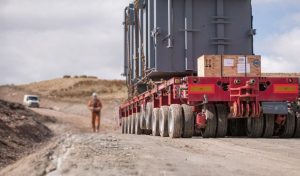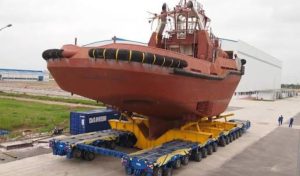
Transporting extremely heavy and oversized equipment requires more than a conventional road trailer. Industrial cargo such as transformers, bridge components, construction machinery, pressure vessels, and large structural assemblies can place substantial demands on the trailer’s axle capacity, steering, suspension, stability, and load distribution.
A multiwheeler trailer is designed for these demanding transportation applications. It uses multiple axle lines and wheels to distribute heavy loads across a larger supporting area, allowing specialized transport operators to move cargo that exceeds the practical capacity of conventional trailers.
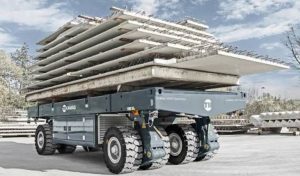
Depending on the configuration, a multiwheeler may operate as a conventional heavy haulage trailer, modular transport system, or part of a larger multi-module heavy transport arrangement. These systems are also suitable for girder transport, where large bridge girders and structural components require controlled load distribution, adequate support, and stable movement throughout the transport route.
Understanding the different types, working principles, components, and applications of multiwheelers helps engineers, contractors, logistics companies, and industrial buyers select an appropriate transportation system for a specific project.
What Is a Multiwheeler Trailer?
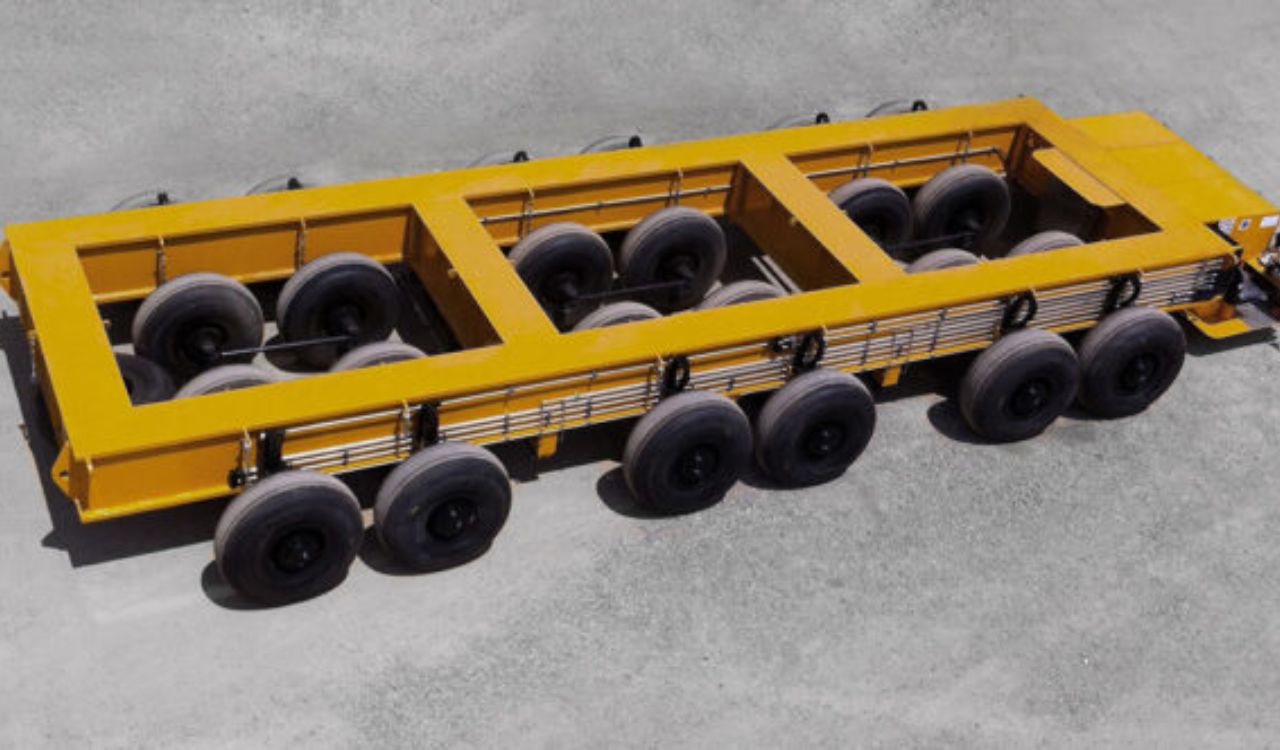
A multiwheeler trailer is a heavy-duty transportation platform equipped with multiple axle lines and a large number of wheels to carry and distribute substantial cargo loads.
Unlike standard semi trailers designed primarily for general freight, multiwheelers are engineered for specialized heavy-haul operations. Their configuration can be adapted according to cargo weight, dimensions, center of gravity, road conditions, turning requirements, and project-specific transportation constraints.
A multiwheeler can be configured with different numbers of axle lines, deck arrangements, suspension systems, and steering mechanisms. Some systems are towed by a tractor, while other specialized configurations may incorporate powered modules or connect with a power source.
The basic objective is to provide controlled and stable movement of heavy cargo while distributing the load across multiple axles.
How Does a Multiwheeler Trailer Work?
The working principle of a multiwheeler is based on distributing the cargo load across numerous axle lines rather than concentrating the entire load on a small number of axles.
When heavy cargo is placed on the trailer deck, the load is transferred through the supporting structure to the suspension and axle assemblies. The wheels then transfer the resulting forces to the road or prepared transport surface.
Several systems work together during transportation:
- Axle lines support and distribute the cargo weight.
- Hydraulic or mechanical suspension manages vertical movement and load transfer.
- Steering systems control the direction of multiple axle groups.
- Braking systems provide controlled deceleration.
- Deck structures support the cargo and maintain structural stability.
- Coupling systems allow compatible modules to be connected when additional capacity or dimensions are required.
- Power systems, where applicable, provide propulsion for self-propelled configurations.
The configuration must be selected according to the actual cargo and route rather than simply choosing the trailer with the highest nominal capacity.
Main Types of Multiwheeler Trailers
Multiwheeler systems can be configured in several forms depending on the cargo and transportation requirements.
Conventional Multiwheeler Trailer
A conventional multiwheeler trailer is normally pulled by a suitable prime mover. Its multiple axle lines provide a greater load-carrying capability than standard commercial trailers.
These trailers are commonly considered for heavy machinery, industrial equipment, construction components, and other concentrated loads.
Modular Multiwheeler Trailer
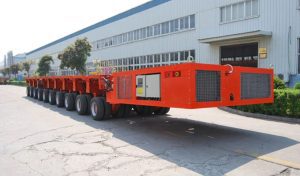
A modular trailer consists of individual transport modules that can be arranged longitudinally or side by side.
This configuration provides flexibility when transporting cargo with unusual dimensions or when a project requires different axle arrangements.
Modular trailers are particularly useful when transport requirements vary between projects because the number and arrangement of modules can be adapted to the cargo.
Self-Propelled Trailer
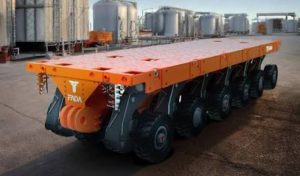
A self-propelled trailer uses an integrated or connected power system to move the transporter without relying on a conventional tractor in the same way as a standard trailer.
Self-propelled systems are useful when extremely heavy cargo must be maneuvered through industrial facilities, construction sites, ports, power plants, or other restricted environments.
SPMT systems are one specialized example of self-propelled modular transportation technology.
Multi-Module Heavy Transport Systems
For exceptionally large cargo, multiple transport modules can be combined to create a wider or longer transportation platform.
This approach allows engineers to distribute the load over additional axle lines and create a configuration suited to the dimensions and weight of the cargo.
The final arrangement depends on factors such as axle capacity, cargo center of gravity, support points, route geometry, and allowable ground loading.
Key Components of a Multiwheeler Trailer
A multiwheeler is more than a large trailer with additional wheels. Its components must work together to maintain controlled movement and safe load distribution.
Axle Lines
Axle lines are fundamental to heavy-haul trailer design. Increasing the number of axle lines can provide additional load-supporting capacity, provided that the overall configuration is engineered correctly.
The axle arrangement also affects turning behavior, load distribution, deck dimensions, and road loading.
Suspension System
The suspension absorbs movement between the trailer and the supporting surface while helping maintain contact between the wheels and the road.
Hydraulic suspension is commonly used in specialized heavy transport because it can provide controlled vertical movement and, depending on the design, allow adjustment of deck height.
Steering System
Multiwheeler steering systems must accommodate the movement of several axle groups.
Depending on the trailer design, steering may be mechanically linked, hydraulically controlled, or integrated into a more advanced electronic control system.
Effective steering is particularly important when the transport route contains tight turns, intersections, industrial access roads, or restricted work areas.
Deck Structure
The deck provides the primary support surface for the cargo.
Its dimensions and structural design must correspond to the cargo’s weight, dimensions, support points, and center of gravity.
Braking System
Heavy loads require controlled braking performance. The braking system must be appropriate for the trailer configuration, cargo weight, operating speed, and applicable regulations.
Coupling and Connection Systems
Multiwheeler and modular configurations may use specialized coupling arrangements to connect transport modules.
These connections must maintain structural integrity and allow the combined system to operate as intended.
Multiwheeler Trailer vs Standard Trailer
A standard trailer is generally designed for conventional freight, whereas a multiwheeler is developed for substantially heavier or more specialized loads.
| Feature | Standard Trailer | Multiwheeler Trailer |
| Typical cargo | General freight | Heavy and oversized cargo |
| Axle configuration | Limited | Multiple axle lines |
| Load distribution | Conventional | Engineered for heavy loads |
| Steering | Standard steering | Multi-axle or specialized steering |
| Suspension | Conventional | Heavy-duty or hydraulic options |
| Configuration flexibility | Limited | Higher |
| Typical applications | Logistics and freight | Industrial and heavy haulage |
| Cargo dimensions | Generally standardized | Can accommodate specialized dimensions |
The exact capabilities vary by trailer model and configuration, so specifications should always be checked against the intended project.
Heavy-Haul Applications of Multiwheeler Trailers
Multiwheelers are used in industries where cargo dimensions or weight exceed the practical capabilities of conventional transportation equipment.
Construction Projects
Large construction machinery, structural components, precast elements, and other heavy equipment can require specialized transport.
A multiwheeler can provide the axle capacity and platform configuration needed for these loads.
Energy and Power Projects
Power transformers, generators, boilers, pressure vessels, and other industrial components may require heavy-duty transportation systems.
Load distribution is particularly important because these components can have high concentrated weights and specific support-point requirements.
Infrastructure Projects
Bridge components, large structural assemblies, and other infrastructure elements may require multi-axle transportation.
The trailer configuration can be adjusted to suit cargo dimensions and project logistics.
Industrial Equipment Transportation
Manufacturing facilities frequently need to move large machinery between production areas or from manufacturing sites to installation locations.
Depending on the cargo and route, a multiwheeler or self-propelled system may be selected.
Port and Industrial Logistics
Heavy components moving through ports and industrial terminals may require specialized transport equipment capable of handling high loads and limited maneuvering space.
In some applications, a multiwheeler can work alongside cranes, lifting equipment, and other material-handling systems.
Factors to Consider When Selecting a Multiwheeler
Selecting a multiwheeler should begin with the cargo and project requirements rather than the trailer model alone.
Important considerations include:
Cargo Weight
Determine the total transported weight, including the cargo and relevant transport equipment.
The axle configuration must provide sufficient capacity with an appropriate engineering margin.
Cargo Dimensions
Length, width, height, and irregular geometry affect the required deck configuration and route clearance.
Center of Gravity
The cargo’s center of gravity affects stability and load distribution.
Heavy or tall cargo may require a carefully designed support arrangement to prevent excessive forces on individual axle groups.
Axle Load
The expected load on each axle line should be evaluated against the trailer’s specifications and applicable road restrictions.
Route Conditions
The route should be assessed for:
- Road width
- Turning areas
- Bridges
- Gradients
- Surface conditions
- Overhead clearance
- Road restrictions
- Access to the final destination
Ground Conditions
For operations away from standard highways, engineers should also consider ground bearing capacity and surface stability.
A trailer that is suitable from a nominal payload perspective may still require additional route or ground preparation when operating on weak surfaces.
Steering Requirements
The steering system should match the route geometry and maneuvering requirements.
Complex industrial sites may require more advanced steering capabilities than open-road transportation.
Multiwheeler Trailer and SPMT: Where They Relate
A multiwheeler and an SPMT trailer can appear similar because both use multiple axle lines and are designed for heavy transportation. However, they represent different equipment concepts.
A conventional multiwheeler is often designed to be pulled by a tractor, while an SPMT is a self-propelled modular transportation system that uses a power pack and integrated control systems.
The choice depends on the cargo, route, maneuverability requirements, propulsion method, and project environment.
For highly controlled industrial movement, an SPMT mover may provide capabilities that are unnecessary for a straightforward road-haulage project. Conversely, a conventional multiwheeler can be more appropriate where towing infrastructure and road transportation are already available.
Benefits of Multiwheeler Trailers
Multiwheelers provide several advantages for specialized transportation.
Higher Load Distribution Capacity
Multiple axle lines distribute heavy cargo across a greater number of wheels and supporting points.
Flexible Configurations
Modular and multi-axle arrangements can be adapted to different cargo dimensions and weights.
Improved Heavy-Cargo Support
A properly configured heavy duty transporter can provide a stable platform for large industrial equipment.
Suitable for Specialized Projects
Multiwheelers can support transportation requirements across construction, infrastructure, energy, manufacturing, and industrial logistics.
Compatibility With Heavy-Haul Operations
Depending on the configuration, multiwheelers can form part of a larger heavy haulage trailer system involving tractors, modular sections, lifting equipment, and specialized transport planning.
Limitations and Challenges
Multiwheeler transportation also involves several challenges.
Route restrictions: Heavy loads may be subject to bridge, road, axle-load, height, and width restrictions.
Complex load planning: Cargo weight must be properly distributed across the available axle lines.
Higher operating requirements: Specialized equipment requires trained operators, appropriate towing equipment, inspections, and project planning.
Maneuverability considerations: A large multi-axle configuration can require additional turning space depending on its steering arrangement.
Surface limitations: Weak roads or unprepared ground may not be suitable for heavy transport without additional engineering measures.
Best Practices for Multiwheeler Operations
Before starting a heavy-haul operation, transport teams should:
- Confirm the cargo weight and dimensions.
- Determine the center of gravity and support points.
- Select an appropriate axle configuration.
- Verify trailer and towing equipment capacity.
- Check route geometry and physical restrictions.
- Assess bridges and road load limitations.
- Evaluate ground and surface conditions.
- Confirm steering and braking requirements.
- Secure the cargo using an engineered securing arrangement.
- Conduct pre-operation inspections.
- Establish communication procedures between the operator and ground team.
- Follow applicable transportation regulations and project-specific requirements.
Role of Multiwheelers in Modern Heavy Transport
As industrial projects become larger and more complex, specialized transport equipment plays an important role in moving oversized components between manufacturing facilities, ports, construction sites, and installation locations.
Multiwheelers provide a practical platform for distributing heavy loads across multiple axle lines, while modular configurations allow transport planners to adapt equipment to different project requirements. In more specialized applications, systems such as SPMTs can provide independent propulsion and advanced maneuverability.
For manufacturers and industrial transport planners, understanding the differences between conventional multiwheelers, modular trailers, and self-propelled systems helps create a transportation configuration that matches the cargo rather than relying on a one-size-fits-all approach.
Shiyun Trailers can be referenced within industrial project discussions where specialized heavy transport supports the movement and installation of equipment used in construction and infrastructure applications.
Frequently Asked Questions
What is a multiwheeler trailer?
A multiwheeler trailer is a heavy-duty transport platform equipped with multiple axle lines and wheels to distribute and carry heavy or oversized cargo.
What is a multiwheeler used for?
Multiwheelers are commonly used for transporting heavy industrial equipment, construction machinery, structural components, transformers, pressure vessels, and other specialized cargo.
Is a multiwheeler the same as an SPMT?
No. A multiwheeler may be a conventional trailer designed to be towed, while an SPMT is a self-propelled modular transportation system with its own propulsion and control architecture.
How many axles does a multiwheeler have?
The number of axle lines varies according to the trailer design and required cargo capacity. Specialized configurations can use multiple axle lines to distribute substantial loads.
Can a multiwheeler transport oversized cargo?
Yes. Multiwheelers are frequently used for heavy and oversized transportation, but the appropriate configuration depends on cargo dimensions, weight, center of gravity, route conditions, and applicable regulations.
What is the difference between a multiwheeler and a modular trailer?
A multiwheeler describes a heavy transport configuration using multiple wheels and axle lines, while a modular trailer generally refers to a system made from transport modules that can be connected and arranged according to project requirements.
When should a self-propelled trailer be used?
A self-propelled trailer can be useful when heavy cargo needs controlled independent movement, particularly in industrial sites, construction areas, ports, and locations where conventional tractor-trailer combinations have limited maneuverability.