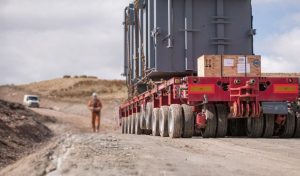
Moving industrial machinery is rarely as simple as transporting ordinary equipment from one location to another. Large generators, transformers, turbines, reactors, pressure vessels, production modules, and other industrial components can weigh hundreds or thousands of tonnes while also having unusual dimensions and sensitive load-bearing points.
This is where SPMTs are used to move industrial machinery in situations where conventional trucks, trailers, or lifting equipment may not provide the required combination of capacity, maneuverability, and positioning control.
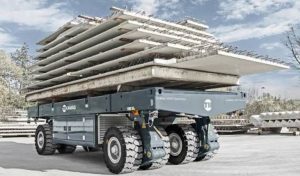
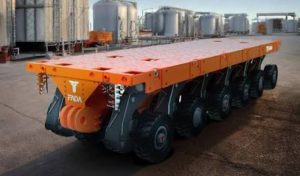
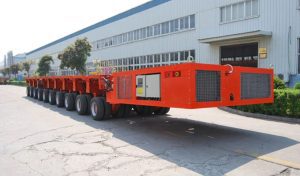
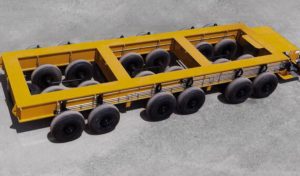
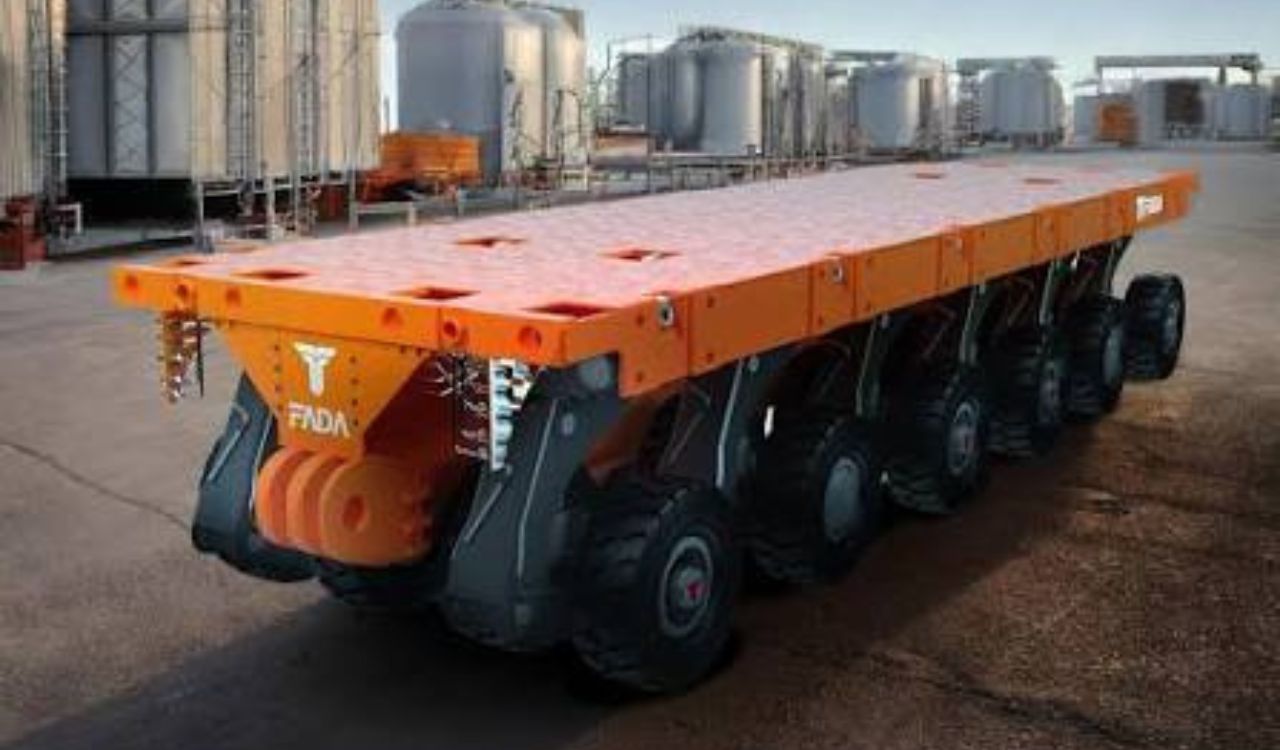
A Self-Propelled Modular Transporter (SPMT) is a motorized, multi-axle platform with hydraulic suspension, steering, and propulsion systems. Multiple SPMT modules can be connected longitudinally, transversely, or in customized arrangements to create a transporter suited to a particular load. FHWA describes SPMTs as computer-controlled multi-axle platforms capable of carrying and precisely positioning very large loads.
What Is an SPMT?
A Self-Propelled Modular Transporter is a specialized heavy-haul platform designed to transport and position extremely heavy or oversized loads.
Unlike a conventional trailer that normally requires a tractor unit for propulsion, an SPMT has its own power and hydraulic drive system. Its modules contain multiple axle lines, wheels, hydraulic suspension components, steering systems, and control equipment.
SPMT modules can be connected to increase the overall:
- Payload capacity
- Platform length
- Platform width
- Number of axle lines
- Number of wheels
- Load-bearing points
Manufacturers offer different axle-line configurations and module sizes. For example, TII SCHEUERLE describes SPMTs that can be configured with different numbers of axle lines and connected in longitudinal or transverse arrangements.
This modularity is particularly useful when industrial machinery has an unusual footprint or when the load must be supported at specific structural points.
Why Are SPMTs Used to Move Industrial Machinery?
Industrial machinery often presents several transportation challenges simultaneously.
The equipment may be:
- Extremely heavy
- Oversized
- Tall
- Wide
- Long
- Difficult to lift
- Sensitive to vibration or inclination
- Supported at specific points
- Located inside a restricted industrial facility
Traditional transportation equipment may not have enough capacity or maneuverability for these conditions.
SPMTs address these challenges through a combination of modular construction, hydraulic suspension, independent steering, self-propulsion, and computerized control.
Enerpac, for example, identifies generators, reactors, generator turbines, transformers, wind-turbine components, and bridge modules among applications for SPMTs.
How SPMTs Move Industrial Machinery
The movement of industrial machinery with an SPMT generally involves several engineering and operational stages.
1. Surveying the Machinery
Before the transporter is selected, engineers need information about the machinery being moved.
Important data includes:
- Total weight
- Length
- Width
- Height
- Center of gravity
- Approved lifting or support points
- Structural limitations
- Load-bearing areas
- Required destination
- Required orientation
- Available clearance
The center of gravity is especially important because an unevenly distributed load can produce different wheel and axle reactions.
2. Designing the SPMT Configuration
The SPMT configuration is then selected according to the load and route.
Modules may be arranged:
- End-to-end
- Side-by-side
- In wider combinations
- Around specific support points
- In customized arrangements
The objective is to distribute the machinery’s weight across an appropriate number of axle lines while maintaining the required stability and maneuverability.
TII SCHEUERLE notes that its SPMT modules can be coupled in transverse and longitudinal directions, allowing payloads and platform dimensions to be scaled according to the transport requirement.
3. Positioning the SPMT Under the Load
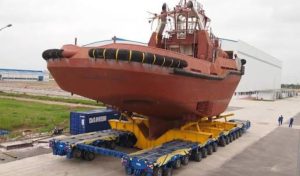
One of the major advantages of an SPMT is its ability to drive beneath loads that are already supported on suitable structures.
Depending on the project arrangement, the SPMT can be positioned beneath:
- Machinery skids
- Heavy-duty supports
- Transport frames
- Pallets
- Temporary support structures
The hydraulic suspension can then be used to raise the transporter platform and transfer the load onto the SPMT.
This method can reduce the need to lift an entire machine with a conventional crane when site conditions make a direct lift impractical.
4. Lifting the Machinery With Hydraulic Suspension
SPMTs use hydraulic suspension systems that allow controlled vertical movement.
After positioning the transporter under the machinery, hydraulic cylinders can raise the deck to the required height.
The system can also compensate for variations in terrain and help maintain a controlled platform position during movement.
Some SPMT manufacturers describe substantial hydraulic axle compensation, allowing the transporter to negotiate uneven surfaces while maintaining controlled load distribution.
5. Moving the Load
Once the machinery is supported, the SPMT moves under its own power.
The operator controls movement through the SPMT control system, which coordinates propulsion, steering, hydraulic suspension, and other operating functions.
Depending on the system, SPMTs can move:
- Forward
- Backward
- Sideways
- Diagonally
- Around a central point
- Through tight turns
This makes them particularly useful inside industrial facilities where a conventional tractor and trailer combination may have limited turning space.
6. Positioning the Machinery
SPMT operations are not limited to simply transporting equipment.
They can also be used for final positioning.
The transporter can maneuver the machinery into a precise location and then lower it onto its final supports.
This capability is important in applications such as:
- Plant installation
- Equipment replacement
- Generator positioning
- Transformer installation
- Refinery construction
- Shipyard assembly
- Industrial plant relocation
Mammoet notes that SPMTs can provide highly precise movement and positioning of heavy loads and can be configured into large platforms by connecting modules side-by-side or head-to-tail.
Main SPMT Features Used in Machinery Transportation
| Feature | Function in Industrial Machinery Transport |
| Modular axle lines | Allows transporter capacity and dimensions to be configured |
| Hydraulic suspension | Supports load distribution and controlled deck movement |
| Independent steering | Improves maneuverability in restricted areas |
| Power Pack Unit | Provides propulsion and hydraulic power |
| Computerized control | Coordinates steering, movement, and other transporter functions |
| Low deck height | Helps position the transporter under supported machinery |
| Multiple modules | Allows larger loads to be supported |
| Multi-directional steering | Enables movement in confined industrial spaces |
| Hydraulic leveling | Helps maintain controlled platform height |
| Load monitoring | Helps operators manage wheel and axle loads |
Types of Industrial Machinery Moved by SPMTs
The range of machinery suitable for SPMT transportation is broad.
Generators
Large generators used in power plants and industrial facilities can be extremely heavy and difficult to move using conventional equipment.
An SPMT can distribute the generator’s weight across numerous axle lines while providing controlled movement through the facility.
Transformers
Power transformers are another important application.
Transformers can have large dimensions and high weights, while their final positioning may require careful control around foundations, electrical infrastructure, and other plant equipment.
SPMTs can be configured to match the transformer’s support points and available movement area.
Turbines
Gas turbines, steam turbines, and related power-generation equipment may require specialized transportation during:
- New plant construction
- Major maintenance
- Equipment replacement
- Plant expansion
- Machinery relocation
The SPMT can transport the equipment from an unloading area to the required installation location.
Reactors and Pressure Vessels
Petrochemical and process industries use large reactors, columns, vessels, and other fabricated components.
These structures can have a high center of gravity or unusual dimensions, making route planning and load distribution particularly important.
Industrial Modules
Modern plants increasingly use modular construction.
Large sections of a plant can be fabricated away from the final installation location and transported as complete modules.
SPMTs can move these modules from fabrication yards to:
- Construction sites
- Assembly areas
- Quaysides
- Installation zones
- Industrial plants
Heavy Manufacturing Equipment
SPMTs can also be used to move large manufacturing equipment such as:
- Presses
- Heat exchangers
- Large machine tools
- Mining equipment
- Steel-processing equipment
- Industrial furnaces
- Production modules
Wheelift, for example, identifies very heavy manufacturing equipment such as mining trucks, steam and turbine generators, and heat exchangers among applications for self-propelled transporters.
How SPMT Load Distribution Works
Load distribution is one of the most important engineering considerations in an SPMT operation.
Instead of concentrating the entire machinery weight on a small number of wheels or axles, the transporter uses many axle lines to distribute the load.
The basic concept can be represented as:
Total supported load = sum of the loads carried by the individual axle lines
However, real-world load distribution is more complex because it depends on:
- Machinery center of gravity
- Support-point locations
- Number of axle lines
- Hydraulic suspension
- Ground conditions
- Transporter geometry
- SPMT configuration
- Inclination
- Dynamic operating conditions
Hydraulically connected axle systems can help distribute pressure across the transporter and ground. TII SCHEUERLE describes hydraulic axle compensation as a mechanism for distributing pressure and managing uneven terrain.
Steering Modes Used for Industrial Machinery
One of the defining characteristics of SPMTs is their steering flexibility.
Different steering modes can be selected according to the required movement.
Longitudinal Steering
The transporter moves primarily forward or backward.
This is useful when the route resembles a conventional transport path.
Transverse Steering
The SPMT can move sideways.
This can be useful when positioning machinery next to a foundation or inside a restricted industrial area.
Diagonal Steering
Diagonal movement allows the transporter to approach a target from an angle.
Carousel Steering
The transporter can rotate around a defined center point.
This is particularly useful when machinery needs to be turned within a limited area.
Individual Wheel Steering
Different axle lines can be controlled to achieve specialized movement patterns.
Modern SPMT systems can provide multiple steering modes, including longitudinal, transverse, diagonal, circular, and all-wheel steering.
SPMT vs. Conventional Trailer for Industrial Machinery
A conventional heavy-haul trailer remains useful for many machinery transportation projects, particularly where road transportation is required.
However, SPMTs provide different capabilities for on-site movement.
| Factor | SPMT | Conventional Heavy Trailer |
| Propulsion | Self-propelled | Usually tractor-powered |
| Modular configuration | Highly configurable | Depends on trailer type |
| Steering | Multi-directional | Primarily road-oriented |
| Tight-space maneuvering | Excellent capability | More limited |
| Sideways movement | Available on suitable systems | Generally limited |
| Hydraulic suspension | Integrated into many SPMT designs | Depends on trailer |
| On-site positioning | Highly suited | More dependent on tractor/trailer geometry |
| Long road transportation | Not normally the primary use | Common application |
| Industrial plant movement | Strong application | Depends on access and equipment |
| Final positioning | Highly precise | More limited |
This distinction is important when comparing an SPMT with equipment such as a multiwheeler, hydraulic modular trailer, or other heavy-haul trailer.
SPMT vs. Modultrailer
A modultrailer and an SPMT may both use modular axle-line concepts, but they should not automatically be treated as identical equipment.
A hydraulic modular trailer normally requires an external tractor or power source for propulsion, whereas an SPMT integrates its own propulsion and control system.
The appropriate solution depends on the transport route, payload, required maneuverability, road access, project duration, and available site infrastructure.
SPMTs in Ports and Shipyards
Ports and shipyards frequently involve extremely heavy components and restricted movement areas.
SPMTs can be used to move:
- Ship sections
- Engines
- Offshore structures
- Steel modules
- Heavy machinery
- Fabricated assemblies
Their low deck configuration and multi-directional steering can be particularly useful when large components must be transferred between fabrication, storage, assembly, and loading areas.
This application differs from conventional port trailers, which may be designed for specific port logistics and road or terminal movements.
SPMTs for Plant Relocation
Industrial plant relocation is another important application.
When a factory, processing facility, or production line is being expanded or relocated, individual machines may need to be moved without dismantling them completely.
An SPMT can potentially:
- Approach the machinery.
- Position its modules beneath the designated support points.
- Raise the machinery hydraulically.
- Transport it through the facility.
- Navigate around obstacles.
- Position it at the new location.
- Lower it onto the prepared foundation or supports.
The actual procedure depends on the machine design, support requirements, route conditions, and engineering plan.
Key Factors to Consider Before Using an SPMT
Machinery Weight
The total weight determines the required number of axle lines and overall transporter configuration.
Center of Gravity
A high or offset center of gravity can affect stability and load distribution.
Support Points
Engineers need to understand where the machinery can safely be supported.
Ground Bearing Capacity
The route must be capable of supporting the expected wheel and axle loads.
Ground conditions should be assessed before transportation begins.
Route Geometry
The engineering team should examine:
- Turning areas
- Door openings
- Building clearances
- Ramps
- Slopes
- Bridges
- Overhead utilities
- Underground services
- Floor loading
- Obstacles
Deck Height
A low deck can be important when moving machinery through buildings or beneath existing structures.
Clearance
The complete machinery-plus-transporter height and width should be evaluated rather than considering the transporter dimensions alone.
Environmental Conditions
Weather, surface contamination, rain, dust, temperature, and other conditions can affect the transport operation.
Benefits of Using SPMTs for Industrial Machinery
High Load Capacity
Multiple axle lines can be combined to create a transporter configuration appropriate for very heavy machinery.
Flexible Configuration
Modules can be connected to match the size and support requirements of different loads.
Precise Maneuvering
Multi-directional steering provides control in areas where conventional trailers may have difficulty maneuvering.
Self-Propelled Operation
The integrated power system reduces dependence on a conventional tractor during on-site movement.
Hydraulic Load Management
Hydraulic suspension helps manage platform height and axle compensation.
Reduced Dependence on Fixed Transport Paths
SPMTs are particularly valuable for controlled on-site transportation where conventional road trailers are difficult to use.
Precise Final Positioning
The transporter can move equipment into tight installation locations rather than stopping only at a general unloading area.
Limitations of SPMT Machinery Transportation
SPMTs are powerful transport systems, but they are not suitable for every project.
Important limitations include:
- High equipment and engineering requirements
- Need for detailed route planning
- Significant ground-loading considerations
- Specialized operators
- Restricted travel speed
- Dependence on suitable ground conditions
- Complex configuration requirements
- Need for adequate clearance
- Requirement for professional load-support engineering
SPMTs are generally associated with on-site heavy transport rather than ordinary long-distance highway hauling. Mammoet describes SPMTs primarily as equipment for on-site transportation over limited distances.
Safety and Planning Best Practices
A successful SPMT machinery move begins before the transporter arrives at the site.
Complete a Load Assessment
Confirm the machinery’s:
- Weight
- Dimensions
- Center of gravity
- Support points
- Structural limitations
Engineer the Transport Configuration
Determine the number and arrangement of axle lines required for the planned load.
Survey the Route
Check the entire route for:
- Ground capacity
- Slopes
- Turning space
- Overhead clearance
- Door dimensions
- Underground utilities
- Obstacles
- Surface condition
Verify SPMT Condition
Inspect:
- Tires or wheels
- Hydraulic systems
- Steering systems
- Axle lines
- Power Pack Unit
- Control systems
- Emergency systems
Establish Communication
Everyone involved in the move should understand the communication protocol, movement sequence, stop commands, and exclusion zones.
Conduct a Controlled Test
Where appropriate, a controlled initial movement can help confirm transporter behavior, clearances, load distribution, and route conditions before continuing the full operation.
Monitor the Operation
Operators and engineering personnel should monitor the transporter and load throughout the move.
SPMT control systems can provide information relating to parameters such as steering, hydraulic pressure, load distribution, and wheel alignment, depending on the equipment design.
SPMTs in Construction and Infrastructure Projects
Although industrial machinery is a major application, SPMTs are also used for large structural components.
Examples include:
- Bridge sections
- Building modules
- Steel structures
- Wind-energy components
- Offshore structures
- Large fabricated assemblies
FHWA has documented SPMT use for moving complete bridge structures, including transporting bridge spans into position and removing the transporter after placement.
This demonstrates how the same combination of modular capacity, hydraulic control, and precise steering can be applied beyond industrial machinery.
The Role of Construction Chemicals in Industrial Projects
Industrial machinery transportation often forms part of a larger construction or infrastructure project. Once equipment is positioned, the surrounding structure may require concrete designed for specific strength, workability, durability, waterproofing, or corrosion-resistance requirements.
Shiyun trailers supplies construction chemical and concrete admixture solutions for applications where these performance characteristics are required. Its product range includes water-reducing, slump-retaining, expansion, waterproofing, and corrosion-inhibiting technologies.
The connection is therefore primarily at the project level: SPMTs can help position heavy industrial equipment, while appropriate concrete admixtures can contribute to the performance requirements of the supporting infrastructure.
What About Semi Trailer Leasing Prices?
Semi trailer leasing prices are determined by factors such as trailer type, capacity, lease duration, location, maintenance arrangements, and market conditions.
However, conventional semi-trailer leasing should not be used as a direct comparison for SPMT project costs.
SPMT operations involve specialized self-propelled equipment, modular axle configurations, hydraulic suspension, steering systems, engineering, route assessment, and specialized operation. The appropriate equipment should therefore be selected according to the actual machinery-moving requirements rather than comparing equipment solely by leasing price.
Frequently Asked Questions
What types of industrial machinery can SPMTs move?
SPMTs can transport many types of large and heavy equipment, including generators, transformers, turbines, reactors, pressure vessels, heat exchangers, industrial modules, mining equipment, and large manufacturing machinery. The suitability of an SPMT depends on the machinery’s weight, dimensions, center of gravity, support points, and route requirements.
How does an SPMT lift industrial machinery?
An SPMT can be positioned underneath a load supported on suitable structures. Its hydraulic suspension system can then raise the platform and transfer the load onto the transporter. The exact lifting procedure depends on the equipment design, support arrangement, and engineered transport plan.
Can SPMTs move machinery sideways?
Yes. Depending on the SPMT’s steering system and configuration, it can perform transverse, diagonal, circular, or other specialized movements. These capabilities are particularly useful when machinery must be positioned inside restricted industrial spaces.
How are SPMTs different from conventional trailers?
An SPMT is self-propelled and uses multiple independently controlled axle lines, hydraulic suspension, and specialized steering. Conventional trailers generally rely on a tractor for propulsion and are primarily designed around road transportation. SPMTs are particularly suited to controlled on-site movement and precise positioning.
Are SPMTs suitable for moving machinery inside factories?
Yes. Their low platform height, modular configuration, hydraulic suspension, and multi-directional steering can make them suitable for moving large equipment through industrial plants, provided the floor loading, clearances, route geometry, and other engineering requirements have been assessed.
How is the correct number of SPMT axle lines determined?
The configuration is determined from the machinery’s total weight, weight distribution, support points, center of gravity, allowable axle loads, ground conditions, and transporter specifications. A qualified engineering team should develop and verify the configuration rather than selecting axle lines based only on total weight.
Are SPMTs used for long-distance road transportation?
SPMTs are primarily associated with heavy on-site transportation and positioning. For longer highway movements, conventional heavy-haul combinations may be more appropriate, depending on the load and applicable transport requirements.
Conclusion
SPMTs are used to move industrial machinery when a project requires a combination of high load capacity, flexible configuration, controlled steering, hydraulic suspension, and precise positioning.
Generators, transformers, turbines, reactors, pressure vessels, industrial modules, and heavy manufacturing equipment can present transportation challenges that conventional trailers cannot always address efficiently. By combining multiple axle lines into a purpose-designed platform, an SPMT can distribute heavy loads while providing controlled movement through industrial facilities and construction sites.
The success of an SPMT operation ultimately depends on engineering rather than equipment capacity alone. Machinery weight, center of gravity, support points, ground conditions, route geometry, clearances, transporter configuration, hydraulic systems, and operating procedures all need to be considered before movement begins.
For industrial buyers, contractors, manufacturers, and project engineers, the key is to select an SPMT configuration based on the complete transport requirement rather than treating the transporter as a standard trailer.