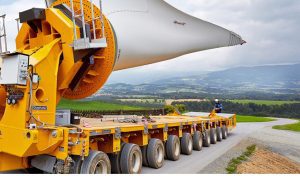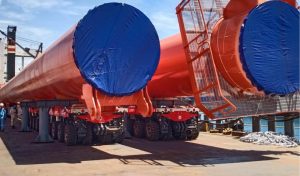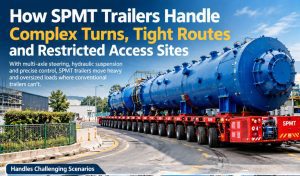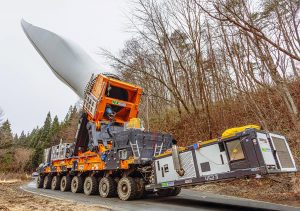
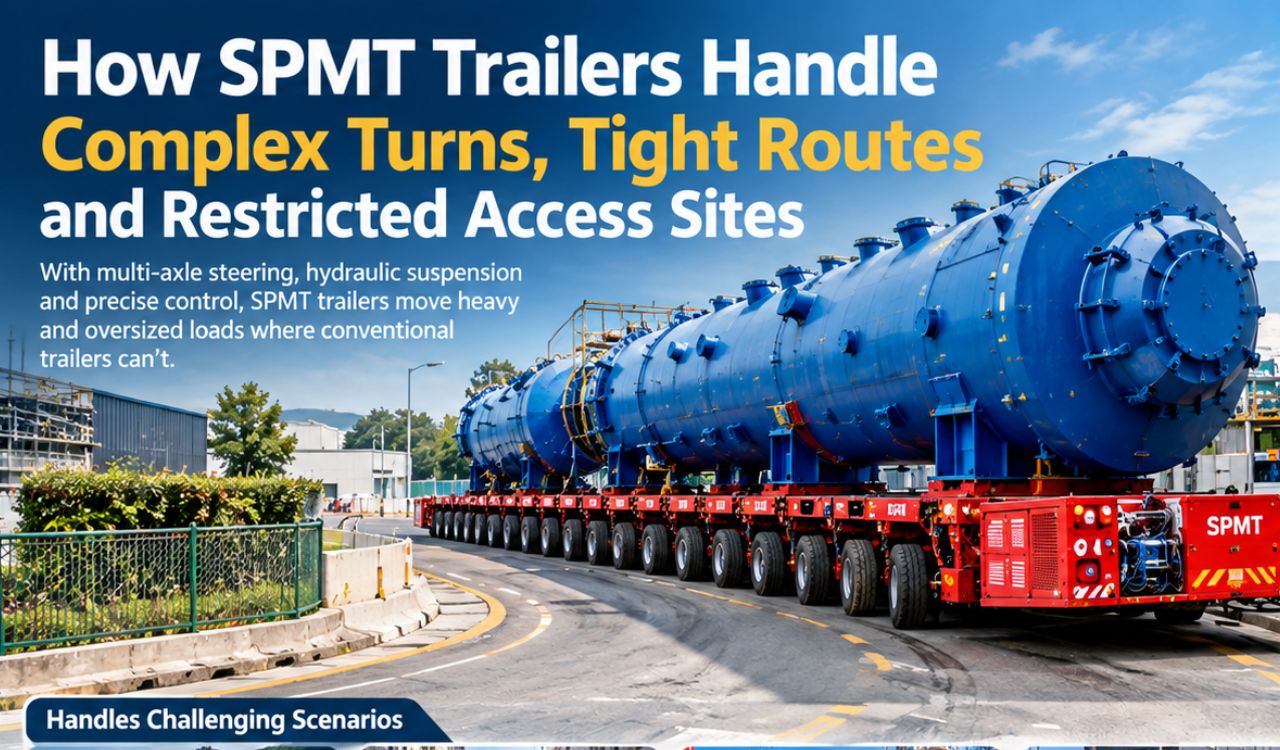
Transporting extremely heavy and oversized equipment can become challenging when the route includes sharp turns, narrow roads, confined industrial areas, or restricted access points. Large transformers, pressure vessels, bridge sections, industrial modules, generators, and other heavy components often cannot be moved efficiently with conventional trailers in these environments.
This is where an SPMT trailer a special one can provide significant advantages. Self-Propelled Modular Transporters (SPMTs) are designed for moving exceptionally heavy and oversized loads while providing precise steering and maneuverability. Their modular axle configuration, independent steering capabilities, hydraulic suspension, and controlled movement allow transport teams to handle complex routes that may be difficult for conventional heavy-haul equipment.
Understanding how SPMT systems manage difficult turns and restricted spaces helps explain why they are widely used for demanding industrial and infrastructure transportation projects.
What Is an SPMT Trailer?
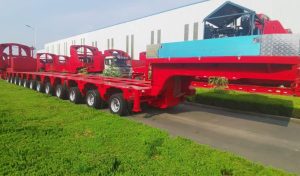
An SPMT, or Self-Propelled Modular Transporter, is a specialized heavy transport system made up of multiple axle lines that can be combined into different configurations. These systems are designed to move exceptionally heavy and oversized loads in environments where conventional trailers may not provide sufficient maneuverability or positioning control.
Unlike a conventional trailer that normally requires a tractor unit to pull it, an SPMT has its own propulsion system. Operators can control the transporter electronically, allowing it to move and position very heavy loads with a high degree of precision. Because SPMTs can carry substantial loads and operate in complex environments, proper planning, equipment inspection, and operator competence are essential parts of safe operation.
The modular design also means that the number and arrangement of axle lines can be adjusted according to the project’s requirements. An SPMT configuration may be selected based on factors such as:
- Load weight
- Load dimensions
- Center of gravity
- Required ground pressure
- Route conditions
- Turning requirements
- Available space
- Final positioning requirements
These considerations are closely connected to spmt safety standards and operator certification. Before an SPMT operation begins, the equipment configuration, load distribution, steering behavior, braking system, travel route, ground conditions, and emergency procedures should be assessed according to the applicable site and regulatory requirements.
Operator certification and training are equally important. SPMT operators need to understand the transporter’s control systems, steering modes, load characteristics, operating limitations, communication procedures, and site-specific safety requirements. Depending on the country, industry, employer, and project, the required qualifications may differ, so operators should follow the applicable regulations and company procedures rather than relying on a single universal certification standard.
This combination of appropriate equipment configuration, documented operating procedures, competent personnel, and effective supervision helps reduce operational risks. It also makes SPMTs particularly useful for specialized heavy transport operations involving industrial plants, infrastructure projects, construction sites, shipyards, and other locations where precise movement of oversized loads is required.
Why Complex Turns Are Difficult for Heavy Transport
A large load does not behave like a normal vehicle when it travels through a turn.
The overall length and width of the load can create a large swept path. During a turn, different parts of the load may move significantly outside the path followed by the transporter itself.
This can create challenges around:
- Buildings
- Walls
- Roadside structures
- Utility poles
- Pipelines
- Trees
- Bridges
- Other industrial equipment
A conventional trailer may require a large turning area to negotiate these obstacles.
An SPMT’s steering flexibility can reduce some of these limitations by allowing the transporter to follow more controlled movement patterns.
How SPMT Steering Improves Maneuverability
One of the most important features of an SPMT is its multi-axle steering system.
The wheels across the axle lines can be coordinated electronically according to the selected steering mode. This means the transporter can perform different types of movements depending on the route.
Common movement capabilities can include:
- Straight-line movement
- Conventional turning
- Tight-radius turning
- Diagonal movement
- Sideways movement
- Controlled rotational movement
The exact steering functions depend on the specific SPMT system and manufacturer.
This level of control gives operators more options when navigating confined areas.
Handling Tight Turns
Sharp turns are common on industrial sites, construction projects, ports, and infrastructure routes.
For example, an SPMT may need to move a large transformer through an industrial facility where a building wall prevents a conventional trailer from taking a wide turning path.
By coordinating the steering angles of its axle lines, the SPMT can make a controlled turn within a more restricted area.
The transporter does not simply follow the path of a towing vehicle. Instead, its steering system actively controls the movement of the multiple axle lines.
This can significantly improve maneuverability during complex transportation operations.
Sideways Movement in Restricted Areas
Another useful capability of many SPMT systems is lateral or sideways movement.
Instead of only traveling forward or backward, the transporter can be configured to move laterally under appropriate operating conditions.
This can be particularly useful during final positioning.
For example, after moving a heavy piece of equipment into an industrial building, the transporter may need to shift the load sideways to align it with a foundation or installation location.
With conventional trailers, achieving this type of positioning may require multiple repositioning operations or additional equipment.
SPMT systems can provide more direct control over these movements.
Navigating Restricted Access Sites
Some heavy transport projects take place in environments where space is extremely limited.
Examples include:
Power Plants
Power plants often contain large equipment, pipelines, structures, and restricted internal roads. SPMTs can be used to move heavy components through these confined areas.
Refineries and Petrochemical Facilities
Refineries can contain complex networks of pipes, vessels, buildings, and access routes. Precise transporter control can be valuable when navigating these environments.
Shipyards
Shipyard projects may require large components to be moved through areas containing cranes, vessels, buildings, and other equipment.
Construction Sites
Construction areas frequently have temporary roads, uneven surfaces, restricted entrances, and changing site conditions.
Ports
Heavy loads moving through ports may need to negotiate narrow access areas and work around existing infrastructure.
Hydraulic Suspension and Uneven Surfaces
Steering is only one part of SPMT maneuverability.
Hydraulic suspension is also important because heavy transport routes are not always perfectly level.
SPMT hydraulic suspension systems can help maintain controlled support for the load while the transporter moves across variations in the surface.
The system can compensate for certain changes in ground level and help keep the load platform at an appropriate height.
This is particularly important when transporting loads with a high center of gravity or sensitive structural components.
Managing Load Stability During Turns
A heavy load must remain stable throughout the entire transportation process.
During a turn, forces acting on the load can change. Factors such as speed, center of gravity, load height, axle configuration, and surface conditions can influence stability.
For this reason, operators generally use controlled speeds when navigating complex turns.
Transport engineers also consider the load’s center of gravity when determining the appropriate SPMT configuration.
A higher center of gravity can require additional attention because the load may experience greater movement during steering, acceleration, or braking.
Route Planning Before SPMT Transport
Although SPMTs provide advanced maneuverability, they do not eliminate the need for detailed route planning.
A heavy transport project should be evaluated before movement begins.
Engineers and transport planners may assess:
- Road width
- Turning radius
- Swept path
- Overhead clearance
- Ground bearing capacity
- Bridge limitations
- Underground utilities
- Obstacles
- Entry and exit points
- Load dimensions
- Load weight
- Center of gravity
Route surveys and computer-based simulations can also help identify difficult sections before the actual transportation operation begins.
Why Speed Control Matters
Speed is particularly important when an SPMT is negotiating a difficult route.
Moving too quickly through a turn can increase dynamic forces and make precise positioning more difficult.
Controlled movement gives the operator more time to monitor clearances and respond to changing conditions.
The appropriate operating speed depends on the equipment, load, route, site conditions, and project-specific procedures.
Final Positioning of Heavy Loads
One of the biggest advantages of SPMT technology is its ability to perform precise final positioning.
Some industrial components must be placed within a very specific area. The installation location may leave only a small amount of clearance around the load.
After reaching the general installation area, the SPMT can perform carefully controlled movements to align the load with its final position.
This can reduce the need for repeated lifting or repositioning operations, depending on the project design.
SPMT Trailers vs. Conventional Heavy-Haul Trailers
Conventional heavy-haul trailers remain useful for many transportation applications. However, their maneuverability can become limited when routes contain very tight turns or restricted access points.
SPMT systems offer several characteristics that make them particularly suitable for complex environments:
| Feature | SPMT System | Conventional Trailer |
| Self-propelled movement | Yes | Usually requires tractor |
| Multi-axle steering | Yes | More limited |
| Sideways movement | Possible | Generally limited |
| Modular configuration | Yes | Depends on trailer |
| Precise positioning | High | More limited |
| Restricted-site maneuverability | Excellent | Depends on route |
The best transportation solution depends on the load and project requirements. SPMTs are particularly valuable when precise control and maneuverability are major priorities.
Key Factors for Successful SPMT Operations
Successful SPMT transportation requires more than selecting a suitable transporter.
Important considerations include:
- Accurate load information — Weight and dimensions should be confirmed before planning.
- Center of gravity assessment — The load’s weight distribution affects stability.
- Detailed route survey — Obstacles, clearances, and turning areas should be identified.
- Correct SPMT configuration — Axle lines should be selected according to the project.
- Ground assessment — Roads and surfaces must be capable of supporting the required loads.
- Steering planning — Appropriate steering modes should be established for difficult sections.
- Controlled operation — Operators should follow the approved movement plan.
- Weather monitoring — Environmental conditions can affect certain heavy transport operations.
Conclusion
SPMT trailers provide a highly flexible solution for moving oversized and extremely heavy loads through complex transportation environments. Their multi-axle steering, modular configuration, hydraulic suspension, self-propelled operation, and precise control make them particularly suitable for tight turns, restricted access sites, and challenging industrial routes.
However, advanced maneuverability does not replace proper engineering. Load calculations, route surveys, ground assessments, steering plans, clearance checks, and experienced operators are all important parts of a successful SPMT transport operation.
When these factors are considered together, SPMT technology can provide the control and flexibility required for some of the most demanding heavy transport projects.
Frequently Asked Questions
1. What is an SPMT trailer used for?
An SPMT trailer is used to transport extremely heavy and oversized loads such as transformers, generators, industrial modules, bridge sections, pressure vessels, and other large equipment.
2. Can an SPMT handle tight turns?
Yes. SPMTs are designed with multi-axle steering systems that allow them to perform controlled turns and maneuver through relatively restricted areas.
3. Can an SPMT move sideways?
Many SPMT systems can perform lateral movement by coordinating the steering angles of their axle lines. This capability can be useful for precise positioning in confined areas.
4. Why are SPMTs suitable for restricted access sites?
Their modular design, self-propelled operation, multi-axle steering, and precise control allow SPMTs to maneuver in environments where conventional trailers may have difficulty.
5. How does hydraulic suspension help an SPMT?
Hydraulic suspension helps maintain controlled support for the load and can accommodate certain variations in the supporting surface while the transporter is moving.
6. What factors affect SPMT stability during a turn?
Important factors include load weight, center of gravity, load height, axle configuration, steering angle, speed, and ground conditions.
7. Is route planning necessary for SPMT transportation?
Yes. Detailed route planning is essential. Engineers typically assess road geometry, ground capacity, clearances, obstacles, turning areas, and the characteristics of the transported load.
8. Can SPMTs precisely position heavy equipment?
Yes. Their controlled steering and movement capabilities make them useful for accurately positioning large equipment at construction, industrial, and installation sites.