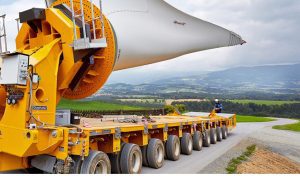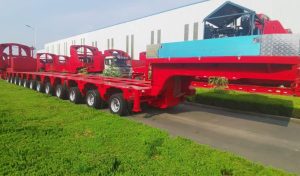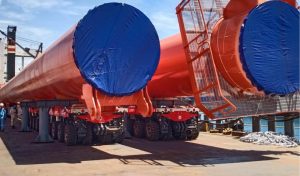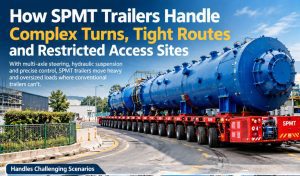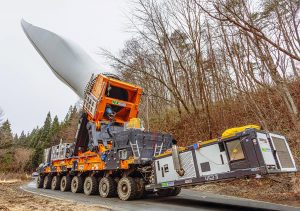
Transporting extremely heavy and oversized loads requires more than high load capacity. In many projects, the biggest challenge is maneuvering the load through narrow roads, industrial facilities, construction sites, ports, and other restricted environments. This is especially important when moving large structural components such as bridge girders, where precise positioning and controlled movement are often required.
This is where SPMT trailer steering modes become particularly important. Self-Propelled Modular Transporters (SPMTs) use multiple independently controlled axle lines to provide a high level of steering flexibility. Instead of relying only on the steering system of a tractor unit, an SPMT can coordinate the movement of its axle lines to follow different travel paths. This makes an SPMT a useful solution for projects involving a girder transporter, particularly when heavy bridge girders or other oversized structural components need to be moved through confined areas.
This capability allows heavy transport teams to handle complex turns, lateral movements, tight positioning, and other challenging maneuvers with greater precision. Depending on the project requirements, different steering modes can help the transporter move forward, backward, diagonally, or rotate within a limited space, making SPMT systems highly adaptable for demanding heavy-haul and infrastructure applications.
What Is an SPMT Trailer?
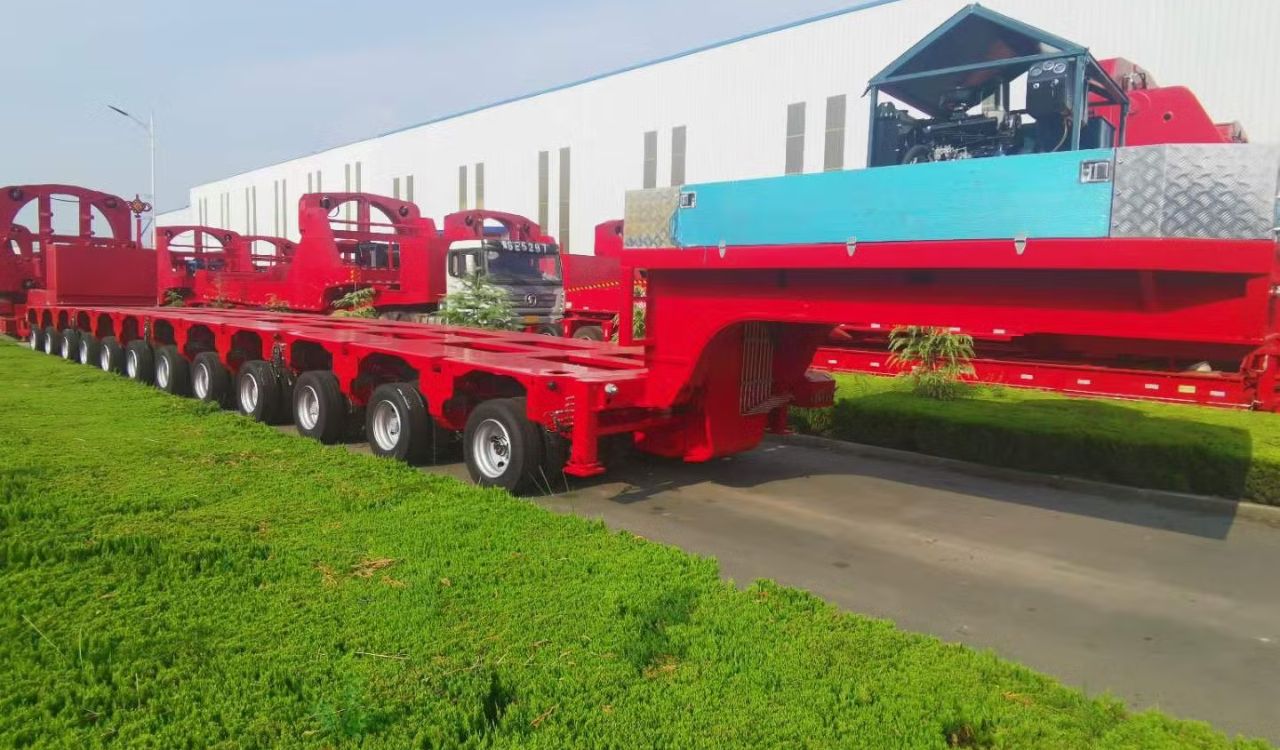
An SPMT, or Self-Propelled Modular Transporter, is a modular heavy transport system designed to move large and exceptionally heavy loads.
SPMT modules consist of multiple axle lines and are equipped with their own propulsion, steering, suspension, and control systems.
Different modules can be connected to create a transporter configuration suitable for a particular load.
SPMTs are commonly used for transporting equipment such as:
- Power transformers
- Generators
- Pressure vessels
- Industrial modules
- Bridge sections
- Large machinery
- Offshore structures
- Construction components
The modular nature of the system provides flexibility in both load capacity and maneuverability.
How SPMT Steering Works
The steering system is one of the defining features of an SPMT.
Multiple axle lines can be electronically controlled so that their wheels turn according to the selected steering mode. The control system coordinates these movements to produce the desired direction of travel.
Instead of having one steering axle at the front, as is common with many conventional vehicles, an SPMT can control steering across a much larger portion of its structure.
This gives operators significantly more control over the movement of an oversized load.
The exact steering modes available can vary according to the SPMT manufacturer, model, and control system.
Common SPMT Trailer Steering Modes
Different steering modes are used depending on the route and movement requirements.
Some of the most common movement patterns include conventional steering, transverse movement, diagonal movement, and rotational or tight-turning operations.
1. Conventional Steering
Conventional steering is similar to the movement of a standard vehicle.
The wheels are positioned so the SPMT can travel forward or backward while following a normal curved path.
This mode is suitable for relatively straightforward routes where there is enough space for the transporter to make gradual turns.
It is often used during normal movement between different areas of a project site.
2. Transverse or Sideways Steering
One of the most useful capabilities of an SPMT is lateral movement.
By adjusting the steering angles of its axle lines, the transporter can move sideways under appropriate operating conditions.
This is particularly useful when a heavy load needs to be positioned close to a building, foundation, machine, or other fixed structure.
For example, an SPMT may transport a large industrial module into a facility and then move laterally to align it with its final installation position.
This type of movement would be difficult to achieve with a conventional tractor-trailer combination.
3. Diagonal Movement
Diagonal steering allows the SPMT to move at an angle rather than traveling directly forward, backward, or sideways.
This can provide additional flexibility when navigating restricted areas.
A diagonal movement can help the transporter adjust its position relative to a structure or follow a route where the available space does not align directly with the travel direction.
It can also be useful during final positioning operations.
4. Tight Turning
SPMT systems can be configured to perform controlled tight turns by coordinating the steering angles across multiple axle lines.
This can reduce the turning space required compared with a conventional trailer.
Tight turning can be useful at:
- Industrial facilities
- Power plants
- Construction sites
- Shipyards
- Ports
- Refineries
- Manufacturing facilities
The ability to make controlled turns is especially important when the load is much wider or longer than the transporter itself.
5. Rotational Movement
Certain SPMT configurations can perform controlled rotational movements.
This allows the transporter to change the orientation of the load within a confined area.
Such movement can be particularly valuable when a large piece of equipment needs to be aligned with a foundation or installation location.
The exact rotational capability depends on the SPMT system and its control configuration.
Why Multi-Axle Steering Improves Maneuverability
The main advantage of multi-axle steering is that the transporter can control the direction of numerous axle lines rather than relying on a single conventional steering arrangement.
Each axle line contributes to the overall steering geometry.
The control system coordinates the individual wheel movements to produce the selected travel path.
This can provide:
- Smaller turning paths
- Greater positioning accuracy
- Better control in confined areas
- More flexible movement options
- Improved route adaptability
These characteristics make SPMTs particularly valuable for complex heavy transport projects.
Steering Modes and Restricted Access Sites
Restricted access is one of the situations where SPMT steering technology becomes especially useful.
Industrial facilities often contain permanent structures that cannot be moved to accommodate a heavy load.
These can include:
- Buildings
- Pipelines
- Storage tanks
- Columns
- Machinery
- Electrical equipment
- Walls
- Loading areas
An SPMT can use different steering modes to navigate around these obstacles while maintaining controlled movement.
However, the availability of advanced steering does not mean that every route is automatically suitable. A detailed route assessment is still required before transportation begins.
How Steering Affects the Turning Radius
Turning radius is an important consideration when moving oversized equipment.
A conventional trailer generally requires significant space to negotiate a turn because the trailer follows the movement of the towing vehicle.
An SPMT can use coordinated steering across its axle lines to create a different turning path.
This can allow the transporter to negotiate tighter curves.
The actual turning capability depends on several factors, including:
- SPMT configuration
- Number of axle lines
- Load dimensions
- Steering mode
- Load center of gravity
- Route width
- Surface conditions
- Required clearances
Therefore, turning performance should always be evaluated for the specific project rather than based on a generic SPMT specification.
Steering and Load Stability
Maneuverability and stability must be considered together.
When a very heavy load changes direction, forces acting on the transporter and load can change.
The load’s height, weight distribution, center of gravity, speed, and support arrangement can influence its behavior during a turn.
Operators therefore need to use appropriate steering modes and controlled speeds based on the project plan.
A highly maneuverable transporter still requires careful operation when carrying a large or high-center-of-gravity load.
The Role of Hydraulic Suspension
SPMT steering systems work alongside hydraulic suspension.
Hydraulic suspension helps maintain controlled support across the different axle lines as the transporter moves over variations in the supporting surface.
Industrial sites may contain ramps, uneven surfaces, temporary roads, or changes in elevation.
Maintaining appropriate suspension behavior helps support the load while the transporter performs steering movements.
The suspension system can therefore contribute to both load support and maneuverability.
Steering Modes During Final Positioning
SPMTs are often used not only to transport heavy equipment but also to position it accurately.
The final positioning stage can be one of the most demanding parts of a heavy transport operation.
A transformer, generator, industrial module, or other large component may need to be aligned with a foundation or installation area where only limited clearance is available.
Different steering modes can allow operators to make small and controlled adjustments.
For example, the SPMT may first move forward into the installation area, then use lateral or diagonal movement to align the load with its final position.
SPMT Steering and Route Planning
Steering mode selection should be included in the transport planning process.
Before movement begins, engineers and operators can evaluate the complete route and identify sections requiring specialized maneuvering.
Important factors include:
Road Geometry
The width, curves, intersections, and turning areas should be assessed.
Obstacles
Fixed structures should be identified along the route.
Ground Conditions
The supporting surface must be able to withstand the expected loads.
Overhead Clearance
Buildings, bridges, power lines, and other overhead structures may affect the route.
Load Dimensions
The total length and width of the load can significantly affect the swept path.
Final Position
The route should account for the space required to position the load accurately at its destination.
SPMT Steering vs. Conventional Trailer Steering
SPMTs provide a different approach to heavy transport maneuverability compared with conventional trailers.
| Feature | SPMT | Conventional Trailer |
| Independent axle steering | Yes | Generally limited |
| Self-propelled | Yes | Usually requires tractor |
| Sideways movement | Possible | Very limited |
| Diagonal movement | Possible | Limited |
| Tight turning | Excellent flexibility | More restricted |
| Precise positioning | High | More limited |
| Modular configuration | Yes | Depends on trailer type |
The choice between systems depends on the project’s weight, dimensions, route, and maneuvering requirements.
Advantages of Multi-Axle SPMT Steering
Multi-axle steering can provide several important advantages for heavy transportation.
Greater Maneuverability
The transporter can follow complex paths and operate in restricted spaces.
Precise Positioning
Controlled steering allows operators to make accurate adjustments during final placement.
Flexible Movement
Different steering patterns can be selected according to the route.
Better Use of Limited Space
Tight turning and lateral movement can reduce the space needed for certain operations.
Adaptability
Modular SPMT systems can be configured for different loads and transportation requirements.
What Determines the Best Steering Mode?
There is no single steering mode that is ideal for every transportation project.
The appropriate mode depends on the specific conditions.
Engineers and operators may consider:
- Load weight
- Load dimensions
- Center of gravity
- SPMT configuration
- Route geometry
- Ground conditions
- Available maneuvering space
- Required clearances
- Final positioning requirements
- Site-specific operating procedures
The steering strategy should be established before the heavy load begins its journey.
Conclusion
SPMT trailer steering modes are a major reason why self-propelled modular transporters can handle challenging heavy transport operations. Multi-axle steering allows the transporter to perform conventional turns, tight turns, lateral movements, diagonal movements, and other controlled maneuvers depending on the equipment and control system.
This flexibility is particularly valuable when oversized loads must travel through industrial facilities, construction sites, ports, power plants, and other locations with restricted access.
However, steering capability is only one part of a successful SPMT operation. Load distribution, center of gravity, ground conditions, route geometry, clearances, speed, and operator experience must all be considered together.
With proper engineering and planning, multi-axle SPMT steering provides the maneuverability and precision needed for many complex heavy transportation projects.
Frequently Asked Questions
1. What are SPMT trailer steering modes?
SPMT trailer steering modes are different steering configurations that control the axle lines of a Self-Propelled Modular Transporter. They allow the transporter to perform various movements depending on the route and load requirements.
2. Can an SPMT turn in a tight space?
Yes. SPMTs are designed with multi-axle steering systems that can provide tight-turning capabilities, making them suitable for many confined transportation environments.
3. Can an SPMT move sideways?
Many SPMT systems can perform lateral or sideways movement by coordinating the steering angles of their axle lines.
4. What is diagonal steering on an SPMT?
Diagonal steering allows an SPMT to move at an angle relative to its normal direction of travel. It can be useful when navigating restricted areas or making precise positioning adjustments.
5. Why is multi-axle steering important?
Multi-axle steering gives the transporter greater maneuverability because multiple axle lines can be coordinated to follow the required travel path.
6. How does SPMT steering affect load stability?
Steering changes can influence the forces acting on a heavy load. Load weight, center of gravity, height, speed, and transporter configuration should therefore be considered when selecting and operating a steering mode.
7. Can SPMTs rotate a heavy load?
Certain SPMT configurations can perform controlled rotational movements. The exact capability depends on the transporter system, configuration, and operating conditions.
8. Are all SPMT steering modes available on every transporter?
Not necessarily. Available steering and movement functions depend on the specific SPMT model, manufacturer, control system, and configuration.
9. What factors determine the correct SPMT steering mode?
Load dimensions, weight, center of gravity, route geometry, ground conditions, available space, clearance requirements, and final positioning needs can all influence steering mode selection.
10. Is route planning required before using an SPMT?
Yes. A detailed route and engineering assessment is important to determine appropriate steering modes, clearances, ground requirements, transporter configuration, and operating procedures.