Transporting extremely heavy and oversized equipment requires much more than selecting a trailer with sufficient capacity. Engineers must determine how the weight will be distributed across the transporter, how much load each axle line will carry, and whether the ground can safely support the resulting pressure.
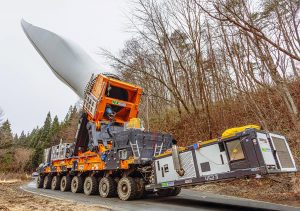
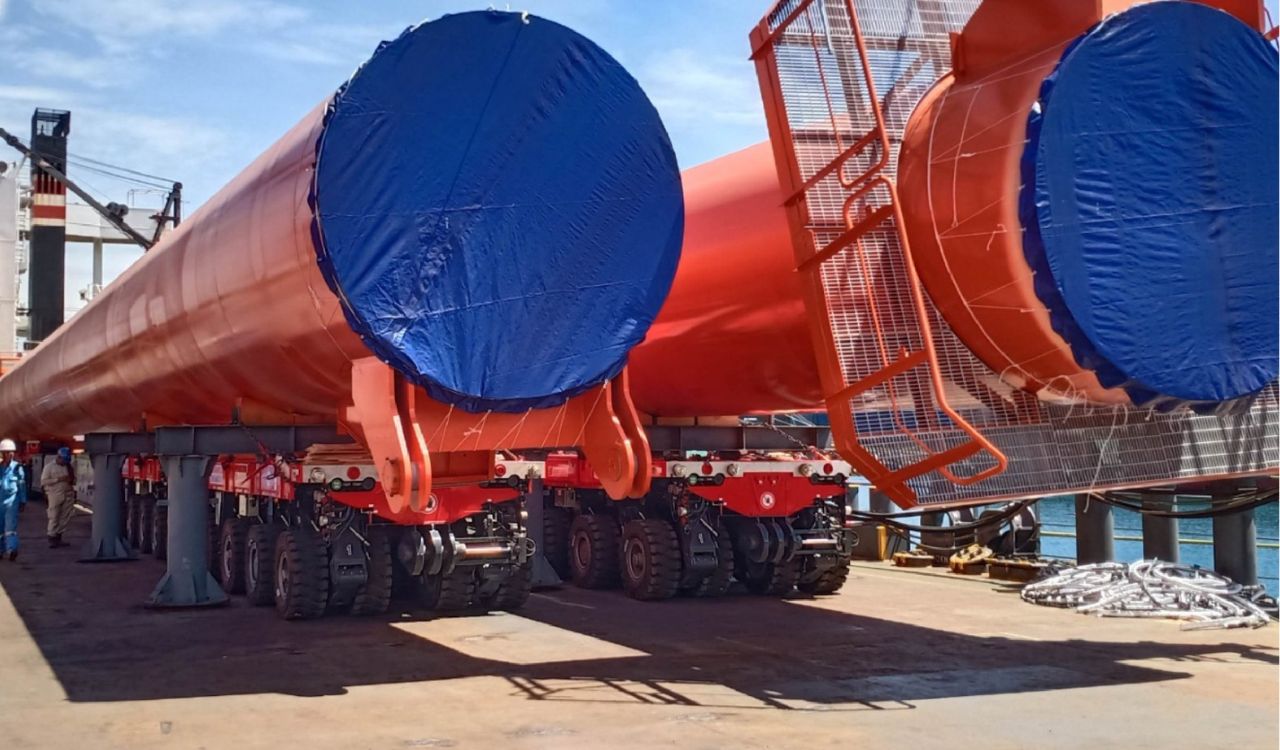
SPMT trailer load distribution is therefore an important part of heavy transport planning. Self-Propelled Modular Transporters (SPMTs) are designed with multiple axle lines that can be combined into different configurations according to the weight, dimensions, and characteristics of the transported load.
Correct load distribution helps support the equipment, manage ground pressure, improve stability, and maintain controlled movement throughout the transportation process.
What Is SPMT Trailer Load Distribution?
Load distribution describes how the weight of a transported object is transferred through the SPMT and onto the supporting surface. Proper load distribution is a fundamental consideration in safe SPMT operations because uneven loading can affect stability, axle loads, steering behavior, and ground pressure.
An SPMT consists of multiple axle lines, with each axle line supporting a portion of the overall load. When several SPMT modules are connected together, the transporter can support very large loads across a wider area. The objective is to distribute the load appropriately rather than concentrating excessive weight on a small number of axle lines.
This is particularly important when transporting:
- Transformers
- Generators
- Pressure vessels
- Industrial modules
- Bridge sections
- Large machinery
- Offshore equipment
- Construction components
Each project requires a configuration based on its specific load characteristics and route conditions. Factors such as total weight, center of gravity, axle-line arrangement, ground-bearing capacity, turning requirements, and travel path should be considered during transport planning.
Proper load distribution is also closely connected with spmt safety standards and operator certification. Operators need to understand how changes in load position, SPMT configuration, steering, acceleration, and ground conditions can influence transporter behavior. Appropriate training helps operators recognize potential hazards and operate the equipment within its specified limits.
Safety procedures may also include pre-operation inspections, verification of the SPMT configuration, communication between operators and site personnel, route assessments, and monitoring of ground conditions. Certification or qualification requirements can vary by country, employer, equipment manufacturer, and project, so operators should follow the applicable regulations and site-specific procedures.
By combining accurate load planning, suitable SPMT configuration, competent operation, and appropriate safety controls, heavy transport teams can improve stability and maintain better control when moving exceptionally large and heavy loads.
Why Axle Loads Are Important
Every SPMT component has operating limits, and the supporting surface also has limitations.
The axle load affects the forces transferred through the wheels, suspension, and ground. If the load is not appropriately distributed, certain axle lines may experience higher loads than others.
Engineers therefore consider axle loading when designing the transporter configuration.
The objective is to achieve an appropriate balance between:
- Total load weight
- Number of axle lines
- Load distribution
- Ground bearing capacity
- Transporter capacity
- Load stability
This helps create a transportation system that is suitable for the specific project.
How SPMT Load Distribution Is Calculated
At a basic level, engineers can consider the total weight of the load and the number of supporting axle lines.
For example, a load weighing 500 tonnes could theoretically be distributed across a large number of axle lines. However, actual calculations are more complex than simply dividing 500 tonnes by the number of axles.
The location of the load’s center of gravity, support points, dimensions, and SPMT configuration can all affect how the weight is transferred.
An unevenly shaped load may place significantly more weight on one section of the transporter than another.
Therefore, project-specific engineering calculations are required.
The Role of the Center of Gravity
The center of gravity is one of the most important considerations when planning SPMT transportation.
The center of gravity represents the point at which the load’s mass can be considered concentrated for stability calculations.
If the center of gravity is positioned toward one end, the corresponding SPMT modules may carry a greater portion of the load.
For example, a long industrial component may have heavy machinery concentrated at one end. Using a simple symmetrical transporter arrangement without considering this weight distribution could result in uneven loading.
Engineers can use the center of gravity and load-support information to develop a more suitable configuration.
Load Distribution and Stability
Load distribution directly influences the stability of the transportation system.
A properly configured SPMT provides appropriate support beneath the load. This becomes particularly important when the transporter accelerates, brakes, turns, or moves across changes in surface elevation.
The load’s height also matters.
A high center of gravity can increase the potential for movement during steering or changes in direction. Consequently, engineers consider both horizontal and vertical load characteristics when developing the transport plan.
How Hydraulic Suspension Supports Load Distribution
Hydraulic suspension is another important part of an SPMT system.
The suspension system helps maintain support across the multiple axle lines as the transporter moves over the supporting surface.
Industrial sites are not always perfectly flat. Variations in road surfaces, ramps, temporary access roads, or industrial floors can create differences in elevation.
Hydraulic suspension can help accommodate these changes while maintaining controlled support of the load.
This contributes to overall load management and transporter stability.
Ground Pressure and SPMT Transportation
The load does not stop at the SPMT.
The weight ultimately transfers through the wheels and onto the road, concrete floor, bridge, or other supporting surface.
This means ground bearing capacity must be considered during transport planning.
Engineers may evaluate:
- Soil conditions
- Concrete slab capacity
- Road construction
- Bridge limitations
- Underground structures
- Utility locations
- Surface condition
- Temporary reinforcement requirements
If the ground cannot support the expected loading, additional measures may be required.
These can include ground reinforcement, steel plates, temporary road construction, or other engineered solutions.
Load Distribution During Turns
Load distribution is not only important during straight-line travel.
Turning can change how forces are distributed across the transporter.
When an SPMT enters a turn, the steering geometry changes and forces acting on the load can also change. Speed, turning radius, load height, center of gravity, and axle arrangement can influence the resulting behavior.
For this reason, transport engineers should consider the complete route rather than evaluating the load only when the transporter is stationary.
Choosing the Correct SPMT Configuration
One of the biggest benefits of an SPMT is its modular design.
Different numbers of axle lines can be connected to create configurations suitable for different loads.
A smaller load may require a relatively compact arrangement, while an extremely heavy or wide load may require many axle lines or multiple SPMT units operating together.
Configuration decisions can depend on:
Load Weight
The total weight determines the overall capacity requirement.
Load Dimensions
The length and width of the load influence how the SPMT should be positioned underneath it.
Center of Gravity
The center of gravity affects how weight is transferred across the transporter.
Ground Conditions
The available ground bearing capacity can influence the number and arrangement of axle lines.
Route Requirements
Tight turns, narrow passages, slopes, and restricted access areas can influence the configuration.
SPMT Load Distribution and Heavy Transport Planning
Load distribution should be considered during the initial planning stage rather than after the equipment reaches the site.
A typical planning process may include:
- Confirming the load’s weight and dimensions.
- Determining the approximate center of gravity.
- Identifying the required load support points.
- Assessing the route and ground conditions.
- Selecting an appropriate SPMT configuration.
- Calculating expected axle loads.
- Checking clearances and maneuvering requirements.
- Developing the transportation procedure.
- Reviewing site-specific operating requirements.
- Monitoring conditions during transportation.
This systematic approach helps reduce unexpected problems during the actual movement.
What Happens If Load Distribution Is Poor?
Incorrect load distribution can create several challenges.
Excessive loading on particular axle lines can increase mechanical stress. Uneven loading can also affect how the transporter behaves during steering and movement.
Ground pressure can become another concern if too much weight is concentrated over a limited area.
Potential issues may include:
- Excessive axle loading
- Uneven suspension loading
- Increased ground pressure
- Reduced stability
- Difficult maneuvering
- Greater mechanical stress
- Increased risk during transportation
Proper engineering helps identify and address these issues before movement begins.
Multiple SPMTs Working Together
For exceptionally heavy loads, multiple SPMT units can be combined and controlled as a coordinated system.
This approach allows the load to be supported over a larger number of axle lines.
Multiple SPMTs can also provide flexibility when the load is extremely wide or has several designated support points.
The configuration must be engineered carefully to ensure that the different transporter units work together and maintain appropriate load sharing.
Why Accurate Load Information Matters
Accurate information is essential for calculating the appropriate SPMT arrangement.
Transport planners may need information such as:
- Total weight
- Overall dimensions
- Center of gravity
- Approved lifting or support points
- Load-bearing limitations
- Equipment drawings
- Route information
- Site conditions
Incorrect weight or center-of-gravity information can lead to an unsuitable configuration.
For this reason, accurate technical documentation should be available before final transport planning.
Conclusion
SPMT trailer load distribution is a fundamental part of planning safe and efficient heavy transportation. By considering axle loads, center of gravity, hydraulic suspension, ground pressure, and transporter configuration, engineers can develop an SPMT arrangement suited to the specific load and route.
Because oversized and heavy loads can vary considerably in weight, shape, and weight distribution, there is no single SPMT configuration suitable for every project. Detailed engineering assessment is essential for determining how the load should be supported and how the transporter should be configured.
When load distribution, route conditions, ground capacity, and operational requirements are considered together, SPMT technology provides a flexible solution for demanding heavy transport projects.
Frequently Asked Questions
1. What is SPMT trailer load distribution?
SPMT trailer load distribution refers to how the weight of a transported load is shared across the SPMT’s axle lines and transferred to the supporting ground.
2. Why is axle load important in SPMT transportation?
Axle load affects the mechanical loading of the transporter and the pressure transferred to the supporting surface. Proper axle loading is important for stable and controlled transportation.
3. How is the required number of SPMT axle lines determined?
The number of axle lines depends on factors such as total load weight, permissible axle loading, center of gravity, load dimensions, ground capacity, and project-specific requirements.
4. How does the center of gravity affect SPMT load distribution?
The center of gravity determines how the load’s weight is transferred to different parts of the transporter. An offset center of gravity can result in greater loading on one section of the SPMT.
5. Does SPMT load distribution affect stability?
Yes. Proper load distribution contributes to stable support of the load, particularly during acceleration, braking, turning, and movement across variable surfaces.
6. What is ground pressure in heavy transport?
Ground pressure is the force transferred from the transporter to the supporting surface. Engineers assess ground capacity to determine whether roads, floors, bridges, or soil can safely support the planned transportation operation.
7. Can multiple SPMTs be used for one heavy load?
Yes. Multiple SPMT units can be combined and controlled together to support exceptionally heavy or large loads.
8. Why is hydraulic suspension important for SPMTs?
Hydraulic suspension helps maintain controlled support across the axle lines and can accommodate certain variations in the supporting surface during transportation.
9. Can load distribution change during transportation?
The overall static weight distribution is determined by the load and transporter configuration, but dynamic forces can change how loads are experienced during turning, braking, acceleration, and uneven surface conditions.
10. Is professional engineering required for SPMT load planning?
For major heavy transport projects, detailed engineering and project-specific calculations are essential to determine the appropriate SPMT configuration, axle loading, ground requirements, and transportation procedure.