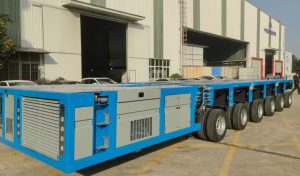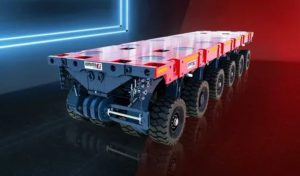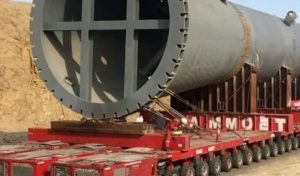
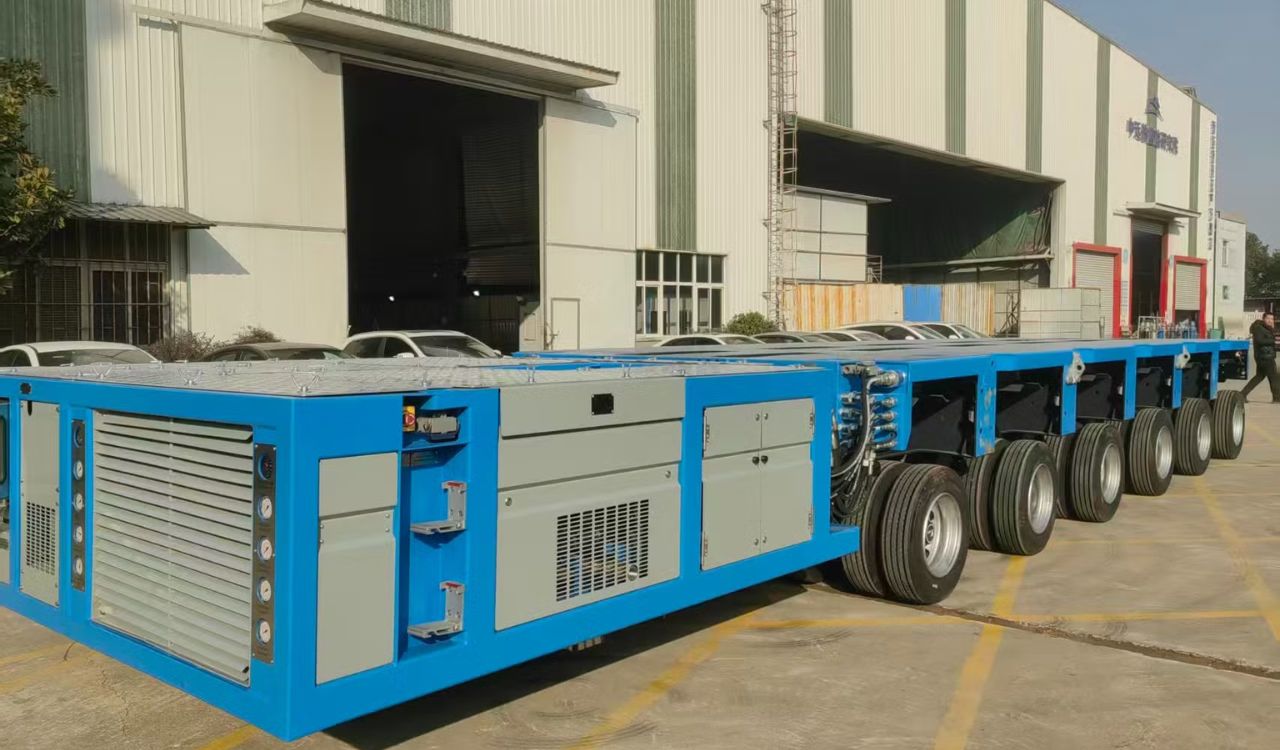
Self-propelled modular transporters (SPMTs) move some of the heaviest, most awkward loads in industry, bridge girders, transformers, reactor vessels, wind turbine sections, often through congested plant yards or narrow city streets. None of that precision is possible without the remote control system that sits at the center of the operation. A single operator, standing well clear of the load, can steer dozens of axle lines and hundreds of tons with two joysticks.
This article breaks down how SPMT remote control systems actually work, the components involved, the steering modes available, and the factors that determine safe, efficient operation.
What Is an SPMT Remote Control System?
An SPMT remote control system is the wireless (or tethered) command interface that lets an operator control the steering, drive, lifting, braking, and leveling functions of a self-propelled modular transporter from outside the vehicle. Instead of a driver’s cab, the operator carries a handheld or backpack-mounted radio remote control unit and walks alongside or ahead of the load, maintaining a clear sightline at all times.
This is fundamentally different from operating a conventional truck or hydraulic modular trailer. An SPMT can consist of multiple coupled modules with dozens of independently steerable axle lines, and the control system is what turns that mechanical complexity into a single, coordinated vehicle that one person can drive.
Core Components of the System
Power Pack Unit (PPU)
The PPU is the engine and hydraulic power source for the SPMT. It supplies hydraulic pressure to the drive motors, steering cylinders, and lift/lower cylinders on every axle line. One or more PPUs can power a combined SPMT configuration, and the control system automatically balances output across them.
Hydraulic Axle Lines
Each axle line has its own hydraulic drive motor, steering actuator, and suspension cylinder. Axles can typically swivel up to 270°, and on some platforms a full 360°, giving the transporter the ability to move in almost any direction without turning the chassis.
Radio Remote Control Unit
The handheld controller — usually weighing between 3–4 kg — includes:
- Two multi-axis joysticks (one for steering, one for drive/speed)
- Selector switches for steering mode
- A display screen showing axle load, support pressure, tilt angle, and system status
- Emergency stop and deadman controls
Onboard Control Computer
This is the “brain” that translates joystick input into individual commands for every axle line, calculates real-time load distribution, and monitors sensor feedback for pressure, angle, and speed.
How SPMT Remote Control Systems Work
- Configuration recognition – When modules are physically coupled, the control system automatically detects how many axle lines are connected and treats them as one vehicle, so the operator never has to manually program the configuration.
- Joystick input – The operator’s steering and drive commands are sent wirelessly to the onboard computer.
- Command distribution – The computer calculates the required angle, speed, and hydraulic pressure for each axle line individually and sends commands via the vehicle’s internal control network (often a CAN bus system).
- Load sensing and leveling – Pressure sensors on each suspension cylinder continuously report load, allowing the system to redistribute weight across axles and keep the deck level, even on uneven ground or ramps.
- Real-time feedback – Status data (axle pressure, tilt, fault alerts) is sent back to the remote’s display so the operator can react immediately if something is out of tolerance.
Master-Slave Configuration
When multiple PPUs and multiple SPMT modules are combined, one PPU is designated the master and the others are slaves. The operator’s remote controls the master unit only; the master then relays synchronized commands to every slave unit over a wired or wireless control link. This is what allows a single controller to operate transport combinations that may span 100+ meters and carry several thousand tons, without any loss of coordination between modules.
Steering Modes
| Steering Mode | Description | Typical Use Case |
| Normal (Ackermann) steering | Front and rear axles steer in opposite directions, similar to a standard vehicle | Straight-line travel, standard turns |
| Crab steering | All wheels turn to the same angle, moving the entire load diagonally without rotating the chassis | Tight lateral positioning, moving between obstacles |
| Carousel (circular) steering | Wheels are angled so the SPMT rotates around a fixed center point | Turning within a confined footprint |
| Independent axle steering | Each axle line is steered manually or semi-independently | Precision positioning, complex load geometries |
Switching between modes is typically a single button press on the remote, with no re-programming required between jobs.
Types of SPMT Remote Control Systems
- Wireless radio remote control – The industry standard; gives the operator full mobility around the load.
- Tethered/cabled remote control – Used in high-interference environments (e.g., near heavy electrical equipment) where radio signal reliability is a concern.
- Cab-based control with remote override – Some SPMT combinations include a ride-on operator cab for long transport runs, with the option to switch to walk-alongside remote control for precision maneuvering.
- Fleet/synchronized control – Software-based systems that allow one operator, or a coordinated team, to run multiple SPMT platforms (e.g., front and rear groups under a large structure) as a single unit.
Key Benefits of Remote Control Operation
- Operator safety – The operator stays outside the vehicle and load path, with full visibility of clearances, obstacles, and personnel.
- Precision positioning – Millimeter-level accuracy is achievable, critical for tasks like setting bridge girders onto bearings or aligning modules for coupling.
- Reduced labor requirement – One trained operator can manage a large multi-module combination instead of needing a driver per unit.
- Automatic load balancing – Continuous pressure monitoring prevents overloading individual axle lines.
- Faster setup – Automatic configuration detection eliminates manual programming between jobs.
Applications
SPMTs and their remote control systems are used across:
- Bridge construction and replacement (girder and deck section placement)
- Power plant and refinery equipment installation (transformers, reactors, generators)
- Shipyard and offshore module transport
- Wind turbine component handling (nacelles, tower sections, blades)
- Building relocation and structural moves
- Plant and factory equipment relocation
Because SPMTs handle the heaviest end of abnormal load transport, they’re often used alongside other heavy-haul and multiwheeler transport equipment, including hydraulic modular trailers, multi-axle low-loaders, and skeletal trailers — depending on load weight, route, and site access. For projects that don’t require full self-propulsion, a towed modular trailer or skeleton trailer may be a more cost-effective option; understanding when each is appropriate is part of proper transport planning.
Important Factors to Consider
Signal Reliability
Radio interference from nearby industrial equipment, cranes, or dense structural steel can affect wireless control signals. Sites with known interference risks may require tethered control or signal-boosting equipment.
Operator Training and Certification
Controlling an SPMT combination involves understanding load charts, steering geometry, and emergency procedures. Most manufacturers and heavy-haul contractors require formal certification before an operator is permitted to run the remote independently.
Battery and Power Management
Remote units are battery-powered and typically include low-battery warnings and automatic safety stops if the connection or battery drops below a safe threshold.
Load Distribution Limits
Even with automated load sensing, operators must stay within the manufacturer’s per-axle-line load ratings. The control system will flag overloads, but route and load planning still needs to confirm total capacity before the move begins.
Environmental Conditions
Wind, ground slope, and surface conditions all affect stability. Remote systems display tilt and pressure data, but pre-planned route surveys remain necessary for safe operation.
Limitations
- Remote control range is finite (typically a few hundred meters), which limits how far an operator can stand from the load in open environments.
- Wireless systems are still subject to interference in electrically noisy environments.
- Complex multi-module configurations require experienced operators — the system reduces manual complexity, but not the skill required to read load behavior in real time.
- Remote controllers require regular maintenance, calibration, and battery servicing to remain reliable on long-duration projects.
Best Practices for Operating SPMT Remote Control Systems
- Conduct a full pre-move inspection of joysticks, emergency stop, and display readings before every job.
- Keep a clear, unobstructed line of sight to the load and travel path at all times.
- Confirm steering mode before movement begins — an incorrect mode selection is a common cause of positioning errors.
- Monitor axle pressure readings continuously, not just at the start of the move.
- Maintain a spotter or second operator for large multi-module combinations, particularly around blind corners or tight clearances.
- Follow manufacturer-specified maintenance intervals for both the PPU and the remote control unit itself.
FAQs
1. How far can an operator be from an SPMT while using the remote control?
Effective range varies by manufacturer and site conditions but is typically up to a few hundred meters in open areas. Range decreases in environments with structural steel, heavy machinery, or radio interference.
2. Can one person operate multiple SPMT modules at once?
Yes. Through a master-slave configuration, a single remote control unit commands the master PPU, which synchronizes movement across all coupled slave units, effectively letting one operator run the entire combination as a single vehicle.
3. What happens if the remote control loses signal during a move?
SPMT systems include fail-safe protocols — typically an automatic stop — that halt all axle movement if the wireless connection drops, preventing uncontrolled motion.
4. Is special certification required to operate an SPMT remote control?
Most manufacturers and heavy-haul contractors require operators to complete formal training and certification covering steering modes, load charts, and emergency procedures before independent operation.
5. How is weight distributed automatically across axle lines?
Pressure sensors on each suspension cylinder feed real-time load data to the onboard control computer, which adjusts hydraulic pressure across axle lines to keep the load balanced within safe limits.
6. What’s the difference between an SPMT and a standard modular trailer?
A standard (hydraulic) modular trailer is towed by a separate prime mover and steered mechanically or via a simpler hydraulic system. An SPMT is self-propelled, with its own PPU and drive motors on each axle line, and is controlled entirely through a wireless remote system rather than a tow vehicle.
7. Can SPMTs operate on inclines?
Yes. Many PPUs include tilt cylinders that allow the power unit to adjust to slopes while keeping the transport deck level, which the control system manages automatically alongside load balancing.