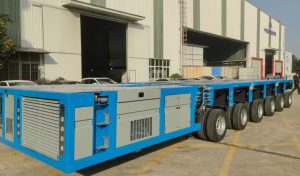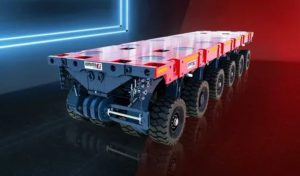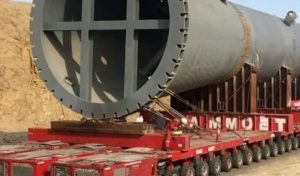
A multiwheeler trailer is designed to transport heavy and oversized loads that require greater capacity, stability, and control than conventional trailers can provide. Because these trailers are often used in industrial plants, ports, construction sites, power projects, and heavy-haulage operations, their ability to maneuver through restricted areas is an important consideration.
Turning radius is a key factor in how a multiwheeler trailer moves around corners, approaches loading areas, and travels through confined workspaces. However, maneuverability does not depend on turning radius alone. Steering configuration, axle arrangement, trailer dimensions, load distribution, hydraulic suspension, and the operating environment all influence how effectively the trailer can be positioned.
What Is the Turning Radius of a Multiwheeler Trailer?
The turning radius is the distance between the center of the turning path and the point on the vehicle or trailer that follows the widest path during a turn. In simple terms, it indicates how much space a vehicle needs to make a particular turn.
For a multiwheeler trailer, the actual turning path can vary depending on the number of axle lines, steering system, trailer configuration, load dimensions, and steering angle.
Unlike a conventional trailer, a multiwheeler may use hydraulic or electronically controlled steering systems that allow several axle lines to change direction. This can significantly improve maneuverability during low-speed operations.
Why Turning Radius Matters for Heavy Transport
Heavy loads are frequently moved through areas where available space is limited. A project site may include narrow access roads, structural columns, equipment foundations, storage areas, or other obstacles.
A suitable turning configuration can help operators:
- Navigate restricted work areas
- Position heavy equipment more accurately
- Reduce unnecessary reversing
- Improve control around corners
- Maintain clearance from structures
- Reduce the amount of space required for maneuvering
- Support safer loading and unloading operations
For this reason, turning performance should be considered during transportation planning rather than only after the trailer reaches the site.
Factors That Affect Multiwheeler Trailer Maneuverability
Several factors influence how a multiwheeler trailer turns and responds to steering commands.
Axle Configuration
The number and arrangement of axle lines affect the trailer’s overall dimensions and steering behavior. A larger configuration may provide greater load capacity, but it also requires careful planning to ensure adequate clearance and steering control.
Therefore, select the axle arrangement based on load weight, dimensions, road conditions, and the required route.
Steering System
The steering system has a major influence on maneuverability. Multiwheeler trailers may use different steering arrangements, including hydraulic steering systems and electronically coordinated steering controls.
Depending on the configuration, the axle lines can be coordinated to follow a controlled turning path. This allows the trailer to move more accurately through curves and confined areas.
Trailer Length and Width
Trailer dimensions directly affect the space required during a turn. A longer trailer can have greater off-tracking, meaning the wheels or rear section may follow a different path from the towing vehicle.
Trailer width is also important because a wide load can require additional clearance from barriers, buildings, poles, and other infrastructure.
Load Dimensions
The trailer itself is only part of the turning calculation. The transported load can extend beyond the trailer deck and may have a greater turning envelope than the trailer wheels.
Long equipment, industrial vessels, transformers, structural components, and other oversized loads can require additional clearance when turning.
Load Distribution
Weight distribution affects how the trailer responds during movement. A properly distributed load helps maintain stability and allows the steering and suspension systems to operate within their intended parameters.
Uneven loading can affect axle loads, suspension behavior, and overall control, particularly during low-speed turns.
Suspension System
Many heavy-haul multiwheeler configurations use hydraulic suspension to manage axle loading and maintain deck stability.
The suspension system can help compensate for variations in ground conditions and load distribution. When combined with an appropriate steering system, it supports controlled movement during turning and positioning operations.
How Multiwheeler Steering Improves Maneuverability
A major advantage of a specialized multiwheeler trailer is its ability to use coordinated steering across multiple axle lines.
During a conventional trailer turn, the towing vehicle determines much of the trailer’s movement. A multiwheeler with independent or coordinated steering can provide greater control over the trailer’s path.
Depending on the steering system and configuration, the trailer may be capable of different steering modes for specific operating conditions.
Normal Steering
Normal steering is generally used when the trailer is following a conventional road path. The axle lines respond to the steering input to guide the trailer through the turn.
Crab Steering
In crab steering, multiple axle lines can be positioned in the same general direction. This allows the entire trailer to move laterally while maintaining its orientation.
Crab steering can be useful when positioning a heavy load beside another structure or when precise lateral movement is required.
Coordinated Steering
Coordinated steering allows multiple axle groups to work together during a turn. The steering angles can be controlled according to the trailer’s configuration and movement requirements.
This can reduce the amount of space needed for certain low-speed maneuvers.
360-Degree or Tight-Space Maneuvering
Some specialized heavy transport systems are designed for extremely tight positioning operations. Their steering and propulsion systems can allow movement patterns that would not be practical with conventional trailers.
The exact capabilities depend on the trailer design and control system, so operators should always verify the manufacturer’s specifications before planning a maneuver.
Multiwheeler Trailer Turning Path
When a multiwheeler turns, the trailer does not necessarily follow the exact path of the towing vehicle. The rear portion can track inside the path of the front portion, while the outer edges of the load may extend beyond the wheel path.
This is particularly important for oversized loads.
Before beginning a turn, transport planners may need to evaluate:
- Inner turning clearance
- Outer turning clearance
- Load overhang
- Trailer width
- Trailer length
- Road width
- Obstacle locations
- Ground conditions
- Steering angle
- Required reversing space
A turning-path assessment can help identify potential conflicts before the transport operation begins.
Turning Radius vs. Maneuverability
Turning radius and maneuverability are related but they are not exactly the same thing.
A trailer may have a relatively controlled turning radius but still require significant operating space because of its overall dimensions. Conversely, a specialized steering system can improve positioning capability even when the trailer carries a very large load.
Maneuverability depends on the complete transport system, including:
Trailer + steering system + load + towing or power unit + route + operator
This is why selecting equipment based only on a stated turning-radius figure may not provide a complete picture of its practical performance.
Route Planning for Multiwheeler Trailers
Before moving a heavy load, the transportation route should be assessed for its ability to accommodate the trailer and cargo.
Route planning may include checking:
- Road widths
- Intersections
- Roundabouts
- Tight corners
- Bridges
- Tunnels
- Overhead structures
- Utility lines
- Traffic restrictions
- Road surface conditions
- Slopes and gradients
- Available turning areas
For particularly large loads, a detailed route survey can help determine whether modifications, temporary access arrangements, traffic management, or alternative routes are required.
Maneuvering in Construction and Industrial Sites
Multiwheelers are often required to operate at low speeds inside construction and industrial environments. These areas can present different challenges from public roads.
For example, an industrial facility may have limited space between buildings, equipment foundations, storage areas, and access roads. A construction site may have changing ground conditions and temporary obstacles.
In these situations, precise steering and controlled movement can be more important than achieving high travel speeds.
Ground Conditions and Turning Performance
Ground conditions should also be considered when evaluating maneuverability.
A heavy multiwheeler places substantial loads on the ground through its axle lines. Soft soil, uneven surfaces, loose aggregate, or poorly prepared access areas can affect steering and stability.
Before a heavy-haul operation, engineers and transport planners may evaluate the ground bearing capacity and determine whether reinforcement, steel plates, temporary roadways, or other measures are required.
How to Improve Multiwheeler Maneuverability
Good maneuverability starts with selecting the appropriate trailer configuration for the load and route.
Several practices can help improve operational control:
- Choose the correct axle configuration for the required payload.
- Use an appropriate steering system for the intended operating environment.
- Distribute the load correctly across the available axle lines.
- Conduct a route survey before transportation.
- Check turning areas at critical intersections and site entrances.
- Consider the complete load envelope, not just the trailer dimensions.
- Verify ground conditions along the route.
- Use trained operators and spotters during restricted maneuvers.
- Maintain appropriate clearances from structures and obstacles.
- Use controlled low-speed movements when positioning oversized loads.
Multiwheeler Trailer vs. Conventional Trailer Maneuverability
A conventional trailer may be suitable for standard cargo and relatively open routes, but specialized heavy transport can require more advanced steering and axle configurations.
A multiwheeler trailer is generally designed around the requirements of heavy and oversized cargo. Its multiple axle lines and specialized steering arrangements can provide greater control when transporting large loads through industrial facilities, construction sites, ports, and other challenging environments.
However, the exact maneuverability depends on the specific trailer configuration and operating conditions. There is no single turning-radius value that applies to every multiwheeler.
Final Considerations
The turning radius of a multiwheeler trailer is an important part of heavy-haul transportation planning, but it should be considered alongside steering capability, axle configuration, load dimensions, trailer size, ground conditions, and route geometry.
For large and complex transportation projects, understanding the complete turning envelope can help planners identify restricted areas and determine the appropriate equipment and operating approach. Proper route assessment, load distribution, steering control, and trained operation all contribute to controlled maneuvering.
For companies involved in heavy haulage, selecting a multiwheeler configuration based on the actual load and route requirements can make transportation planning more practical and predictable.
FAQs
What is the turning radius of a multiwheeler trailer?
The turning radius is the distance from the center of a turn to the part of the trailer or load that follows the widest turning path. The actual radius varies according to the trailer configuration, steering system, dimensions, and load.
What affects the maneuverability of a multiwheeler trailer?
Maneuverability is affected by axle configuration, steering system, trailer dimensions, load size, weight distribution, suspension, road width, ground conditions, and the available space for turning.
Can a multiwheeler trailer turn in tight spaces?
Yes, specialized multiwheeler trailers can be designed for controlled movement in restricted areas. Their steering systems can provide greater maneuverability than conventional trailer configurations, although the available turning space still depends on the specific equipment and load.
How does steering affect a multiwheeler trailer’s turning radius?
The steering system determines how the axle lines respond during a turn. Coordinated steering can help the trailer follow a controlled path and improve maneuverability during low-speed heavy-load operations.
Why is route planning important for multiwheeler trailers?
Route planning helps identify narrow roads, tight corners, bridges, obstacles, slopes, and other restrictions that could affect the movement of the trailer and its load.
Does load size affect multiwheeler maneuverability?
Yes. A load that is wider or longer than the trailer can increase the overall turning envelope and require additional clearance around corners and obstacles.
What is crab steering on a multiwheeler trailer?
Crab steering is a steering mode in which multiple axle lines are positioned in the same general direction, allowing the trailer to move laterally while maintaining its general orientation. It can be useful for precise positioning in restricted areas.
How does ground condition affect multiwheeler trailer operation?
Ground conditions can affect stability, steering, and axle loading. Soft or uneven ground may require additional preparation to provide adequate support for a heavy multiwheeler and its cargo.