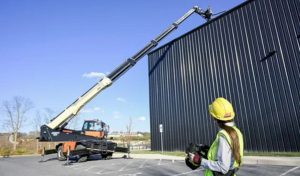
Telehandlers are versatile machines used across construction, agriculture, industrial facilities, warehouses, and material handling operations. Their telescopic boom allows operators to lift, move, and position materials at different heights and distances. When a telehandler needs to be moved between equipment yards, suppliers, rental facilities, or project sites, transportation must be planned around its weight, dimensions, attachments, and destination.
Telehandler delivery involves more than selecting a trailer and arranging a pickup. The transport team needs to consider loading requirements, overall vehicle dimensions, axle loads, route conditions, ground clearance, securing methods, permits, and access at the delivery location. Different types of heavy transport equipment are designed for different cargo, so a wind blade trailer, for example, is configured for long and oversized wind turbine blades rather than conventional construction machinery.
Choosing an appropriate transport method can help reduce logistical complications and ensure that the machine arrives ready for use. The trailer configuration should always match the equipment being transported, its dimensions, weight distribution, and the requirements of the planned route.
What Is Telehandler Delivery?
Telehandler delivery is the process of transporting a telescopic handler from one location to another using suitable road transportation equipment.
A delivery may involve:
- Equipment manufacturers
- Rental companies
- Construction contractors
- Agricultural businesses
- Industrial facilities
- Equipment dealers
- Logistics providers
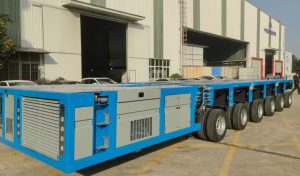
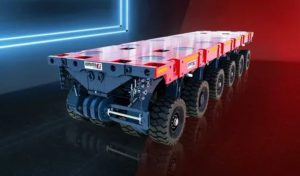
The transportation method depends largely on the telehandler’s operating weight and dimensions. A compact machine may require a relatively straightforward equipment trailer, while a larger telehandler may need a low loader or specialized heavy transport configuration. For unusually heavy or oversized equipment, a modular trailer can provide greater flexibility through adjustable axle configurations and load distribution options, although it is generally selected based on the specific transport requirements rather than used for every telehandler delivery.
Why Does Telehandler Transport Require Planning?
Telehandlers are self-propelled machines, but driving them over long distances is not always practical. Road regulations, travel distance, machine wear, traffic conditions, and equipment dimensions can make trailer transportation more suitable.
Planning is important because a telehandler can have:
- Significant operating weight
- Considerable overall height
- Wide wheelbase
- Long telescopic boom
- Large tires
- Additional attachments
- A relatively high center of gravity
The loaded transport combination must remain within applicable weight and dimensional limits while providing adequate stability and clearance.
Common Transport Options for Telehandlers
Different trailers can be considered depending on the size of the telehandler and the transportation route.
| Transport option | Typical use | Important consideration |
| Low loader | Construction and industrial equipment | Low deck height and loading access |
| Flatbed trailer | Suitable equipment dimensions | Overall height and securing |
| Lowboy trailer | Larger heavy machinery | Deck height and payload |
| Multi-axle trailer | Heavier equipment | Axle-load distribution |
| Multiwheeler | Specialized heavy loads | Configuration and ground loading |
| Modular trailer | Unusual or demanding loads | Flexible axle arrangement |
The trailer should be selected according to the machine’s actual specifications rather than using a standard configuration for every delivery.
Low Loaders for Telehandler Delivery
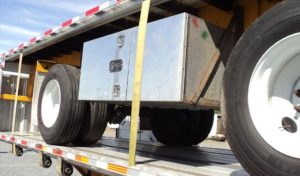
Low loaders are commonly considered for transporting construction and industrial machinery because their deck height can help reduce the overall height of the loaded vehicle.
Lower overall height can be particularly useful when the telehandler has a tall chassis or when the route contains bridges, overhead structures, or other clearance restrictions.
Before selecting a low loader, verify:
- Payload capacity
- Deck length
- Deck width
- Loading angle
- Ramp capacity
- Loaded height
- Axle configuration
- Securing points
The loading arrangement should also provide sufficient clearance for the telehandler’s tires and undercarriage.
Multi-Axle Trailers and Heavy Equipment
A heavier telehandler may require a trailer with multiple axle lines to distribute the total load.
A multi-axle configuration can affect:
- Axle loading
- Ground loading
- Vehicle stability
- Road compliance
- Trailer capacity
The number of axles should be determined according to the total transport weight and applicable requirements.
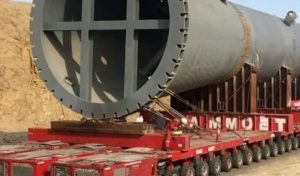
A multiwheeler may be considered for particularly demanding heavy-load applications, but it is not automatically necessary for every telehandler delivery.
Modular Trailers for Specialized Transport
A modular trailer consists of transport modules that can be combined into different configurations.
For a conventional telehandler delivery, a modular system may not be necessary. However, modular transport can become relevant when equipment is unusually heavy, oversized, or transported as part of a larger industrial movement.
The configuration can be adapted according to:
- Cargo weight
- Cargo dimensions
- Axle loading
- Platform requirements
- Route conditions
- Maneuverability requirements
This flexibility makes modular trailers useful for specialized project transportation.
Understanding Telehandler Dimensions
Accurate dimensions are essential before arranging transportation.
Important measurements include:
Overall Length
The machine’s length affects trailer deck requirements and the total transport combination.
Overall Width
Width determines whether the loaded vehicle remains within standard road limits or requires additional arrangements.
Overall Height
Height is particularly important because the telehandler is often a relatively tall machine. The total loaded height must include the trailer deck height.
Operating Weight
The telehandler’s operating weight determines the required trailer capacity and influences axle loading.
Boom and Attachment Dimensions
The boom should be placed and secured according to the manufacturer’s transportation instructions. Forks, buckets, work platforms, or other attachments can also change the overall transport dimensions.
Preparing a Telehandler for Transport
Proper preparation can make loading and securing easier.
Before transportation, the machine should be checked according to the manufacturer’s instructions and the transport provider’s requirements.
Preparation may include:
- Retracting or positioning the boom correctly
- Removing or securing attachments
- Checking tire condition
- Securing movable components
- Checking for fluid leaks
- Confirming designated tie-down points
- Inspecting brakes and steering systems
- Cleaning excessive mud or debris from the machine
Attachments that cannot remain safely installed may need to be transported separately.
Loading a Telehandler onto a Trailer
The loading method depends on the trailer and equipment configuration.
A typical process may involve:
- Positioning the trailer on suitable ground.
- Preparing ramps or loading equipment.
- Aligning the telehandler with the trailer.
- Driving or lifting the machine onto the deck according to the approved procedure.
- Positioning the machine to achieve appropriate weight distribution.
- Lowering and securing the boom.
- Applying the required parking and securing measures.
- Inspecting the complete load before departure.
The loading area should provide sufficient space and stable ground for both the trailer and telehandler.
Load Securing
Load securing is a critical part of equipment transportation.
The securing system should account for the telehandler’s weight, center of gravity, attachment configuration, and trailer design.
Depending on the equipment and applicable requirements, securing may involve:
- Chains
- Binders
- Tie-down systems
- Wheel restraints
- Manufacturer-approved securing points
The transport team should follow applicable regulations and equipment manufacturer’s instructions rather than relying on a generic securing arrangement.
Route Planning for Telehandler Delivery
A route that is suitable for an ordinary truck may not necessarily be suitable for a loaded equipment trailer.
Before transportation, review:
- Road width
- Bridge restrictions
- Overhead clearances
- Sharp turns
- Steep grades
- Road surface
- Weight restrictions
- Construction zones
- Traffic restrictions
- Delivery-site access
For larger equipment, a route survey may be appropriate to identify potential obstacles before dispatch.
Ground Conditions at the Delivery Site
The destination should be evaluated before the telehandler arrives.
Consider whether the site has:
- Stable access roads
- Adequate turning space
- Suitable unloading ground
- Sufficient clearance
- Appropriate slopes
- Adequate pavement or soil capacity
Construction sites may have temporary roads or recently disturbed ground. Heavy transport equipment can place significant loads on these surfaces, so ground conditions should be checked in advance.
Permits and Legal Requirements
Transportation requirements depend on the equipment dimensions, total vehicle weight, axle loading, route, and local regulations.
Some deliveries may require permits if the loaded vehicle exceeds standard dimensional or weight limits.
Before transportation, the logistics team should confirm:
- Maximum permitted dimensions
- Gross vehicle weight
- Axle-load limits
- Oversized-load requirements
- Operating restrictions
- Escort requirements
- Route-specific restrictions
- Required permits
Requirements can vary between jurisdictions, so local regulations should be verified for the specific delivery route.
Factors That Affect Telehandler Delivery Costs
The cost of transporting a telehandler depends on several factors rather than distance alone.
| Cost factor | Why it matters |
| Machine size | Larger equipment may require specialized trailers |
| Machine weight | Determines trailer capacity and axle requirements |
| Transport distance | Influences fuel, labor, and operating costs |
| Route complexity | May require additional planning |
| Permits | Oversized or heavy loads may require approvals |
| Loading method | Special loading equipment can increase costs |
| Delivery site | Difficult access can require additional preparation |
| Attachments | May increase transport dimensions or require separate handling |
| Equipment configuration | Specialized trailers can affect overall transport cost |
Comparing equipment or semi trailer leasing prices alone may not provide an accurate picture of total delivery costs. The complete transportation operation should be considered.
When Is Specialized Heavy Transport Equipment Needed?
Not every telehandler requires specialized heavy transport equipment.
A conventional equipment trailer may be appropriate when the machine falls within normal weight and dimensional limits. Larger or unusually configured machines may require low loaders, multi-axle trailers, or modular transport systems.
Specialized equipment may become relevant when:
- The machine has a high operating weight.
- Overall dimensions exceed standard limits.
- The route has strict axle-load restrictions.
- Ground loading is an important concern.
- The delivery site has limited maneuvering space.
- Multiple pieces of heavy equipment must be moved together.
- Precise transport positioning is required.
The equipment should always be selected based on the actual machine and project conditions.
Telehandler Delivery for Construction Sites
Construction companies frequently move telehandlers between equipment depots and active project sites.
Delivery planning should account for the construction schedule as well as site conditions. A trailer may need to enter through a temporary access road, position near a building structure, or unload in a restricted area.
Before scheduling delivery, contractors should confirm:
- Site access
- Delivery window
- Unloading area
- Ground conditions
- Available personnel
- Required lifting or unloading equipment
- Traffic arrangements
Early coordination can help prevent situations where the transport vehicle arrives before the site is ready to receive the machine.
Telehandler Delivery for Industrial and Agricultural Applications
Telehandlers are also used outside conventional construction.
Industrial facilities may use them for material handling, maintenance, and equipment movement. Agricultural businesses may use them for handling feed, hay, pallets, and other materials.
Each environment creates different transport considerations.
Industrial sites may have controlled gates, narrow internal roads, or overhead structures. Agricultural sites may have gravel roads, soft ground, narrow entrances, or seasonal access limitations.
The delivery plan should therefore be based on the actual destination rather than assuming standard road and site conditions.
Best Practices for Telehandler Transport
A well-planned delivery begins with accurate information.
Confirm the Equipment Specifications
Obtain the manufacturer’s weight and dimensions before selecting the transport equipment.
Select the Trailer Based on the Load
Consider payload capacity, deck dimensions, axle arrangement, loading method, and overall loaded height.
Plan the Route
Review bridges, overhead structures, road width, turns, gradients, and other restrictions.
Prepare the Delivery Site
Make sure the destination has sufficient space and suitable ground for unloading.
Secure the Machine Properly
Use appropriate securing points and methods based on the equipment and applicable requirements.
Check Permits
Confirm whether the loaded vehicle requires special permits or other approvals.
Inspect Before Departure
Carry out appropriate checks on the telehandler, trailer, securing equipment, and loading arrangement before starting the journey.
Role of Shiyun Trailers in Heavy Equipment Transportation
Trailer selection becomes particularly important when construction equipment varies significantly in weight, dimensions, and operating requirements.
Shiyun Trailers provides transportation equipment for heavy-load applications, with available configurations selected according to cargo characteristics, payload requirements, axle arrangements, and operating conditions.
For each project, the appropriate trailer should be determined from the machine specifications, route requirements, loading method, and applicable transportation regulations.
Frequently Asked Questions
What is telehandler delivery?
Telehandler delivery is the transportation of a telescopic handler from one location to another using an appropriate equipment trailer or specialized transport system.
What type of trailer is used to transport a telehandler?
Low loaders, lowboy trailers, flatbeds, and multi-axle equipment trailers can be used depending on the telehandler’s weight, dimensions, and route. Larger machines may require specialized transport equipment.
Can a telehandler be transported on a flatbed trailer?
A flatbed may be suitable when its payload capacity, deck dimensions, loading method, and overall height are appropriate for the telehandler. The loaded combination must also comply with applicable requirements.
Does a telehandler need to be secured during transport?
Yes. A telehandler should be secured using appropriate methods and designated securing points in accordance with applicable transportation requirements and manufacturer guidance.
Can a multiwheeler transport a telehandler?
A multiwheeler can be used for heavy machinery when its capacity and configuration are suitable. Whether it is necessary depends on the telehandler’s weight, dimensions, axle requirements, and route conditions.
What information is needed to arrange telehandler delivery?
Useful information includes the telehandler’s make and model, operating weight, dimensions, boom and attachment configuration, pickup location, delivery location, preferred delivery date, and site-access conditions.
What should be checked before delivering a telehandler?
Confirm the machine specifications, trailer capacity, loaded dimensions, route restrictions, ground conditions, securing arrangements, permits where applicable, and unloading space at the destination.
Conclusion
Telehandler delivery requires coordination between equipment specifications, trailer selection, loading procedures, route planning, load securing, and site preparation. The appropriate transportation method depends on the machine’s weight and dimensions as well as the route and destination conditions.
For many machines, a suitable equipment trailer or low loader may be sufficient. Heavier or more demanding movements can require multi-axle systems, multiwheelers, or modular transport equipment.
By confirming accurate equipment specifications, selecting the appropriate trailer, reviewing the route, preparing the delivery site, and checking applicable transportation requirements, contractors and equipment owners can create a more organized and practical telehandler delivery plan.