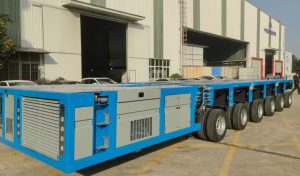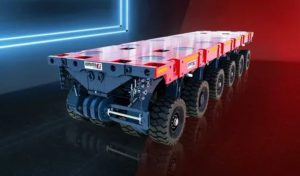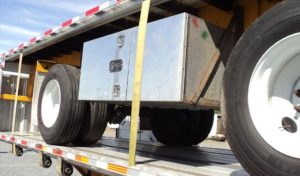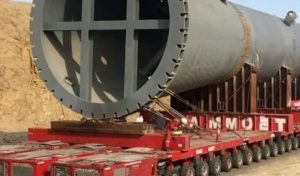
Moving a 200-ton transformer, a bridge girder, or a wind turbine nacelle is nothing like moving a standard shipping container. These loads exceed the size, weight, and geometry limits of conventional trucks, which is why the heavy haulage industry relies on two specialized categories of equipment: self-propelled modular transporters (SPMTs) and conventional modular trailers (also called hydraulic modular trailers, or HMTs).
Both are built around the same core idea, modular axle lines that can be combined to match almost any load, but they differ fundamentally in how they move, how they’re powered, and where they perform best. Choosing the wrong one can mean blown schedules, unnecessary rigging costs, or a load that simply can’t reach its destination. This guide breaks down how each system works, where they differ, and how to decide which one fits your project.
What Are Modular Trailers?
A modular trailer is a heavy-duty transport platform built from standardized axle modules, often called axle lines or bogies, that can be coupled together side by side or end to end. Each axle line typically carries a fixed load rating (commonly 18 to 45 tons per line), so operators can scale the trailer’s overall capacity up or down simply by adding or removing modules.
This modularity is what separates modular trailers from fixed-frame lowbed or flatbed trailers. Instead of buying a new trailer for every load configuration, a fleet operator can reconfigure the same set of axle lines into 2-file, 3-file, 4-file, or wider “multiwheeler” arrangements depending on the width, length, and weight of the cargo.
Within this category, there are two distinct drive configurations:
- Conventional modular trailers, towed by a separate prime mover or ballast tractor
- Self-propelled modular transporters (SPMTs), which carry their own hydraulic drive system and move independently
Conventional Modular Trailers: How They Work
A conventional modular trailer, sometimes called a hydraulic modular trailer (HMT), has no engine of its own. It is pulled by a tractor unit (often a ballast tractor with added weight for traction and braking) and relies on hydraulic suspension to keep the load level across uneven axle loading points.
Key Characteristics
- Towed operation: Requires a separate prime mover for propulsion and braking on inclines.
- Hydraulic suspension: Independently adjustable axles compensate for road camber, ramps, and uneven ground, keeping the deck and cargo level.
- High-tensile steel construction: Since weight reduction isn’t a priority (payload capacity is independent of the tractor), frames are built from high-tensile steel rather than aluminum for durability under repeated heavy loading.
- Pneumatic tires: Because HMTs travel on public roads at highway speeds, they use pneumatic (air-filled) tires rather than solid ones — the main long-term maintenance point on these trailers.
- Steerable axles: Hydraulic or mechanical steering allows the trailer to follow the tractor through tight turns despite its length.
Where Conventional Modular Trailers Excel
Conventional modular trailers are the standard choice for long-distance, on-highway transport of oversized or overweight loads — think transformers, generators, precast concrete segments, and industrial machinery moving between a factory and a project site over public roads. Their reliance on a road-legal tractor keeps operating costs lower than a full SPMT fleet, and their pneumatic tires handle sustained highway speeds without excessive wear.
Self-Propelled Modular Transporters (SPMTs): How They Work
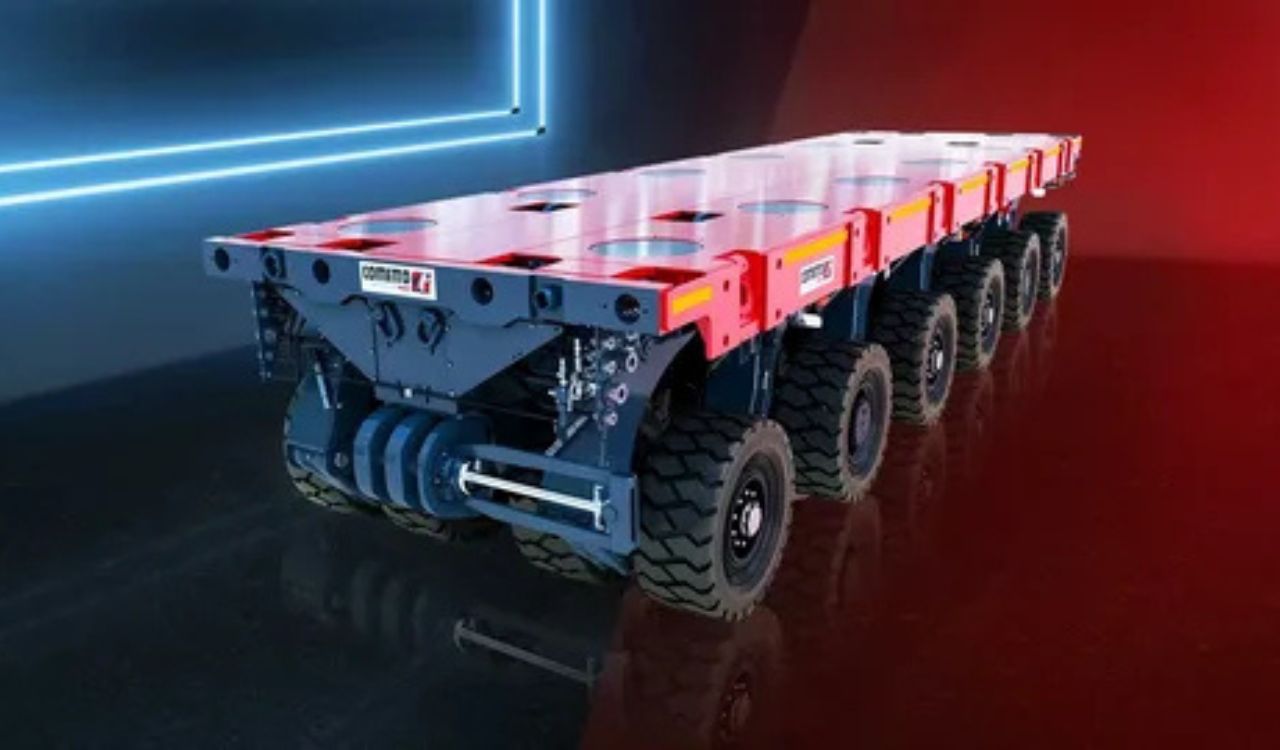
An SPMT is essentially an upgraded, self-powered evolution of the hydraulic modular trailer. Each axle line has its own hydrostatic drive motor, and the entire unit — or a coupled combination of units — is controlled from a single console, either onboard or via wireless remote.
Key Characteristics
- Individually driven axles: Every wheel or axle module has its own hydraulic drive motor, giving the platform independent traction control across all wheels.
- Power Pack Unit (PPU): A dedicated hydraulic power source (diesel-driven pump unit) supplies pressure to the drive motors, steering system, and suspension — this can be mounted on the platform or coupled externally.
- 360° steering and crab/carousel movement: Wheel bogies can typically rotate well beyond 90°, enabling sideways travel, diagonal movement, and rotation in place — critical for maneuvering in tight plant environments, shipyards, or congested job sites.
- Solid tires: Because SPMTs operate at low speeds (rarely above 5 km/h) over short distances, they use solid rather than pneumatic tires, eliminating blowout risk under sustained heavy load.
- Deck height adjustment: Hydraulic ram strokes let operators raise, lower, or tilt the deck for self-loading, self-unloading, and precise alignment during installation.
- Coupling flexibility: Multiple SPMT units can be linked longitudinally and laterally and driven as a single vehicle, scaling capacity from tens of tons to several thousand tons.
Where SPMTs Excel
SPMTs are built for on-site precision movement rather than long-distance travel — shipyards, refineries, power plants, offshore module yards, and construction sites where a crane can’t reach or where the load must be positioned with millimeter-level accuracy. They’re the standard for RoRo (roll-on/roll-off) vessel loading, module installation, plant relocation, and moving loads through confined plant corridors.
SPMT vs Conventional Modular Trailer: Direct Comparison
| Factor | Conventional Modular Trailer | Self-Propelled Modular Transporter (SPMT) |
| Power source | External tractor/ballast tractor | Onboard hydraulic drive on each axle line |
| Typical speed | Highway speeds (with tractor) | Low speed, typically 0–5 km/h |
| Tires | Pneumatic | Solid |
| Steering | Steerable axles, tractor-guided | Independent wheel bogies, 260°+ rotation, crab/carousel steering |
| Best use case | Long-distance road transport | On-site precision positioning, loading/unloading |
| Load control | Manual/hydraulic leveling | Computer-assisted, remote/wireless control |
| Capacity per axle line | ~18–45 tons | ~30–60 tons (varies by manufacturer) |
| Operating cost | Lower (shared tractor, simpler system) | Higher (dedicated PPU, specialized crew) |
| Maneuverability | Limited to tractor’s turning geometry | 360° movement including sideways and rotation |
| Typical environment | Public roads, highways | Shipyards, plants, ports, confined sites |
Types and Configurations
Conventional Modular Trailer Configurations
- 2-file, 3-file, 4-file, and multiwheeler configurations — describing how many axle lines run side by side to widen the load-bearing platform
- Extendable modular trailers — telescoping frames for long, narrow loads such as girders or wind blades
- Skeletal trailers (skeleton trailers) — a lighter-frame modular trailer variant designed mainly for container and intermodal freight rather than abnormal-load haulage; they share the modular axle concept but are optimized for standard ISO container dimensions rather than oversized cargo
- Goosenecks and lowbed modular combinations — for loads requiring a reduced deck height to meet bridge or overhead clearance limits
SPMT Configurations
- Standard platform SPMTs — flat-deck units used individually or coupled for medium loads
- Heavy-capacity SPMT combinations — dozens of coupled axle lines for loads exceeding 1,000–5,000 tons, common in bridge launching and module transport
- Compact/low-height SPMTs — slimmer designs built for confined indoor or plant environments such as nuclear and petrochemical facilities
- SPMTs with hydraulic gantry or lifting systems — combined with jacking systems for self-load/self-unload operations without a crane
Applications by Industry
Conventional modular trailers are typically used for:
- Transporting transformers, generators, and industrial equipment between manufacturing plants and project sites
- Moving precast bridge beams and concrete segments over public highways
- Long-haul delivery of oversized machinery to refineries, power plants, and construction sites
SPMTs are typically used for:
- Positioning bridge sections and launching bridge girders on-site
- Loading and unloading vessels via RoRo operations at ports and shipyards
- Moving reactors, turbines, and process modules within refineries and petrochemical plants
- Relocating entire prefabricated building modules
- Installing wind turbine tower and nacelle components at assembly sites
Key Factors to Consider When Choosing Between the Two
- Distance: Long-distance road transport favors conventional modular trailers with a tractor; short-distance, high-precision movement favors SPMTs.
- Site access and space: Confined shipyards, plant floors, and port terminals often can’t accommodate a crane or a wide-turning tractor combination — this is where SPMT maneuverability matters most.
- Load weight and distribution: Both systems scale by adding axle lines, but SPMTs offer finer per-axle load control through independent hydraulic drive, which matters for delicate or unevenly distributed cargo.
- Speed requirements: If the load needs to travel at road speeds between locations, only a conventional modular trailer (or a combination with a ballast tractor) is practical — SPMTs are not designed for sustained highway travel.
- Budget and crew requirements: SPMT operations typically require a trained crew and dedicated power pack units, raising day-rate costs compared to a standard tractor-trailer combination.
- Regulatory and route constraints: Bridge weight limits, road width restrictions, and permit requirements affect which configuration (2-file, 4-file, multiwheeler) is viable for a given route.
Limitations to Keep in Mind
- Tires remain the weak point on both systems — pneumatic tires on conventional trailers are vulnerable to blowouts under sustained heavy load, while solid tires on SPMTs limit them to low speeds.
- SPMTs are not road-legal for highway travel in most jurisdictions and are generally restricted to private sites, ports, or short escorted movements.
- Conventional trailers depend entirely on the tractor’s power and braking capability, particularly on inclines, which can constrain route selection.
- Both systems require experienced operators; incorrect axle loading or steering coordination on multiwheeler configurations can damage cargo or infrastructure.
Best Practices for Heavy Haulage Planning
- Conduct a full route or site survey before selecting axle configuration, factoring in ground bearing pressure, bridge capacity, and turning radii.
- Match tire type to operating conditions — pneumatic for road speed, solid for slow, high-load site movement.
- Use manufacturers’ rated axle-line capacities as a hard limit, not a target, to preserve suspension and steering performance over the trailer’s service life.
- For projects requiring both long-distance transport and precision on-site positioning, plan for a combined approach — conventional modular trailers for the road leg, SPMTs for final placement.
- Work with a trailer manufacturer or heavy-haulage specialist — such as Shiyun Trailers — early in project planning to confirm axle configuration, capacity, and compatibility with local road and site constraints before committing to equipment.
Frequently Asked Questions
What is the main difference between an SPMT and a conventional modular trailer?
An SPMT has its own hydraulic drive on every axle and moves independently, while a conventional modular trailer has no engine and must be towed by a separate tractor unit.
Can SPMTs travel on public roads?
Generally no. SPMTs use solid tires and are designed for slow-speed, short-distance movement within controlled sites like ports, shipyards, and plants — not for sustained highway travel.
How much weight can a modular trailer carry?
Capacity depends on the number of axle lines used. Each axle line typically carries 18–45 tons on conventional trailers and 30–60 tons on SPMT platforms, and units can be combined to reach capacities of several hundred to several thousand tons.
What is a multiwheeler trailer?
“Multiwheeler” refers to a modular trailer configuration with multiple axle lines coupled side by side to widen the load-bearing platform and increase total capacity for extremely heavy or wide loads.
Are skeletal (skeleton) trailers the same as modular trailers?
Not exactly. Skeletal trailers share the lightweight, modular frame concept but are purpose-built for standard container and intermodal freight, whereas modular trailers and SPMTs are engineered for oversized, abnormal, and heavy-lift cargo.
Why do SPMTs use solid tires instead of pneumatic tires?
Because SPMTs operate at very low speeds under sustained heavy loads, solid tires eliminate blowout risk. Pneumatic tires, used on conventional modular trailers, are better suited to the higher speeds of road transport.
When should a project use both SPMTs and conventional modular trailers?
When cargo needs to travel a long distance by road and also requires precise final positioning, for example, delivering a transformer to a plant by conventional trailer, then using an SPMT to maneuver it into its exact installed location.