Moving extremely heavy equipment across a perfectly flat surface is rarely possible in real-world industrial transport. Construction sites, ports, industrial facilities, power projects, and infrastructure works can contain slopes, surface irregularities, changes in elevation, ramps, temporary roads, and other ground conditions that make heavy-load movement more complicated.
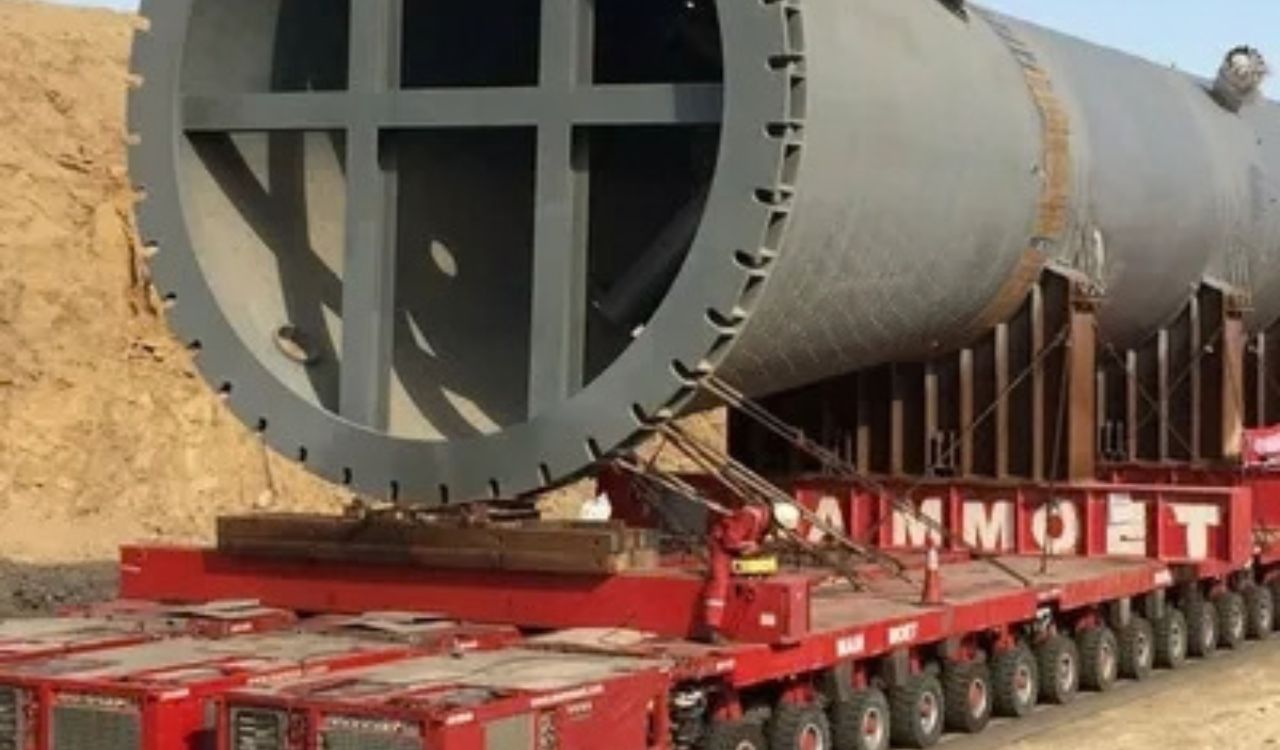
A Self-Propelled Modular Transporter (SPMT) is specifically designed for controlled movement of very heavy and oversized loads. One of its important capabilities is the use of independently controlled hydraulic suspension and multiple axle lines to manage changes in terrain while keeping the transported load within controlled operating conditions.
Understanding how SPMTs handle uneven ground requires looking at more than the suspension system. Ground bearing capacity, load distribution, steering, hydraulic control, route preparation, and operator input all contribute to the safe movement of a heavy load.
What Is an SPMT?
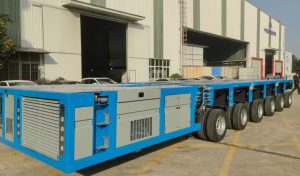
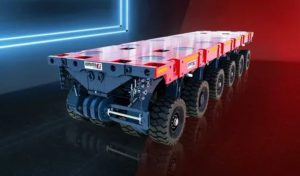
A Self-Propelled Modular Transporter is a modular heavy-duty transporter consisting of multiple axle lines, hydraulic suspension units, drive systems, steering mechanisms, and a power pack unit.
Unlike a conventional trailer that normally depends on a tractor or truck for propulsion, an SPMT has its own propulsion system. This allows it to move large loads at controlled speeds within industrial and construction environments.
An SPMT can be configured by connecting multiple modules to achieve the required:
- Payload capacity
- Deck dimensions
- Axle-line arrangement
- Steering capability
- Load distribution
- Transport configuration
This modular approach makes SPMTs suitable for loads that would exceed the practical capacity or maneuverability of conventional heavy haulage equipment.
Why Uneven Ground Is a Challenge for Heavy Transport
A heavy load does not respond to an uneven surface in the same way as a normal road vehicle.
When one section of a transporter encounters a higher or lower surface, the resulting change in elevation can influence axle loading, deck level, suspension movement, and load stability.
Uneven ground can include:
- Potholes and surface depressions
- Ramps and changes in elevation
- Longitudinal slopes
- Cross slopes
- Uneven temporary roads
- Construction-site surfaces
- Uncompacted soil
- Gravel or aggregate surfaces
- Transitions between different pavement levels
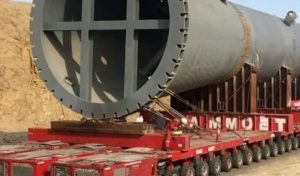
The challenge becomes greater as cargo weight and dimensions increase. A large transformer, pressure vessel, generator, bridge section, or industrial module may require highly controlled movement because even relatively small changes in deck position can affect the load.
How SPMTs Handle Uneven Ground
SPMTs use several systems together to manage uneven surfaces rather than relying on a conventional fixed trailer suspension.
The principal mechanisms include hydraulic suspension, multiple independently controlled axle lines, load distribution, steering control, and hydraulic leveling.
Hydraulic Suspension
Hydraulic suspension is one of the most important features of an SPMT.
Each axle line can be connected to hydraulic suspension cylinders that allow controlled vertical movement. When the transporter encounters a difference in surface elevation, the suspension can respond to the change rather than forcing the entire deck to follow every irregularity in the ground.
The hydraulic system helps maintain controlled contact between the wheels and supporting surface while allowing suspension movement across the modular configuration.
This capability is particularly important when transporting loads where excessive deck movement needs to be avoided.
Independent Axle-Line Movement
An SPMT consists of multiple axle lines rather than a small number of conventional trailer axles.
The suspension of these axle lines can be controlled through the hydraulic system. Depending on the SPMT configuration and control system, different sections of the transporter can respond to variations in ground level.
This distributes the effects of uneven terrain across the transporter instead of concentrating them at one point.
Hydraulic Deck Leveling
Another important capability is controlled deck leveling.
When an SPMT travels over an uneven surface, the hydraulic suspension can be adjusted to maintain the desired deck position within the operating range of the equipment.
Deck leveling can be particularly useful when transporting:
- Large industrial machinery
- Transformers
- Pressure vessels
- Bridge components
- Power-generation equipment
- Process modules
- Offshore structures
The exact leveling capability depends on the transporter design, hydraulic system, load configuration, and site conditions.
The Role of Load Distribution
Handling uneven ground is not simply a suspension issue. The weight of the cargo must also be distributed appropriately across the available axle lines.
An SPMT configuration can be selected according to the dimensions and weight of the load. Engineers may determine how many axle lines are required and how the load should be positioned on the transporter.
Proper distribution helps manage:
- Axle loads
- Ground pressure
- Suspension loading
- Structural loads
- Load stability
- Surface bearing requirements
For extremely heavy cargo, transport planning should therefore consider the complete load path from the cargo support points through the transporter and finally into the ground.
Understanding Ground Bearing Capacity
Ground bearing is a critical consideration when moving heavy loads over uneven surfaces.
Ground bearing capacity refers to the ability of the supporting surface or soil structure to withstand applied loads without excessive deformation, settlement, or failure.
An SPMT can distribute a very large total load across many wheels and axle lines, but that does not mean every surface can support the resulting pressure.
Before a heavy transport operation, engineers may need to evaluate:
- Soil conditions
- Pavement structure
- Surface strength
- Water content
- Existing underground structures
- Drainage
- Expected axle loads
- Contact pressure
- Temporary reinforcement requirements
If the existing surface cannot provide sufficient support, ground improvement or temporary reinforcement may be necessary.
How SPMTs Distribute Loads Across Multiple Axle Lines
The multi-axle arrangement is one reason an SPMT is different from a conventional heavy haulage trailer.
Instead of concentrating the cargo weight on a limited number of axle groups, the transporter can use multiple axle lines to distribute the load.
For example, a modular configuration can be expanded to accommodate a particularly heavy load. The final arrangement depends on the required payload, dimensions, center of gravity, axle loading limits, and site conditions.
This load-sharing capability can be useful when moving heavy cargo over prepared industrial surfaces, provided the supporting ground has been assessed appropriately.
SPMT Steering on Uneven Surfaces
Steering becomes another important consideration when the transporter is operating on uneven ground.
SPMTs can use electronically or hydraulically coordinated steering systems to control multiple axle lines. Different steering modes can be selected according to the required movement.
Depending on the equipment, operations can include:
- Conventional steering
- Transverse movement
- Diagonal or crab steering
- Controlled rotation
- Tight-radius maneuvering
On a restricted construction or industrial site, these steering capabilities can allow the transporter to position heavy equipment more precisely than a conventional trailer configuration.
However, steering capability does not eliminate the need for route assessment. The steering path, load envelope, ground conditions, and available clearance must still be considered.
SPMT Operation on Slopes
Slopes introduce additional forces and require careful planning.
A longitudinal slope changes the elevation between the front and rear sections of the transporter. A cross slope can create differences in elevation from one side of the transporter to the other.
Hydraulic suspension can accommodate a degree of these variations within its operating range, but the transporter must remain within the manufacturer’s specified limits.
Before moving a heavy load on a slope, planners should evaluate:
- Gradient
- Surface condition
- Traction
- Load center of gravity
- Braking and stopping requirements
- Steering response
- Ground bearing
- Clearance
- Hydraulic suspension travel
The acceptable operating range should always be established using the equipment manufacturer’s specifications and the engineering requirements of the particular transport operation.
How an SPMT Operator Manages Uneven Ground
The SPMT operator plays an important role in maintaining controlled movement.
Modern SPMTs may be operated using remote-control systems that allow the operator to monitor and control propulsion, steering, suspension, and other functions.
During movement, the operator may need to monitor:
- Transporter speed
- Steering direction
- Suspension position
- Hydraulic system status
- Axle loading
- Ground conditions
- Obstacles
- Load movement
- Communication with site personnel
For complex moves, operators work alongside transport engineers, supervisors, rigging teams, surveyors, and other site personnel.
SPMT Route Preparation
The best way to deal with difficult ground is often to identify the problem before the transporter reaches it.
A route survey can identify areas where the existing surface may not be suitable for the planned load.
Route preparation can include:
- Surveying the proposed travel path.
- Measuring gradients and cross slopes.
- Checking ground and pavement conditions.
- Identifying underground utilities and structures.
- Calculating expected axle loads.
- Assessing ground bearing capacity.
- Identifying tight turns and restricted areas.
- Reinforcing weak sections where required.
- Establishing suitable access and turning areas.
- Confirming the final SPMT configuration.
Temporary steel plates, engineered roadways, compacted aggregate, concrete improvements, or other engineered solutions may be used where appropriate.
SPMTs on Construction Sites
Construction sites are among the environments where SPMTs can provide significant operational flexibility.
Unlike established public roads, construction sites frequently have temporary access routes and changing surface conditions.
An SPMT can be configured to transport heavy equipment through areas such as:
- Power plants
- Refineries
- Shipyards
- Industrial facilities
- Infrastructure projects
- Manufacturing plants
- Construction sites
- Ports
The ability to steer and control multiple axle lines can help when the available route has limited space.
SPMTs for Bridge Moves
A planned SPMT bridge move presents another example where controlled suspension and load distribution are important.
Bridge sections can be extremely large and may have strict requirements for positioning and support. During a bridge move, the transporter may need to travel across prepared surfaces, negotiate changes in elevation, and position the structure accurately.
Engineers must consider the transporter configuration, bridge load distribution, route geometry, ground bearing, and structural requirements before the move begins.
SPMTs Compared With Other Heavy Transport Equipment
SPMTs are one category within the broader heavy transport industry. Different transporters are appropriate for different operating environments.
| Equipment | Typical Characteristics | Common Applications |
| SPMT | Self-propelled, modular, multi-axle, hydraulic suspension | Industrial modules, transformers, bridge sections |
| Multiwheeler | Multiple axle lines with heavy-load capacity | Heavy industrial cargo and oversized equipment |
| Modultrailer | Modular trailer configuration pulled by a power unit | Heavy and oversized road transport |
| Heavy haulage trailer | Designed for high-capacity road transportation | Machinery and industrial equipment |
| Port trailers | Designed for controlled cargo movement in port environments | Containers and specialized port cargo |
| Skeleton trailer | Open-frame configuration | Container transportation |
| Oversized trailer | Configuration selected for large dimensions | Abnormal and oversized loads |
The right equipment depends on payload, dimensions, route, road regulations, ground conditions, maneuverability requirements, and project objectives.
SPMT vs. a Conventional Heavy Haulage Trailer
A conventional heavy haulage trailer generally depends on a tractor or prime mover for propulsion and steering.
An SPMT incorporates its own propulsion and sophisticated steering and suspension controls. This makes it particularly useful for low-speed positioning operations in confined industrial environments.
This does not mean an SPMT is automatically suitable for every heavy transport project. Public-road transportation, long-distance hauling, and site-specific requirements may favor different trailer configurations.
Applications Where Uneven-Ground Capability Matters
The ability to accommodate surface variations can be valuable across several industries.
Power Generation
SPMTs can transport transformers, generators, turbines, and other large components within power-generation facilities.
Construction
Large structural components and construction machinery may need to be positioned on temporary or changing site surfaces.
Ports and Shipyards
Heavy shipbuilding components and industrial equipment may need controlled movement across large working areas.
Petrochemical Facilities
Process modules, pressure vessels, reactors, and other heavy components often require precise positioning within industrial plants.
Renewable Energy Projects
Large wind-energy components can require specialized transport arrangements. Depending on the component and route, equipment may include a wind turbine trailer or specialized wind blade adapter.
Shiyun Trailers can be considered within this broader heavy-transport equipment landscape when evaluating trailer and transporter configurations for demanding cargo movements.
Important Limitations
Although SPMTs provide advanced suspension and steering capabilities, they are not designed to overcome unlimited ground irregularities.
Several limitations must be considered.
Suspension Travel
Hydraulic suspension has a defined operating range. Ground variations beyond the permitted range can create unacceptable operating conditions.
Ground Strength
Hydraulic suspension cannot compensate for inadequate ground bearing capacity. A weak surface may deform under the transporter even when the suspension system is functioning correctly.
Load Stability
The center of gravity and load dimensions influence stability, particularly on slopes or cross-sloped surfaces.
Clearance
Uneven ground can change the relative position of the transporter and load. Overhead, side, and underbody clearances should therefore be assessed.
Environmental Conditions
Rain, flooding, mud, ice, loose material, or other changing surface conditions can alter traction and ground strength.
Best Practices for SPMT Operations on Uneven Ground
A controlled heavy transport operation should combine equipment capability with proper engineering and site preparation.
Key practices include:
- Conduct a detailed route survey before transportation.
- Confirm the ground bearing capacity for expected loads.
- Select an appropriate number of axle lines.
- Calculate load distribution before the move.
- Check the center of gravity and support points.
- Verify hydraulic suspension travel and operating limits.
- Select suitable steering modes for the route.
- Prepare weak or uneven sections where necessary.
- Maintain controlled speeds.
- Monitor hydraulic and steering systems.
- Keep communication between the SPMT operator and site team.
- Reassess conditions if the route changes.
- Follow applicable transport regulations and site procedures.
Conclusion
Understanding how SPMTs handle uneven ground requires looking at the complete transport system rather than a single feature. Hydraulic suspension allows controlled vertical movement, while multiple axle lines distribute the load and coordinated steering helps the transporter navigate complex routes.
However, SPMT technology does not remove the need for engineering assessment. Ground bearing capacity, load distribution, slope, suspension travel, steering, clearance, and route preparation all influence the success of a heavy transport operation.
For engineers, contractors, and industrial buyers, evaluating these factors before selecting a transporter can help determine whether an SPMT, multiwheeler, modultrailer, or another heavy-duty configuration is appropriate for the specific project.
FAQs
Can SPMTs operate on uneven ground?
SPMTs can operate on certain uneven surfaces because their hydraulic suspension and independently controlled axle lines allow the transporter to accommodate changes in ground elevation within specified operating limits. The ground must still be suitable for the expected loads.
How does hydraulic suspension help an SPMT on uneven terrain?
Hydraulic suspension allows individual sections of the transporter to move vertically within their designed travel range. This helps manage differences in surface elevation and supports controlled deck positioning.
Why is ground bearing important for SPMT operations?
Ground bearing determines whether the supporting soil, pavement, or temporary roadway can withstand the loads generated by the transporter and cargo. Insufficient bearing capacity can lead to excessive settlement or surface failure.
Can an SPMT travel on slopes?
SPMTs can be used on some sloped routes, but the permitted gradient depends on the specific transporter, load, traction, stability, and site conditions. The operating limits should be confirmed through engineering assessment and manufacturer specifications.
How does an SPMT distribute a heavy load?
An SPMT uses multiple axle lines to distribute the cargo weight across a larger number of wheel positions. The required configuration depends on the load weight, dimensions, center of gravity, and allowable axle loads.
What does an SPMT operator monitor during uneven-ground transport?
An operator may monitor steering, propulsion, hydraulic suspension, speed, axle loading, ground conditions, obstacles, and load behavior while coordinating with the wider transport team.
Are SPMTs better than conventional trailers for uneven industrial sites?
SPMTs offer capabilities such as self-propulsion, coordinated steering, modular configuration, and hydraulic suspension that can be useful for complex industrial movements. Whether they are appropriate depends on the load, route, surface conditions, transport distance, and project requirements.