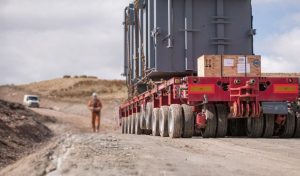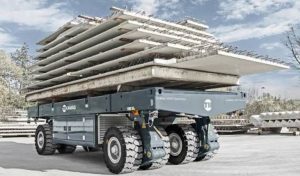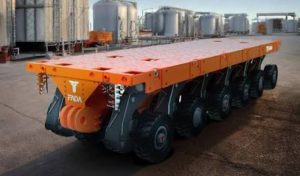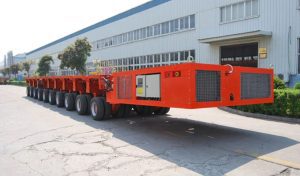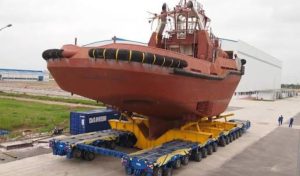
Transporting extremely heavy and oversized cargo requires careful control of how the load is supported and transferred to the transporter. Unlike conventional cargo, large industrial equipment, structural modules, transformers, vessels, and other heavy components may have specific areas designed to carry transportation loads.
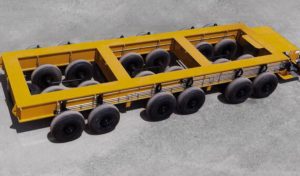
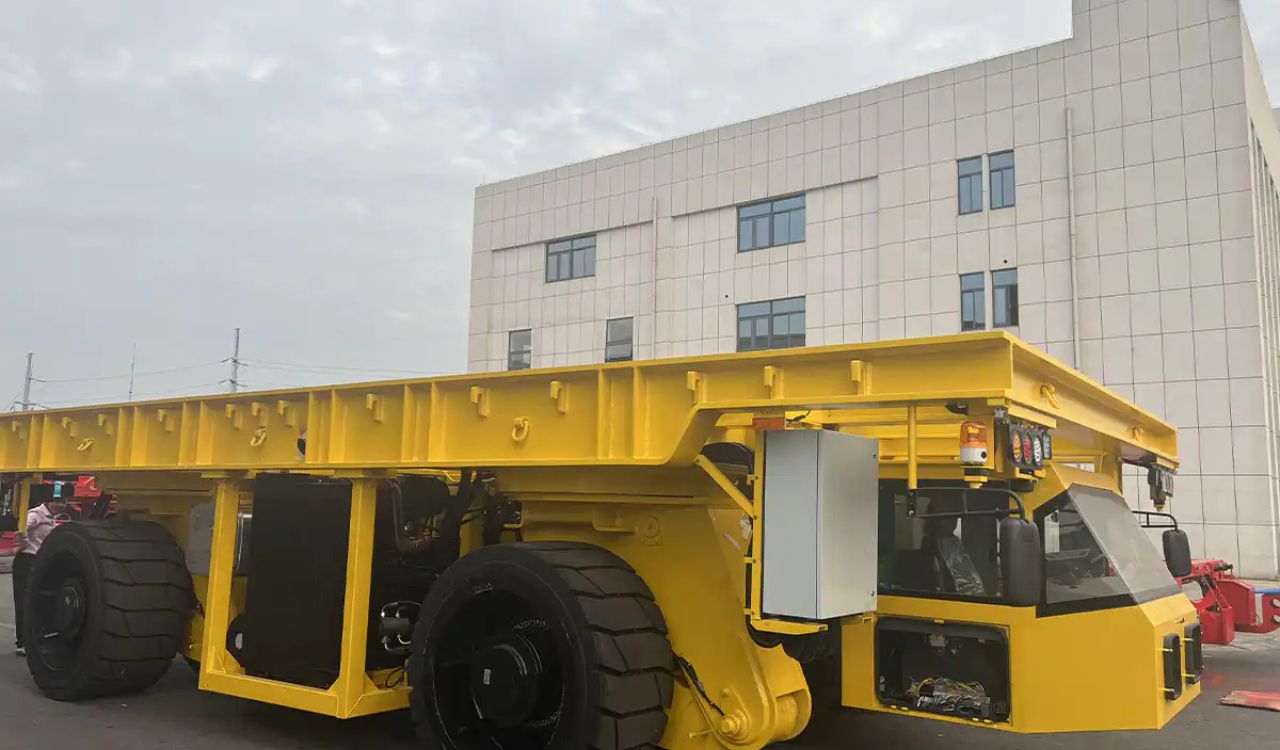
A Self-Propelled Modular Transporter (SPMT) provides a flexible platform with multiple axle lines that can be arranged according to the requirements of the cargo. However, simply placing a heavy load on an SPMT does not guarantee safe transportation. The location of support points, load distribution, center of gravity, and the structure between the cargo and transporter all need to be considered.
Understanding SPMT load transfer and support points is therefore an important part of heavy-haul engineering and transportation planning.
What Is Load Transfer in SPMT Transportation?
Load transfer describes how the weight and forces from the transported cargo move through the supporting structure and into the SPMT.
The basic load path can be understood as:
Cargo → Support Structure → SPMT Deck → Axle Lines → Wheels → Ground
Each part of this load path has an important function.
The cargo transfers its weight through designated support points. These points may connect directly to the SPMT deck or may use additional beams, stools, frames, or other support structures.
The support arrangement then transfers the forces into the SPMT modules. The axle lines distribute the load across multiple wheels, which ultimately transfer the forces to the supporting ground surface.
A properly engineered load path helps prevent excessive stress at individual support locations and contributes to stable transportation.
What Are SPMT Support Points?
SPMT support points are the locations where the transported cargo is supported during the transportation operation.
These points are not necessarily positioned evenly under the cargo. Their location depends on the structural design of the load and the areas capable of safely carrying transportation forces.
For example, a large transformer may have designated lifting or transportation support areas. A pressure vessel may require saddles or specially designed supports, while a structural module may have specific frame members capable of carrying the load.
The support points must therefore be selected according to the cargo’s structural characteristics rather than simply its external dimensions.
Why Support Points Are Important
Support points determine how the cargo’s weight is transferred to the transporter.
If support points are positioned incorrectly, the load may experience unwanted stress or deformation. Excessive loading can also be transferred to parts of the cargo that were not designed to carry transportation forces.
Correct support-point selection helps:
- Distribute cargo weight appropriately
- Maintain cargo stability
- Reduce localized structural stress
- Transfer forces through suitable structural areas
- Improve transporter load distribution
- Support controlled movement
- Reduce the risk of cargo deformation
For extremely heavy loads, even a small change in support-point location can influence the overall load distribution.
How Load Is Distributed Across an SPMT
An SPMT consists of multiple axle lines, allowing the total load to be distributed across a large number of wheels.
When a cargo is positioned on the transporter, its weight is transferred through the selected support points and into the modules underneath.
The distribution is influenced by several factors, including:
- Total cargo weight
- Cargo center of gravity
- Number of support points
- Position of support points
- SPMT module arrangement
- Axle-line configuration
- Hydraulic suspension characteristics
- Ground conditions
The objective is to avoid excessive concentration of load on individual areas.
A properly planned configuration allows the SPMT system to carry the cargo while maintaining an appropriate distribution across its supporting components.
Center of Gravity and Load Transfer
The center of gravity is one of the most important factors in heavy-load transportation.
If the center of gravity is positioned close to the center of the supporting arrangement, the load can generally be distributed more evenly.
However, oversized cargo can have an offset or elevated center of gravity. Equipment containing heavy components on one side, for example, may have an uneven weight distribution.
This affects the forces transferred through individual support points.
Engineers therefore need accurate information about the cargo’s:
- Total weight
- Center of gravity
- Dimensions
- Structural support areas
- Weight distribution
This information is used to determine an appropriate support arrangement and SPMT configuration.
Direct and Indirect Load Support
Not every cargo item can be placed directly on the SPMT deck.
Direct Support
Direct support occurs when the cargo can transfer its load to the SPMT deck through suitable structural contact areas.
This arrangement may be practical for cargo with an appropriate flat or structurally reinforced base.
However, the actual cargo structure must still be evaluated before direct support is used.
Indirect Support
Indirect support uses additional structures between the cargo and SPMT.
These can include:
- Steel beams
- Support frames
- Saddles
- Stools
- Cross beams
- Load-spreading structures
These components help position the cargo and transfer its forces to appropriate locations on the SPMT.
Indirect support can be particularly important when cargo has an irregular shape or limited structural support areas.
Load-Spreading Structures
Large cargo may have only a few structurally suitable support locations. Meanwhile, an SPMT may contain many axle lines distributed across a larger platform.
A load-spreading structure can help bridge this difference.
For example, steel beams may be installed beneath the cargo to distribute its weight across several support locations on the SPMT.
The support structure must itself be engineered to carry the expected forces. Its dimensions, material properties, connection points, and deflection characteristics can all influence the overall load path.
The goal is to transfer the load without creating excessive stress in either the cargo or temporary support structure.
SPMT Hydraulic Suspension and Load Sharing
Hydraulic suspension is an important part of how an SPMT responds to load.
The hydraulic suspension system allows individual axle lines to respond to variations in the ground and loading conditions. This helps maintain contact between the wheels and supporting surface while supporting the transported load.
During transportation, the load can change slightly as the transporter moves over different surfaces or encounters changes in elevation.
The hydraulic system helps accommodate these conditions and contributes to controlled load sharing between the modules.
However, hydraulic suspension does not replace proper engineering. The initial cargo support arrangement and SPMT configuration still need to be correctly designed.
Support Point Design for Heavy Industrial Cargo
Different cargo types require different approaches to support-point design.
Transformers
Transformers can have high concentrated weights and specific structural areas intended for transportation support.
The support arrangement should consider the transformer’s base structure, center of gravity, and approved support locations.
Pressure Vessels
Large pressure vessels may require saddles or other curved support structures.
These supports need to distribute the load appropriately while protecting the vessel shell from excessive localized forces.
Construction Modules
Large modules can have complex structural frames with multiple possible support locations.
Engineers may select support points that align with stronger structural members while distributing the load across the SPMT.
Bridge Components
Bridge sections can be long and relatively flexible compared with their weight.
Support locations therefore need to account for structural behavior and avoid creating excessive bending or localized loading.
How Support Points Affect SPMT Configuration
Support points and SPMT configuration are closely connected.
The position of the support points can influence how many modules are required and where those modules should be positioned.
For example, if the cargo has widely separated support points, the SPMT arrangement may need to provide sufficient modules beneath those areas.
If the cargo has a concentrated center of gravity, additional consideration may be required to ensure that the corresponding SPMT axle lines are not overloaded.
This means the transporter should be configured around the actual load path rather than simply matching the external dimensions of the cargo.
Load Transfer During Movement
The load path does not remain completely static during transportation.
When an SPMT accelerates, stops, turns, or moves over changes in elevation, additional forces can act on the cargo and support system.
Turning can introduce lateral forces, while changes in ground elevation can influence the distribution between different axle lines.
This is one reason why cargo restraint and support structures must be considered alongside static weight distribution.
The transportation plan should account for the expected operating conditions rather than evaluating the cargo only while it is stationary.
Ground Conditions and Load Transfer
The final stage of the load path is the transfer of forces from the SPMT wheels to the ground.
Ground conditions can vary significantly between project locations.
Industrial facilities may have reinforced concrete surfaces, while temporary construction routes may use compacted soil, gravel, or specially prepared roads.
Engineers may need to evaluate:
- Ground bearing capacity
- Surface condition
- Underground structures
- Bridge capacity
- Temporary road construction
- Local variations in ground strength
If the ground cannot safely support the expected loading, additional preparation may be necessary.
Load distribution at the transporter level therefore needs to be considered together with ground conditions.
Common Problems With Poor Support-Point Planning
Improper support-point planning can create several transportation problems.
One potential issue is excessive localized loading on the cargo structure. Another is uneven loading across the SPMT modules.
Poor support arrangements can also result in excessive deflection, instability, or unexpected movement of the cargo.
Common planning problems include:
- Using unsupported cargo areas
- Incorrectly estimating the center of gravity
- Concentrating excessive load on limited axle lines
- Insufficient load-spreading support
- Ignoring dynamic transportation forces
- Failing to check ground conditions
- Using inaccurate cargo weight information
These problems highlight why detailed engineering is necessary before transporting extremely heavy loads.
Engineering Checks for SPMT Load Transfer
Before an SPMT operation begins, engineers typically review the complete load path.
Important checks can include:
Cargo structure: Confirm that the selected areas can safely carry transportation loads.
Support structures: Verify the strength and stiffness of beams, saddles, stools, and other temporary structures.
SPMT configuration: Confirm that the modules and axle lines can support the expected loading.
Center of gravity: Verify its location and influence on load distribution.
Ground conditions: Check whether the transportation surface can support the expected wheel loading.
Clearances: Confirm that the cargo and transporter can move safely along the planned route.
Restraint system: Evaluate the measures required to prevent unwanted cargo movement.
These checks provide a more complete understanding of the transportation system.
Best Practices for SPMT Support Planning
A successful SPMT operation begins with accurate cargo information.
The cargo weight should be verified rather than estimated whenever possible. Engineering drawings should also be reviewed to identify suitable support locations.
Other good practices include:
- Confirm the center of gravity before configuration.
- Identify structurally approved support points.
- Use engineered load-spreading structures when necessary.
- Check the SPMT axle-line loading.
- Evaluate ground-bearing conditions.
- Consider forces during turning and acceleration.
- Verify cargo restraint requirements.
- Conduct route and clearance surveys.
- Use qualified heavy-haul engineers for complex projects.
Clear communication between cargo designers, transport engineers, SPMT operators, and site teams can also reduce the risk of errors.
Why Proper Load Transfer Improves Heavy-Haul Operations
Proper load transfer planning provides several benefits.
It helps protect the transported cargo by ensuring that forces are introduced through suitable structural areas. It also helps the SPMT carry the load within its intended operating parameters.
A well-designed load path can contribute to:
- Better stability
- More predictable load distribution
- Reduced structural stress
- Improved control during movement
- Better use of SPMT capacity
- Safer route execution
- More reliable final positioning
These benefits become increasingly important as cargo weight and dimensions increase.
Conclusion
SPMT load transfer and support points are fundamental elements of heavy and oversized cargo transportation. The weight of the cargo must travel through a carefully designed load path from the cargo structure to the support system, SPMT modules, axle lines, wheels, and finally the ground.
The correct support points depend on the structural characteristics of the cargo, its center of gravity, weight distribution, and transportation requirements. In many projects, additional support structures are required to distribute the load between the cargo and SPMT.
A successful transportation plan therefore considers the entire system rather than looking at the transporter capacity alone. Proper engineering, accurate cargo data, suitable support structures, appropriate SPMT configuration, and adequate ground preparation all contribute to reliable heavy-haul transportation.
Frequently Asked Questions
What is SPMT load transfer?
SPMT load transfer is the process through which the weight and forces of transported cargo move from the cargo structure through its support system, SPMT modules, axle lines, wheels, and into the ground.
What are SPMT support points?
SPMT support points are the specific locations where the cargo is supported during transportation. They should normally correspond to structurally suitable areas of the cargo.
Why is the center of gravity important?
The center of gravity affects how the cargo weight is distributed across the support points and SPMT axle lines. An offset center of gravity can create uneven loading.
Can heavy cargo be placed directly on an SPMT deck?
Sometimes, but not always. Cargo with suitable structural support areas may be directly supported, while irregular or structurally sensitive loads may require beams, stools, saddles, or other engineered support structures.
What is a load-spreading structure?
A load-spreading structure is an engineered component placed between the cargo and transporter to distribute forces across appropriate support locations.
Does hydraulic suspension affect load transfer?
Yes. SPMT hydraulic suspension helps the transporter respond to changes in ground elevation and loading conditions, supporting controlled load sharing between axle lines.
What cargo requires careful support-point planning?
Transformers, pressure vessels, bridge components, industrial modules, generators, and other large or heavy structures can require detailed support-point engineering.
Is SPMT load transfer only important when the transporter is moving?
No. Static load distribution is important before movement, while additional forces can occur during acceleration, braking, turning, and movement over uneven surfaces. Both conditions should be considered during planning.