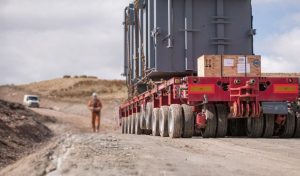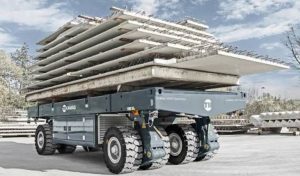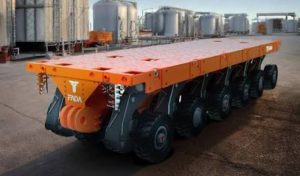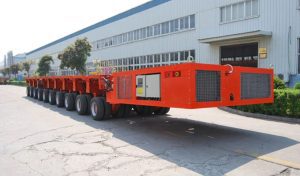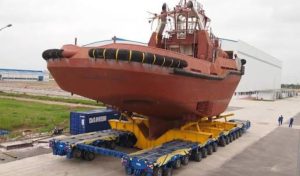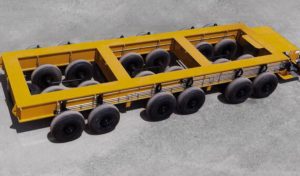
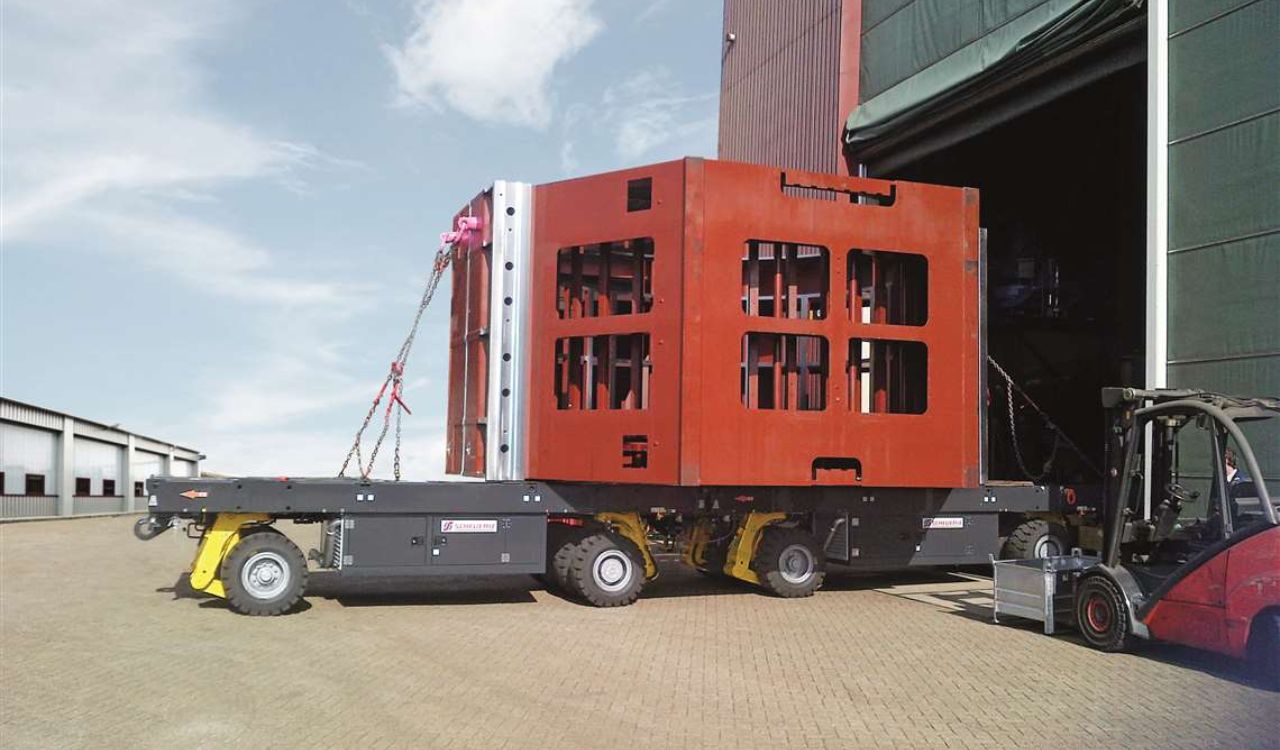
Transporting extremely heavy and oversized structures requires more than sufficient payload capacity. The transporter must also maintain an appropriate deck height as the load travels through different sections of a project site. Clearance, load positioning, ground conditions, structural requirements, and final placement can all influence the required height of the transport platform.
SPMT deck height management is therefore an important part of modern heavy transport engineering. Self propelled modular transporters SPMT systems use hydraulic suspension and lifting capabilities to raise or lower the platform, helping transport teams manage clearance and positioning requirements during complex moves.
Unlike conventional fixed-height transport equipment, an SPMT can provide significant flexibility when the load needs to be adjusted vertically during a transport operation.
What Is SPMT Deck Height?
SPMT deck height is the vertical distance between the supporting ground surface and the transporter deck on which the cargo or its supporting structure is positioned.
The actual deck height can vary depending on:
- SPMT configuration
- Hydraulic suspension position
- Load weight
- Suspension travel
- Tire dimensions
- Ground conditions
- Support equipment
- Required clearance
- Loading and unloading procedure
Because SPMTs use hydraulic suspension systems, the platform can generally be raised or lowered within the operating range of the specific equipment.
This capability is particularly valuable when a heavy load needs to pass beneath structures, align with another platform, or be positioned accurately at its destination.
Why Deck Height Matters in Heavy Transport
Deck height affects several aspects of an SPMT operation.
A lower deck can provide additional overhead clearance, while raising the deck can help the load reach a required elevation during positioning or installation.
Poor deck-height planning can result in:
- Insufficient overhead clearance
- Difficulty passing through restricted areas
- Problems aligning with foundations
- Unnecessary changes to the transport route
- Increased positioning time
- Interference with site structures
- Difficulties during load transfer
- Reduced operational flexibility
For this reason, deck height should be considered during the initial engineering stage rather than treated as an adjustment that can be solved after the SPMT arrives on site.
How SPMT Hydraulic Lifting Works
Hydraulic lifting is based on controlled hydraulic cylinders and suspension components that can change the vertical position of the transporter platform.
A hydraulic system uses pressurized fluid to generate force. The hydraulic cylinders can extend or retract according to commands from the control system.
In an SPMT, this allows the transporter to perform controlled vertical movements while supporting a very heavy load.
The exact hydraulic architecture varies between manufacturers and models, but the basic operating concept involves:
- Hydraulic power generation
- Hydraulic pressure control
- Cylinder movement
- Suspension response
- Platform height adjustment
- Continuous monitoring and control
The system is designed to provide controlled movement rather than simply acting as a conventional mechanical jack.
SPMT Hydraulic Suspension and Deck Height
Hydraulic suspension has an important relationship with deck height.
An SPMT’s suspension system allows the transporter to respond to variations in the supporting surface while maintaining controlled contact between the wheels and the ground.
When the transporter encounters changes in elevation, hydraulic suspension can accommodate vertical movement while helping maintain the required platform behavior.
This becomes particularly useful when transporting a long or rigid structure across an area where the ground elevation changes.
However, hydraulic suspension does not mean that any terrain can be safely traversed. The route still needs to be surveyed and engineered for the expected load and transporter configuration.
Main Reasons to Adjust SPMT Deck Height
There are several situations in which vertical adjustment can become an important part of the transport plan.
1. Increasing Overhead Clearance
One of the most obvious reasons for lowering an SPMT deck is to increase clearance beneath overhead obstacles.
Potential obstacles can include:
- Pipe racks
- Factory structures
- Bridges
- Utility infrastructure
- Gantries
- Building entrances
- Temporary structures
- Process equipment
When the cargo itself is extremely tall, even a relatively small reduction in deck height can provide valuable additional clearance.
However, engineers should calculate the complete transport envelope, including the cargo’s maximum height and any expected movement of the suspension.
2. Raising the Load for Final Positioning
The opposite situation can also occur.
A heavy component may need to be raised to align with:
- A foundation
- A support structure
- Installation stools
- Rails
- Another transport platform
- A construction interface
In these circumstances, hydraulic lifting can allow the SPMT platform to raise the load to the required working elevation.
The transporter may then be used as a positioning system rather than simply as a means of moving cargo from one location to another.
3. Passing Through Restricted Areas
Industrial facilities frequently contain narrow passages where both horizontal and vertical clearances are limited.
A transport engineering team may therefore need to calculate:
Cargo height + SPMT deck height = total transport height
If the resulting height exceeds available clearance, lowering the deck may become part of the route solution.
But the calculation should also account for:
- Ground elevation changes
- Suspension movement
- Cargo movement
- Temporary structures
- Safety clearance
- Surface irregularities
Deck Height and Overall Transport Height
For oversized cargo, the important measurement is not the SPMT deck alone.
The engineering team needs to consider the entire vertical envelope.
A simplified relationship is:
Overall transport height = deck height + support structure height + cargo height
For example, if a cargo unit is mounted on a transport frame, the frame itself contributes to the total height.
This is why minimizing deck height alone does not necessarily solve a clearance problem.
Engineers should evaluate the complete cargo-support-transporter combination.
Deck Height During Loading Operations
SPMT deck height can also play an important role during load-out.
Depending on the project, cargo may be transferred onto the transporter using:
- Cranes
- Hydraulic lifting systems
- Strand jacks
- Gantry systems
- Hydraulic skidding systems
- Temporary supports
The SPMT may need to be positioned at a specific elevation before the load is transferred.
Hydraulic adjustment can help align the transporter with the required support points.
This is especially useful for large structures where even a small mismatch in elevation can complicate load transfer.
Deck Height During Load Transfer
Load transfer is a critical stage because the weight distribution can change as the cargo moves between temporary supports and the SPMT.
For example, a heavy structure may initially rest on temporary supports while the SPMT moves underneath it.
The transporter can then be raised until its support structure makes controlled contact with the cargo.
At this point, the engineering team needs to consider:
- Support-point locations
- Contact loads
- Structural capacity
- Hydraulic pressure
- Cargo deflection
- SPMT leveling
- Load transfer sequence
The objective is to transfer the load gradually and predictably.
SPMT Deck Height and Load Stability
Changing deck height can also affect the overall geometry of a heavy load.
When a load is raised, its center of gravity becomes higher relative to the ground.
This can influence the stability characteristics of the complete transport system.
For this reason, vertical lifting should be performed only within the operating parameters of the SPMT and the approved engineering plan.
Factors to consider include:
- Cargo center of gravity
- Platform width
- Load distribution
- Ground conditions
- Route slope
- Wind exposure
- Transport speed
- Hydraulic system limits
A higher load may be appropriate for a specific positioning operation but undesirable during certain travel sections.
Deck Height Management on Uneven Ground
One of the benefits of hydraulic suspension is the ability to accommodate changes in surface elevation.
Imagine an SPMT carrying a long industrial module across a route with slight variations in ground elevation.
If the transporter were completely rigid, these variations could create undesirable load reactions.
Hydraulic suspension allows the transporter to respond to vertical changes while maintaining controlled support.
Nevertheless, route preparation remains essential.
Large depressions, weak areas, sudden transitions, or unsupported surfaces can create conditions beyond the intended operating range.
How Engineers Determine the Required Deck Height
Deck height should be determined as part of the overall transport engineering process.
The planning team typically considers:
Cargo Dimensions
The cargo’s overall height, length, width, and support locations must be established accurately.
Clearance Requirements
The team identifies the lowest available overhead clearance along the route.
SPMT Configuration
The selected number and arrangement of axle lines can influence the available platform geometry and operating characteristics.
Hydraulic Range
The actual lifting and suspension range of the selected SPMT must be confirmed from manufacturer specifications.
Ground Profile
Changes in road or yard elevation can affect the available clearance and transporter position.
Final Installation Elevation
If the SPMT is also being used for positioning, the required final elevation needs to be included in the plan.
SPMT Deck Height for Industrial Projects
Deck-height control is particularly valuable in industrial environments.
Large facilities can contain dense networks of:
- Pipelines
- Cable trays
- Structural steel
- Equipment
- Platforms
- Storage systems
- Process units
- Access roads
A heavy-duty transporter may need to move through areas that were never designed for the passage of extremely large cargo.
In these situations, the ability to adjust deck height can give engineers another variable to work with when developing the transport route.
SPMT Deck Height and Bridge Transport
Bridge components can also present challenging vertical requirements.
A bridge girder or prefabricated structure may need to pass through restricted areas before reaching the installation location.
In some cases, the transporter may also need to position the load at a precise elevation for the next construction stage.
Deck-height control can therefore support both transportation and positioning.
This is different from simply moving a cargo item along a road. The transporter may become part of the construction methodology itself.
Advantages of Hydraulic Deck Height Control
Hydraulic deck-height adjustment can provide several operational benefits.
Greater Clearance Flexibility
Lowering the platform can help manage overhead restrictions.
More Precise Positioning
Raising or lowering the platform can help align cargo with its final support location.
Improved Load Transfer
Controlled vertical movement can assist in transferring loads between temporary supports and the transporter.
Better Adaptation to Surface Conditions
Hydraulic suspension can accommodate controlled changes in surface elevation.
Reduced Dependence on Fixed Transport Geometry
The transporter can be adjusted to suit different stages of a project.
Limitations and Important Considerations
Hydraulic lifting is powerful, but it should not be treated as a universal solution to transport challenges.
Hydraulic Travel Is Limited
Every SPMT has a defined operating range. The transporter should not be operated beyond the manufacturer’s specified limits.
Raising the Load Changes Its Geometry
Increasing deck height also increases the height of the overall load.
Ground Conditions Still Matter
Hydraulic suspension cannot compensate indefinitely for weak or unstable ground.
Load Distribution Must Be Verified
Vertical adjustment does not eliminate the need to calculate axle reactions and support loads.
Clearance Must Be Rechecked
Changing the platform height can alter the transport envelope and may create new clearance issues elsewhere.
Best Practices for SPMT Deck Height Management
A well-planned operation should incorporate the following practices:
- Measure cargo dimensions accurately before transport.
- Establish the cargo center of gravity.
- Identify minimum overhead clearance along the route.
- Confirm the SPMT’s available hydraulic lifting range.
- Determine required deck heights for each major transport stage.
- Check the complete transport height rather than the deck alone.
- Verify ground conditions and route elevation changes.
- Avoid unnecessary vertical adjustments while traveling.
- Monitor hydraulic system performance during operation.
- Establish clear communication between the SPMT operator and engineering team.
- Recalculate clearance whenever the route or cargo configuration changes.
- Follow the manufacturer’s operating limits and project-specific engineering procedures.
SPMT Deck Height Management vs Fixed-Height Transport Equipment
A major difference between SPMTs and many conventional transport solutions is the ability to actively control the platform’s vertical position.
| Feature | SPMT | Fixed-height transport equipment |
| Adjustable deck height | Yes, within system limits | Usually limited |
| Hydraulic suspension | Yes | Depends on equipment |
| Load positioning | Highly flexible | More dependent on external equipment |
| Clearance management | More adaptable | Primarily determined by fixed geometry |
| Industrial-site maneuverability | High | Varies |
| Vertical load adjustment | Integrated into system | May require separate equipment |
This flexibility can be particularly useful for projects where transport and final positioning are closely connected.
What Should Be Included in an SPMT Deck Height Plan?
For complex projects, the deck-height plan should document the required vertical position for important stages of the operation.
A useful plan may include:
| Stage | Height consideration |
| Load-out | Required elevation for load transfer |
| Initial travel | Lowest practical transport height |
| Restricted clearance area | Minimum safe overall height |
| Uneven route section | Suspension operating range |
| Turning area | Load geometry and stability |
| Final approach | Required positioning elevation |
| Installation | Height needed for transfer to permanent supports |
This provides the operator and project team with a clear reference rather than requiring height decisions to be made during the move.
Final Thoughts
SPMT deck height management is an important part of planning complex heavy transport operations. Hydraulic lifting and suspension allow SPMTs to adapt their platform elevation to different stages of a project, from load-out and route travel to precise final positioning.
The greatest benefit is flexibility. A transporter can operate at a lower height when clearance is critical and can be raised when the load needs to be aligned with a higher support or installation point.
However, hydraulic adjustment should always be considered alongside load stability, center of gravity, ground conditions, axle loading, route geometry, and manufacturer operating limits.
For engineers, contractors, and heavy transport professionals, treating deck height as an engineering variable—not simply an equipment specification—can lead to better route planning, more controlled load transfers, and more precise positioning of oversized cargo.
Frequently Asked Questions
What is SPMT deck height?
SPMT deck height is the vertical distance from the supporting ground surface to the transporter deck. It can vary depending on the SPMT configuration, hydraulic suspension position, load, tires, and operating conditions.
Can an SPMT raise and lower its deck?
Yes. SPMTs use hydraulic suspension and lifting systems that allow controlled vertical adjustment within the operating range of the particular transporter.
Why is hydraulic lifting important for SPMTs?
Hydraulic lifting allows the transporter to adjust load elevation for clearance management, load transfer, route conditions, and precise final positioning.
Does lowering an SPMT always improve stability?
Lowering the load can reduce overall load height and may provide a more favorable stability configuration, but stability depends on multiple factors, including center of gravity, platform geometry, ground conditions, load distribution, and route characteristics.
How does deck height affect overhead clearance?
A lower deck can reduce the total height of the cargo-transporter combination, potentially increasing available clearance beneath bridges, pipe racks, gantries, and other obstacles.
Can an SPMT change deck height while carrying a heavy load?
SPMT hydraulic systems are designed to support controlled vertical movement, but the permitted operation depends on the specific equipment, load, configuration, and approved engineering procedure.