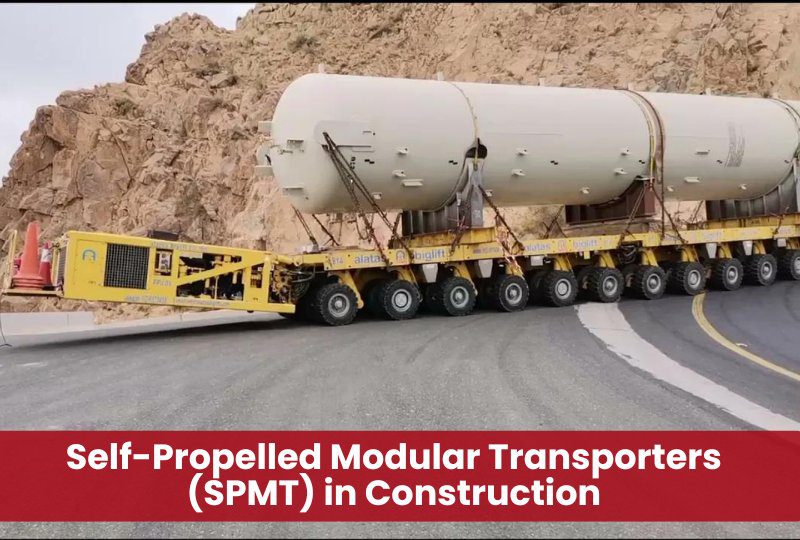
Modern construction sites are handling heavier and larger prefabricated components than ever before. Bridge spans, precast segments, industrial modules, and entire building sections are increasingly built off-site and then moved into position as a single unit. This shift toward modular construction has made the self-propelled modular transporter, or SPMT, one of the most important pieces of heavy transport equipment on a job site.
This guide covers what an SPMT is, how it works, where SPMT in construction is used, and what specifications matter when planning a heavy lift or move.
What Is a Self-Propelled Modular Transporter?
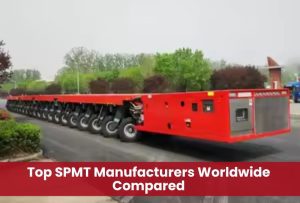
A self-propelled modular transporter is a platform vehicle built from multiple axle lines, each fitted with independent hydraulic suspension and its own steering. Unlike a standard trailer that needs a separate tractor unit, an SPMT carries its own power source through a power pack unit, or PPU, which supplies hydraulic pressure for driving, steering, braking, and lifting.
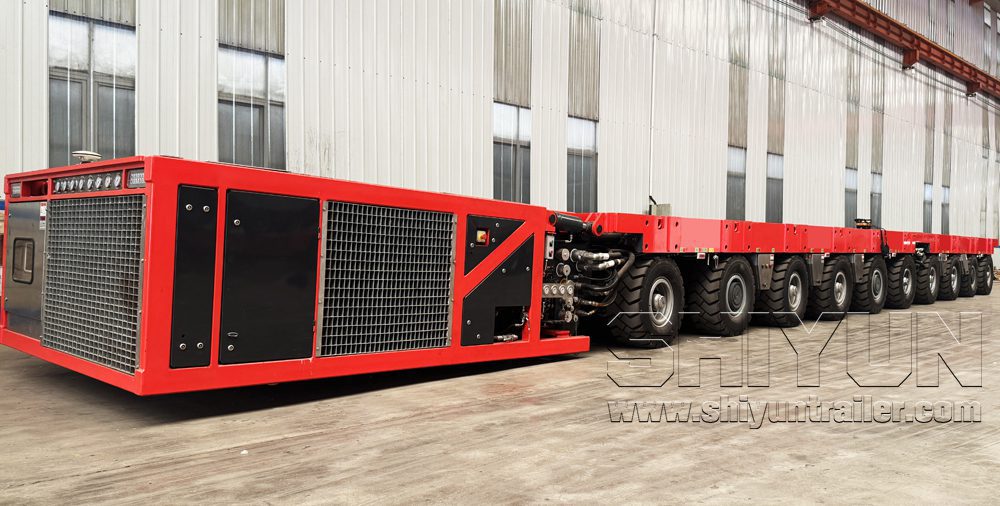
Because each axle line operates independently, an SPMT can raise or lower its deck, correct for uneven ground, and keep a load perfectly level while moving at walking speed. Operators control the entire platform through a wireless remote, allowing one person to guide a convoy of modules carrying hundreds of tons.
An SPMT is often described as an upgraded version of a hydraulic modular trailer. The main difference is self-propulsion. A modular trailer needs a prime mover to pull it, while an SPMT drives, steers, and lifts on its own.
How SPMTs Work on a Construction Site
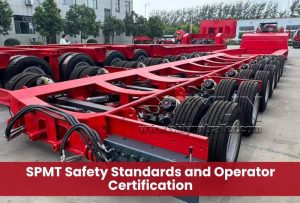
The modular design is what makes SPMTs so adaptable. Individual axle line modules, commonly available in 4, 5, 6, or 8 axle line configurations, can be coupled side by side or end to end to build a platform sized for the load. A small bridge girder might only need a single 4-axle module, while a large industrial vessel or a multi-span bridge section could require dozens of axle lines linked together.
Key functional features include:
360-degree steering. Wheels on each axle line can pivot independently, allowing sideways movement, carousel turns, and precise positioning in tight site conditions where a crane or truck cannot maneuver.
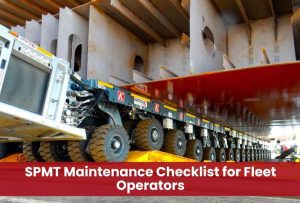
Hydraulic deck lifting. The deck height can typically be adjusted by around 60 centimeters. This lets the SPMT drive under a load, lift it directly off its supports, and lower it into final position without a separate crane lift.
Load distribution. Because weight is spread across many wheels and axle lines rather than concentrated on a few tires, SPMTs place far less point load on pavement, temporary roadways, or barge decks than conventional heavy haul trucks.
Remote operation. A single operator with a handheld controller can manage an entire convoy, coordinating dozens of axle lines as one unit.
SPMT Applications in Construction
Accelerated Bridge Construction
One of the fastest-growing uses of SPMTs is accelerated bridge construction, where a new bridge span is built off-site or alongside the existing structure and then moved into place in a single operation. Instead of closing a highway for months during conventional construction, crews can complete the move in hours, sometimes overnight, and reopen the traffic road almost immediately. Departments of transportation in the United States and Europe have adopted this method specifically to reduce road closures and minimize disruption to traffic.
Plant and Industrial Module Installation
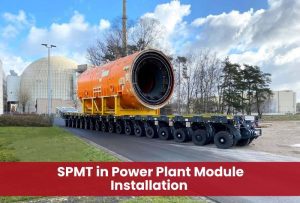
On refinery, chemical, and power plant projects, large equipment such as reactors, compressors, and pipe racks is frequently fabricated off-site as complete modules. SPMTs move these modules into their final position, avoiding the need for on-site assembly in congested plant areas where crane access is limited.
Shipbuilding and Offshore Structures
Shipyards use SPMTs to move hull sections between construction stages and to transfer completed vessels to the launch area. The same equipment handles offshore modules, oil platform components, and other heavy marine structures that must be positioned with sub-centimeter accuracy.
Precast and Prefabricated Building Components
As modular and prefabricated construction grows, SPMTs are increasingly used to move large precast panels, building modules, and structural sections from a fabrication yard to their installation point.
Heavy Equipment and Machinery Relocation
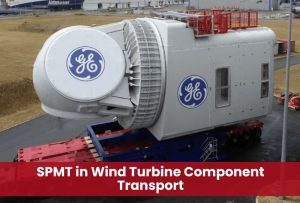
Wind turbine components, large transformers, cranes, and factory equipment that exceed the capacity of conventional trailers are commonly moved using SPMT platforms, particularly where ground access rules out cranes.
SPMT Types and Configurations
Conventional (diesel-driven) SPMTs. The standard configuration, using a diesel-powered PPU for hydraulic drive, steering, and lifting. This remains the most common type for heavy construction work due to power output and reliability on long or demanding routes.
Electric SPMTs. Battery-powered units that reduce emissions and noise, making them suitable for indoor use, enclosed shipyards, and projects with environmental restrictions. Some electric platforms can also function as automated guided vehicles.
Width configurations. SPMTs are commonly built in 2.43 meter and 3 meter platform widths. The narrower 2.43 meter width fits inside a standard flat-rack shipping container, simplifying international transport and often avoiding oversize permit requirements. The 3 meter platform generally supports a higher load capacity per axle line but is less common in the SPMT services market.
Key Specifications to Understand
When evaluating SPMT capability for a project, a few specifications matter more than others.
Axle lines. The basic building block of an SPMT platform. Modules are typically available with 4, 5, 6, or 8 axle lines, and multiple modules can be combined for larger loads.
Load capacity per axle line. This varies by manufacturer and model, generally ranging from roughly 36 to 48 tons per axle line in standard commercial units, with some heavy-duty platforms rated higher. Total payload is calculated by multiplying capacity per axle line by the number of axle lines in the configuration.
Power pack unit (PPU). The engine and hydraulic control unit that drives the platform. PPU sizing needs to match the total number of driven axle lines and the transport weight. An undersized PPU limits how many axle lines the convoy can move; an oversized one adds unnecessary cost.
Deck height and lift range. Determines how much vertical clearance the SPMT provides for loading and unloading without a crane.
Travel speed. SPMTs move slowly, often under 5 km/h and sometimes closer to walking pace when fully loaded, which reflects the precision required rather than a limitation of the equipment.
SPMT vs. Hydraulic Modular Trailer
These two are related but not the same. A hydraulic modular trailer uses the same axle line and suspension technology but requires a separate tractor unit to move, and a mechanical steering system operated through the tractor. An SPMT integrates its own power pack, so it drives, steers, and lifts independently. In practical terms, SPMTs offer more precise control and self-loading capability, while modular trailers are often a more economical option for straightforward point-to-point heavy haulage where independent propulsion is not needed.
Planning Considerations for Construction Projects
Before specifying an SPMT for a project, planning typically covers ground bearing capacity along the travel route, the total number of axle lines needed for the load, clearance for turning and sideways movement, and whether the operation calls for diesel or electric platforms based on site restrictions. Detailed engineering is standard practice for any move involving structural components like bridge spans, since load distribution and route conditions directly affect axle line configuration.
Shiyun Trailer, a heavy-duty trailer and special transporter manufacturer based in Qingdao, China, produces self-propelled modular transporters and hydraulic modular trailers for exporters, EPC contractors, and heavy haul operators working on these types of projects.
Frequently Asked Questions
What does SPMT stand for?
SPMT stands for self-propelled modular transporter, a platform vehicle used to move exceptionally heavy or oversized loads without a separate tractor unit.
What is the difference between SPMT and SPT?
SPT, or self-propelled transporter, is a simplified version of an SPMT that uses linkage rod steering instead of the independent axle steering found on a true SPMT. The two look similar but differ in how steering is controlled.
How much weight can an SPMT carry?
Capacity depends on the number of axle lines and the rating per axle line, which commonly falls between roughly 36 and 48 tons. A 6-axle module can carry over 200 tons, and coupling multiple modules together scales capacity into the thousands of tons for major industrial and marine moves.
Do SPMTs need a road permit to operate?
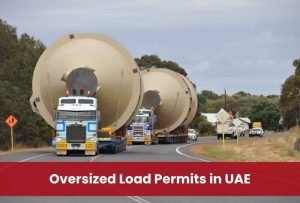
On public roads, oversized SPMT convoys generally require abnormal load permits, similar to other heavy haul transport. Within a construction site, plant, or shipyard, they typically operate under project-specific safety procedures rather than public road permits.
Can an SPMT lift a load without a crane?
Yes. The hydraulic suspension on each axle line allows the deck to rise or lower, so an SPMT can drive under a load, lift it directly, and later lower it into position without crane assistance.
What industries use SPMTs besides construction?
SPMTs are widely used in shipbuilding, oil and gas, power generation, petrochemical plants, and heavy machinery manufacturing, in addition to bridge and building construction.