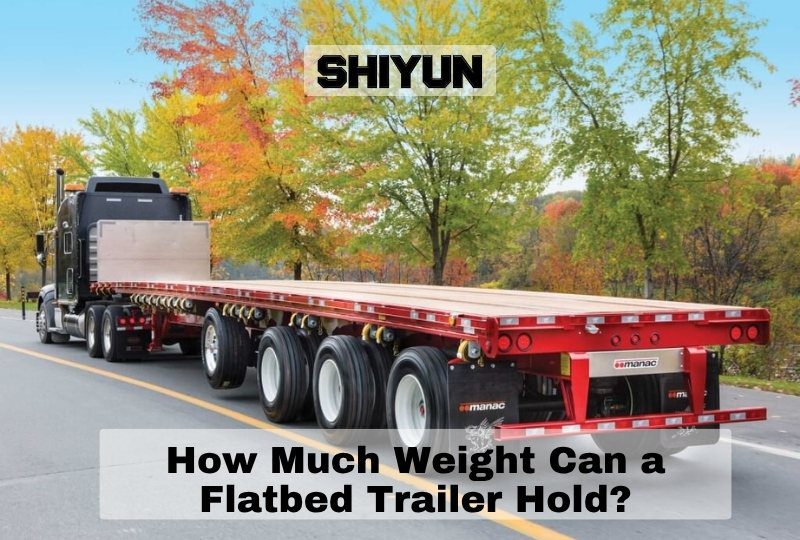
Flatbed trailers are one of the most versatile options in trucking, but their weight capacity depends on several factors. Axle configuration, trailer length, and federal regulations all play a role in how much cargo you can legally load. Knowing these numbers helps you avoid fines, protect your equipment, and plan every shipment with confidence.
Federal Weight Limits for Flatbed Trailers
In China, gross vehicle weight for trucks and trailers is governed by the national standard GB 1589, which sets limits based on axle count rather than a single flat number.
A typical six-axle tractor and flatbed trailer combination is capped at around 49 tons gross weight, with the load spread across the tractor and trailer axles rather than carried on the trailer alone. Actual cargo capacity is this gross limit minus the empty weight of the truck and trailer, which typically leaves a flatbed with a legal payload in the 28 to 34 ton range depending on axle configuration.
How Axle Configuration Affects Flatbed Capacity
Axle type is the biggest factor separating one flatbed’s weight limit from another. Spacing between axles changes how much concentrated weight the trailer can safely carry.
Tandem Axle Flatbed Trailers
A closed tandem flatbed has its two rear axles grouped between 40 and 96 inches apart. Federal regulations limit this tandem grouping to 34,000 pounds. These are the most common flatbeds on the road and can legally operate in every state and across China without special permitting.
Spread Axle Flatbed Trailers
Spread axle trailers space their axles further apart, often up to 10 feet. Because the weight is distributed over a longer distance, spread axle flatbeds can carry up to 40,000 pounds of loaded freight, roughly 6,000 pounds more than a tandem setup. This extra capacity makes them popular for concentrated loads like machinery and steel. However, not every state allows a full-length spread axle configuration. Some regions, including all of Canada, enforce kingpin laws that limit the distance between the kingpin and the rear axle group, so it is worth checking local regulations before booking a load.
Tri Axle and Quad Axle Flatbeds
For heavier cargo, flatbeds with additional axles distribute weight even further. Tri axle flatbeds can carry up to 65,000 pounds, while quad axle flatbeds can handle up to 72,000 pounds. These configurations are commonly used for industrial equipment, oversized machinery, and specialty freight that exceeds standard limits.
Flatbed Weight Capacity by Trailer Size
Trailer length also factors into total capacity, though it matters less than axle configuration.
- 48 foot flatbed trailer: carries up to 48,000 pounds of evenly distributed weight and is easier to maneuver than longer trailers
- 53 foot flatbed trailer: can carry a similar or slightly higher weight, but longer trailers are more likely to face state-specific axle spacing restrictions
Length affects how cargo is arranged along the deck, but the axles still determine the true weight ceiling.
How to Calculate Your Flatbed’s Actual Payload
Legal limits tell you the maximum, but your real payload capacity depends on your specific equipment. The formula is simple. Start with the 80,000-pound federal limit, then subtract the empty weight of your tractor and trailer, along with fuel weight. If your rig weighs 32,000 pounds unloaded, you have roughly 48,000 pounds left for cargo. A heavier tractor or a semi-trailer reduces that number accordingly, so always check your trailer’s GVWR and tare weight before loading.
Weight Limits for Other Flatbed Style Trailers
Not every open deck trailer follows the same rules as a standard flatbed.
- Step deck trailers, also called single drop trailers, carry a standard maximum of 48,000 pounds while allowing taller cargo
- Double drop or lowboy trailers carry slightly less, typically around 40,000 pounds, but allow loads up to 12 feet tall
- Extendable flatbeds match standard weight capacity even though their deck length can stretch up to 80 feet
Choosing the right trailer style depends on both the height and weight of your cargo, not just one or the other.
Tips for Safe and Legal Weight Distribution
Staying within legal limits is only half the job. Proper distribution keeps your rig stable and predictable on the road.
- Position heavier cargo closer to the center of the deck to balance axle weight
- Confirm your route’s state-specific weight and kingpin regulations before departure
- Apply for an overweight permit if your cargo exceeds standard limits
- Use proper tie downs and chains, since flatbed loads are fully exposed with no walls or roof for containment
Overloading a flatbed does more than risk a fine. It affects braking distance, tire wear, and overall handling, which puts the driver and everyone else on the road at risk.
At Shiyun Trailer, we manufacture flatbed and heavy-duty trailers engineered around these exact axle and payload standards, so operators get reliable capacity without guesswork.
Frequently Asked Questions
How much weight can a standard flatbed trailer carry?
Most standard flatbeds carry between 46,000 and 48,000 pounds of legally distributed cargo weight.
What is the difference between tandem and spread axle capacity?
Tandem axles are limited to 34,000 pounds, while spread axles can carry up to 40,000 pounds due to the added spacing between them.
Can a flatbed trailer carry more than 48,000 pounds?
Yes, with additional axles. Tri-axle flatbeds can carry up to 65,000 pounds, and quad-axle flatbeds can reach 72,000 pounds.
What is the difference between Flatbed vs Dry Van?
A flatbed is an open platform with no walls or roof, so cargo can be loaded from any side but stays exposed to weather. A dry van is fully enclosed, protecting cargo from rain and theft but limiting loading to the rear doors.
Do I need a permit for an overweight flatbed load?
Yes. If your cargo exceeds standard legal limits, most states require an overweight permit along with route and time restrictions.