Moving massive industrial components, bridge sections, offshore modules, and oversized structures requires more than standard transport equipment. It requires precision, power, and engineering flexibility. That is where the SPMT trailer stands out.
A Self-Propelled Modular Transporter (SPMT) is one of the most advanced heavy haulage solutions in the world. Designed to carry extremely heavy and oversized loads, SPMTs are built with modular axle lines, advanced steering systems, hydraulic suspension, and self-propelled drive technology. For industries that depend on safe and efficient movement of complex cargo, understanding SPMT trailer specification is essential.
In this guide, you will learn what an SPMT trailer is, the most important specifications to know, how these transport systems work, and why they are critical in modern heavy transport operations.
What Is an SPMT Trailer?
An SPMT trailer is a modular transport platform with multiple computer-controlled axle lines that can move heavy loads under its own power. Unlike conventional trailers, it does not rely entirely on an external truck for movement. Instead, it uses a built-in powered drive system that allows it to carry oversized cargo with exceptional control.
SPMT trailers are used for projects involving:
- Bridge sections
- Refinery equipment
- Cranes and motors
- Ship sections
- Offshore structures
- Power plant components
- Entire buildings
Because the system is modular, multiple SPMT units can be connected side-by-side or end-to-end to create a larger platform for heavier or more complex loads.
Why SPMT Trailer Specification Matters
Every heavy haul project has different transport needs. The specifications of an SPMT trailer affect how much weight it can carry, how it will distribute the load, how well it can maneuver, and how safely it can operate on different surfaces.
Choosing the correct SPMT trailer specification helps improve:
- Project safety
- Load stability
- Transport efficiency
- Site maneuverability
- Equipment compatibility
- Overall operational reliability
For engineering teams, logistics planners, and heavy transport contractors, the right SPMT specification is a major factor in project success.
Core SPMT Trailer Specifications
Axle Line Configuration
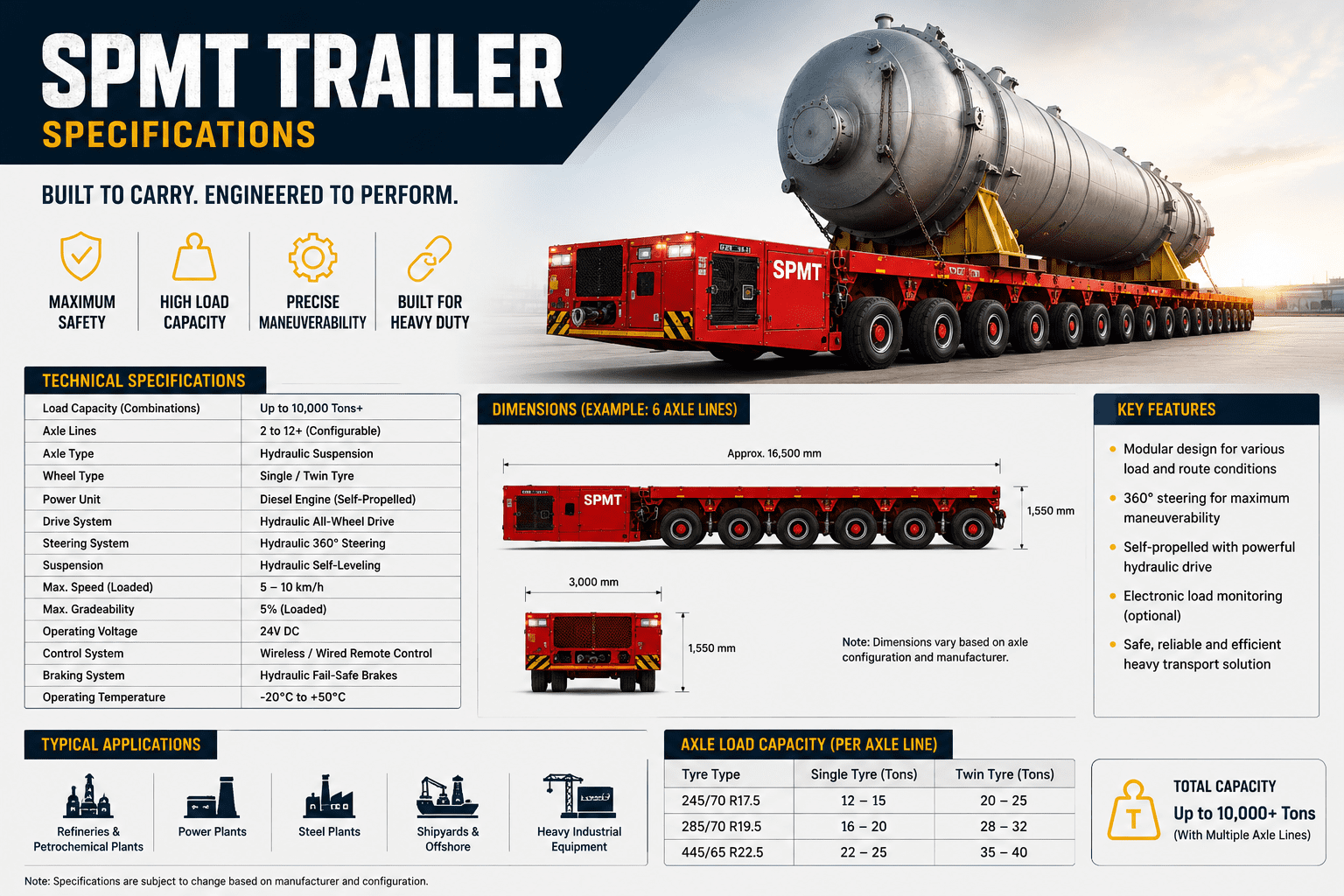
The axle line configuration is one of the most important parts of any SPMT trailer specification. A typical SPMT module includes multiple axle lines arranged in a grid. In many cases, units have two axles across and four to eight axles along the module, though the final setup depends on the project.
Each axle line contributes to:
- Payload support
- Stability
- Weight distribution
- Steering performance
More axle lines allow the transporter to handle heavier loads while spreading weight more evenly across the ground.
Payload Capacity
Payload capacity is a top consideration in any heavy transport project. The total load an SPMT trailer can carry depends on the number of axle lines used, the design of the trailer, and the overall transport setup.
SPMT systems are ideal for loads that weigh hundreds or even thousands of tons, making them essential for industries that regularly move oversized cargo.
Steering Capability
One of the defining features of an SPMT trailer is its steering system. Each axle can be controlled individually, allowing the transporter to make highly precise movements. Many SPMT systems offer axle rotation up to 270 degrees, while some can achieve full 360-degree steering.
This makes it possible for the SPMT to:
- Move sideways
- Rotate in place
- Navigate tight job sites
- Reposition large loads with precision
This level of steering control is one of the main reasons SPMTs are preferred in confined industrial environments.
Hydraulic Suspension
Hydraulic suspension is another major element of SPMT trailer specification. This system allows the transporter to keep the load level and stable, even when moving across uneven surfaces.
Benefits of hydraulic suspension include:
- Better load balance
- Improved ground contact
- Reduced stress on cargo
- Greater operational stability
- Safer transport over imperfect terrain
For sensitive or oversized loads, suspension performance is critical.
Drive System
SPMT trailers are self-propelled, which means they use their own powered drive system rather than depending entirely on towing. Many units use hydrostatic drive systems built into the axle lines.
This allows for:
- Smooth movement under heavy load
- Controlled acceleration and braking
- Better site mobility
- Reduced need for additional haulage equipment
In some situations, ballast tractors may still assist with traction or braking on slopes, but the SPMT remains the primary transport platform.
Power Pack Unit
The Power Pack Unit (PPU) supplies the energy needed for steering, drive, and suspension. This is a vital part of SPMT operation.
Traditional SPMTs typically use internal combustion engine power packs, while newer systems may use electric power units. A single power pack can often drive multiple linked transporter modules, depending on the system design.
Speed
SPMTs are engineered for controlled, safe movement rather than speed. Under full load, they often travel at less than 1 mile per hour.
That slow speed is essential because it helps ensure:
- Better stability
- Accurate positioning
- Safer handling of oversized cargo
- Lower transport risk
In heavy haulage, precision is far more important than travel speed.
Control System
Modern SPMT trailers use sophisticated control systems that coordinate every axle line in real time. Operators may use:
- Handheld remote controls
- Wireless control panels
- Centralized operator consoles
- Driver cabins on some units
When multiple SPMT modules are linked, they can often be operated from a single control system. This is especially important for moving large structures or irregular cargo.
Modular Expandability
One of the biggest advantages of the SPMT is modular flexibility. Modules can be linked in different configurations based on project needs.
This allows companies to create a transport system tailored to:
- Longer loads
- Wider structures
- Heavier cargo
- Complex load geometries
This expandability is what makes SPMTs so valuable in custom heavy haul applications.
Industries That Depend on SPMT Trailers
Construction and Infrastructure
SPMT trailers are often used to move precast concrete sections, bridge spans, and large structural elements. In bridge replacement projects, they can help reduce traffic disruption and accelerate installation schedules.
Oil and Gas
Refinery modules, pressure vessels, offshore structures, and drilling equipment are often too heavy or too large for conventional transport. SPMTs make these moves possible.
Shipbuilding and Offshore
Shipyards increasingly use SPMT trailers to move large ship sections and marine structures. In some cases, they reduce the need for expensive crane operations.
Power and Energy
Heavy transformers, turbines, generators, and energy plant modules are commonly transported using SPMTs because of their size and weight.
Building Relocation
SPMT trailers have also been used to relocate entire buildings safely and efficiently, including projects involving record-breaking structures.
Advantages of Modern SPMT Trailer Specifications
When properly selected for the project, SPMT trailers offer major advantages:
- High load capacity
- Precise steering control
- Flexible modular design
- Better weight distribution
- Strong performance on uneven ground
- Reduced dependence on lifting systems
- Improved job site efficiency
- Reliable transport of oversized cargo
These benefits make SPMTs one of the most effective transport solutions in the heavy haulage industry.
The Future of SPMT Trailer Technology
The heavy transport industry continues to evolve, and SPMT trailer technology is evolving with it. One of the most important developments is the shift toward electric SPMTs, which reduce emissions and noise while improving performance in certain work environments.
The industry is also placing stronger emphasis on safety standards, operator training, and best practice guidelines. As transport projects become more demanding, the role of well-specified SPMT systems will only grow.
Why Businesses Search for SPMT Trailer Specification
Companies researching SPMT trailer specification are often looking for more than basic information. They want to know:
- What type of transporter fits their load
- How many axle lines are needed
- What steering performance is available
- How the suspension handles site conditions
- Whether the transporter can safely move complex structures
- Which setup offers the best balance of safety and cost-efficiency
That is why a clear understanding of specifications is so important before planning any major heavy transport project.
Final Thoughts
An SPMT is far more than a trailer. It is a highly specialized modular transport system designed for some of the heaviest and most technically demanding moves in the world.
Understanding SPMT trailer specification gives project teams the insight they need to choose the right setup for oversized and heavy cargo. From axle lines and payload capacity to steering, suspension, and modular expansion, every detail plays a role in transport performance.
For companies involved in infrastructure, industrial transport, marine logistics, or oversized equipment relocation, SPMTs remain one of the most reliable and flexible heavy haulage solutions available today.
Frequently Asked Questions
What does SPMT stand for?
SPMT stands for Self-Propelled Modular Transporter. It is a modular heavy haul platform used for moving oversized and extremely heavy loads.
What is the main benefit of an SPMT trailer?
The main benefit is its ability to transport massive loads with precision, flexibility, and high stability, even in confined or difficult environments.
How many axle lines can an SPMT have?
An SPMT can have multiple axle lines depending on the module design and project requirements. Modules can also be linked together to create much larger transport systems.
Are SPMT trailers used for building relocation?
Yes. SPMTs are often used for moving large structures, including buildings, because they provide excellent load distribution and maneuverability.
Can SPMTs move sideways?
Yes. Thanks to individually controlled axles, many SPMTs can move sideways, rotate in place, and perform other advanced steering movements.