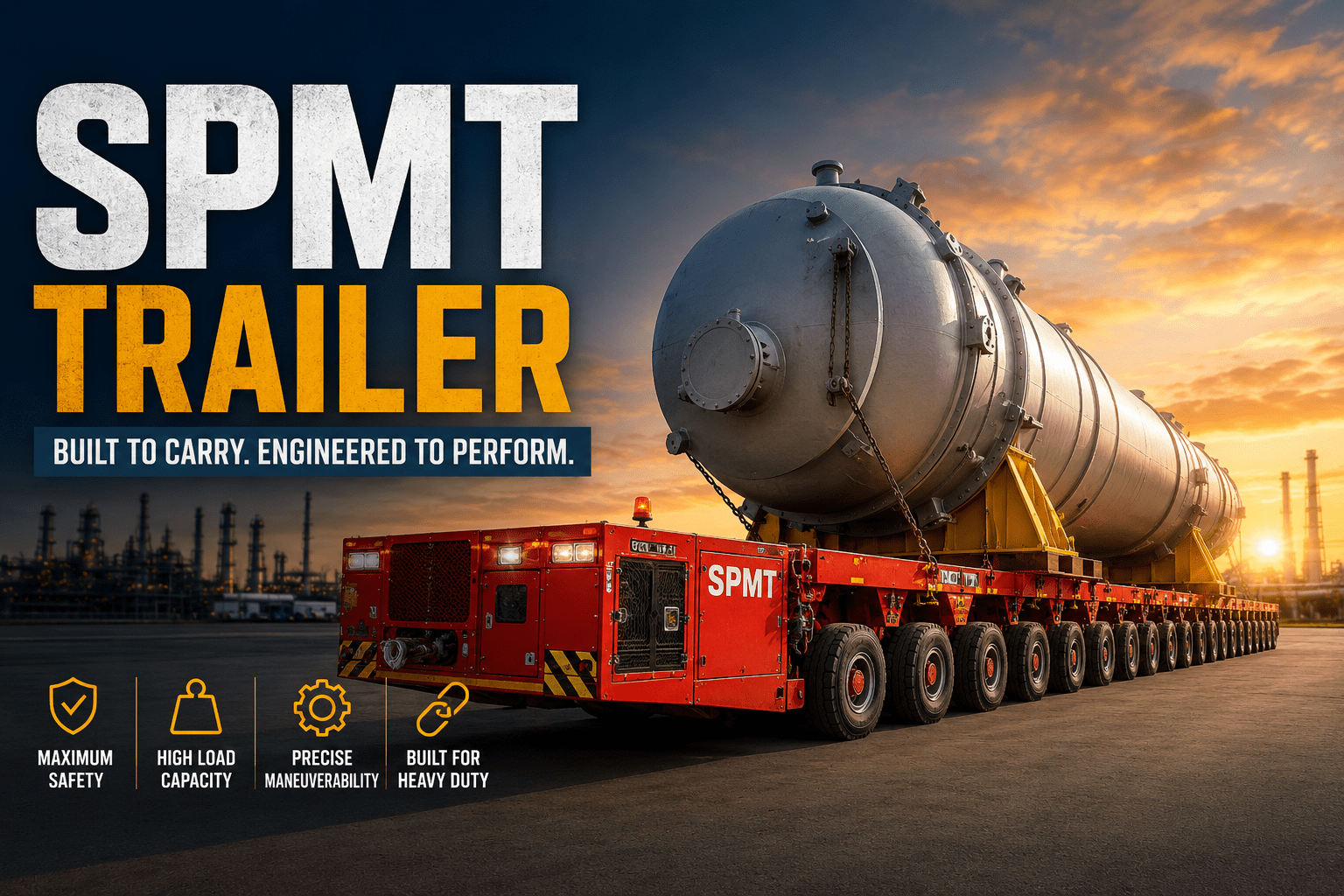
Self-Propelled Modular Transporters (SPMTs), sometimes called Self-Propelled Modular Trailers, are state-of-the-art heavy transport platforms that have revolutionized the way massive objects are moved across industries. As an advanced version of hydraulic modular trailers, SPMTs are designed to handle colossal loads, including large bridge sections, oil refining equipment, cranes, motors, spacecraft, and even entire buildings. Unlike traditional trucks, these modular transporters are capable of maneuvering heavy equipment that exceeds the limits of conventional transport.
Applications Across Industries
SPMTs are highly versatile and play a critical role in multiple sectors:
-
Construction and Civil Engineering: SPMTs transport bridge sections and large precast concrete elements, enabling rapid installation with minimal disruption.
-
Oil and Gas Industry: They move massive refining equipment and offshore modules with precision.
-
Shipbuilding: In shipyards, SPMTs replace costly gantry cranes to move enormous ship sections, reducing costs significantly.
-
Heavy Industry: They are used for transporting power plant components, large motors, and industrial machinery.
-
Specialized Relocations: Entire buildings and oil platforms can be moved using linked SPMTs, demonstrating their adaptability for unique challenges worldwide.
SPMTs are widely used across the United States, Europe, Asia, and Canada, including high-profile projects such as bridge span replacements and large-scale building relocations.
Specifications and Capabilities
A typical SPMT consists of a grid of computer-controlled axles. Common configurations include:
-
Axle Layout: Usually two axles across and four to eight axles in series, called an “axle line.”
-
Steering Precision: Each axle swivels independently—up to 270°, with some models offering 360° rotation. This allows for lateral movement, in-place rotation, and precise navigation over uneven terrain.
-
Weight Distribution: Axles can telescope independently to maintain a level load. Hydrostatic drive units on each axle provide movement and traction.
-
Control Systems: SPMTs are operated via remote panels or onboard cabins, with multiple units linked for transporting extraordinarily large objects.
-
Hydraulic Power Pack: A modular power unit, often driven by an internal combustion engine, provides power for steering, suspension, and drive. Multiple SPMTs can be powered by a single pack.
Due to the extreme weight they carry, SPMTs move slowly—often less than 1.6 km/h (1 mph)—ensuring stability and safety during transport.
History and Evolution
The concept of motorized heavy trailers dates back to 1935 when Gothaer Wagonfabrik in Berlin developed a motorized version of the Culemeyer Heavy Road Trailer. Modern SPMTs were developed in the 1970s, and by the 1980s, Mammoet refined the design, standardizing module widths to fit ISO container flatracks and introducing 360° steering. Scheuerle was commissioned to produce the first units, establishing 4-axle and 6-axle SPMTs with dedicated hydraulic power packs.
In 2016, the European Association of Abnormal Load Transport and Mobile Cranes (ESTA) published the first SPMT best practice guide, addressing safety issues including trailer tipping incidents. By 2022, Mammoet and Scheuerle launched electric SPMTs, reducing carbon emissions and noise while enhancing safety on industrial sites.
Record-Breaking Achievements
SPMTs have set impressive world records:
-
MV Sewol Salvage (2017): ALE used 600 axle lines to transport 17,000 tons, breaking multiple load records.
-
FPSO Curlew Decommissioning (2022): Shell and Mammoet employed 748 axle lines to relocate a 20,300-ton ship structure.
-
Hotel Relocation in Hainan (2023): Sinotrans Heavy-Lift moved a 7,500-ton hotel using 254 axle lines, marking the heaviest building transport.
-
Museum Building Relocation, Ningxia (2023): COSCO subsidiary moved five buildings totaling 11,450 tons using 300 axle lines, achieving records for height, weight, and distance transported.
Notable Manufacturers
Leading companies in the SPMT industry include:
-
Goldhofer
-
Scheuerle
-
Mammoet
-
Faymonville
-
Enerpac
-
Italcarrelli
-
Greiner Heavy Engineering
-
Transporter Industry International (Tii Group)
-
Nicolas
-
Seyiton
-
Suzhou Dafang Special Vehicle (SZDF)
-
Wuhan Wanshan Special Vehicle (Wanshan)
-
China Heavy Lift
-
Supro Heavy Transporter
-
New Dafan.
Conclusion
SPMTs are indispensable tools for moving massive and complex loads across the globe. Their modular design, precision steering, and weight distribution systems ensure safe, efficient, and reliable transport. From historic salvage operations to cutting-edge electric models, SPMTs continue to push the limits of heavy haulage. As industries demand larger, more intricate components, SPMTs provide the solution, combining engineering brilliance with practical functionality.
With their combination of power, flexibility, and innovation, Self-Propelled Modular Transporters are redefining what is possible in heavy transport, ensuring that even the largest structures can be moved safely and efficiently.
FAQ section
What is a self-propelled modular transporter?
A self-propelled modular transporter, or SPMT, is a platform vehicle with multiple computer-controlled axles designed to move extremely heavy and oversized loads. It is commonly used to transport bridge sections, industrial equipment, ship components, and even entire buildings.
What are SPMTs used for?
SPMTs are used in construction, oil and gas, shipbuilding, offshore operations, plant construction, and infrastructure projects. They are ideal for moving loads that are too large or heavy for standard trucks and trailers.
How do SPMTs work?
SPMTs work through a system of individually controlled axles that can steer, rotate, and distribute weight evenly. A hydraulic or electric power pack provides power for steering, suspension, and drive functions, allowing the transporter to move massive loads with precision.
What industries use self-propelled modular transporters?
Industries that use self-propelled modular transporters include construction, bridge engineering, oil and gas, shipbuilding, energy, mining, and heavy industrial manufacturing.
What are the advantages of SPMTs?
SPMTs offer excellent maneuverability, precise load control, modular flexibility, and the ability to transport extremely heavy cargo safely. They also reduce the need for costly cranes in certain operations and can improve project efficiency.