Why Backing a Semi Trailer Is Difficult
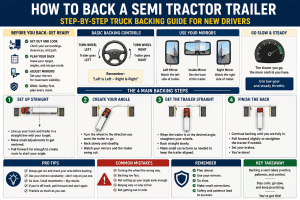
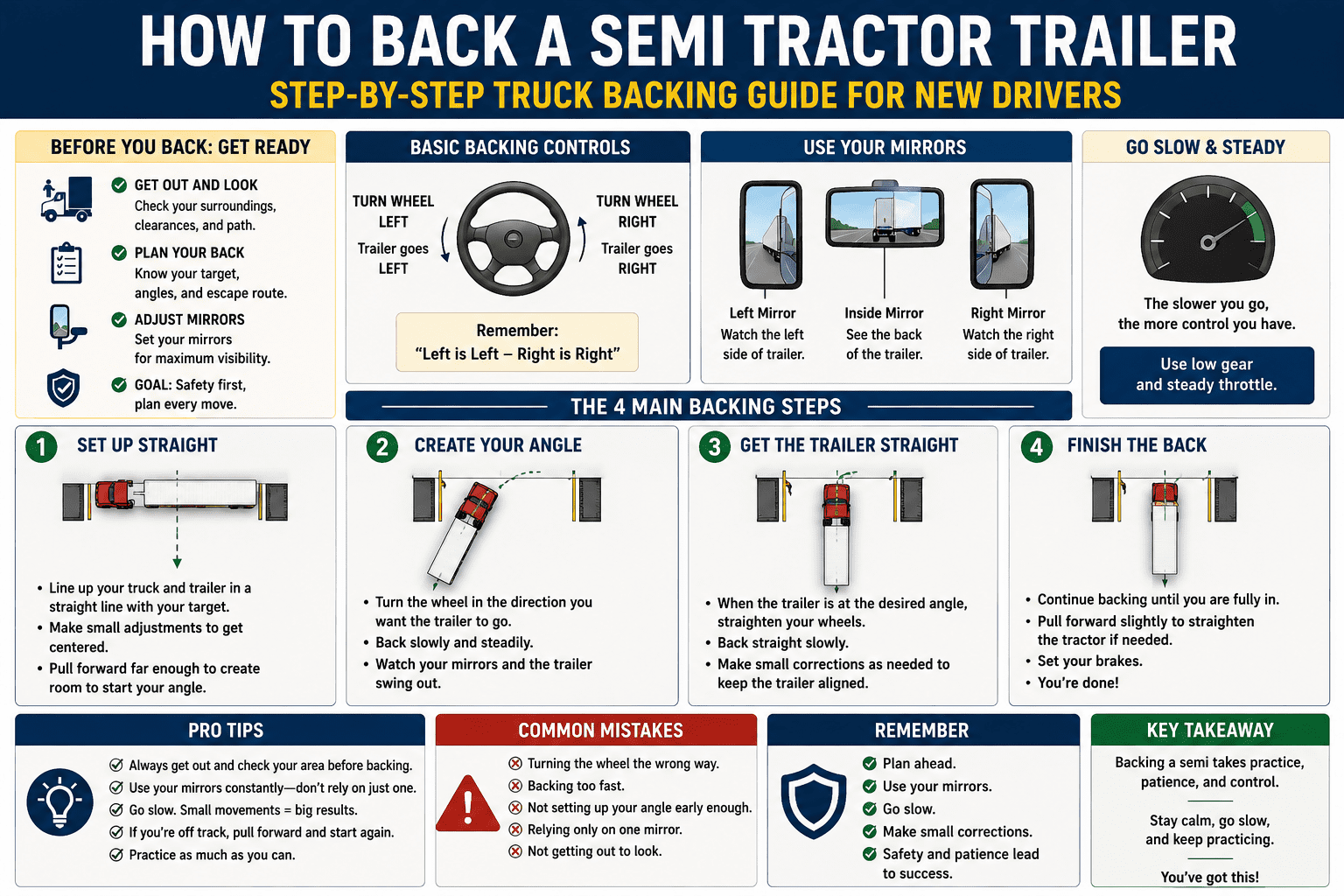
A semi tractor trailer behaves differently from a passenger vehicle because the trailer pivots at the fifth wheel.
When reversing:
- The trailer moves opposite the steering wheel direction.
- Small steering movements create significant trailer movement.
- Visibility is limited.
- Blind spots increase.
- Trailer swing can occur unexpectedly.
Understanding these challenges is the first step toward becoming proficient at backing.
Understanding Trailer Pivot Points
Before learning backing maneuvers, drivers must understand how the tractor and trailer interact.
The Tractor
The tractor controls the direction of movement.
The Fifth Wheel
The fifth wheel acts as the pivot point between the tractor and trailer.
The Trailer
The trailer follows the tractor’s movements but reacts in reverse when backing.
A simple rule to remember:
Move the bottom of the steering wheel toward the direction you want the trailer to go.
This technique helps many new drivers understand trailer movement more easily.
Pre-Backing Safety Checklist
Before backing any semi tractor trailer:
Get Out and Look (GOAL)
Professional drivers always inspect the area before backing.
Check for:
- Obstacles
- Curbs
- Pedestrians
- Vehicles
- Utility poles
- Overhead hazards
- Dock conditions
Never assume the area is clear.
Adjust Mirrors
Ensure all mirrors provide maximum visibility.
Check:
- Driver-side mirror
- Passenger-side mirror
- Convex mirrors
Activate Hazard Lights
Alert nearby workers and vehicles that backing operations are beginning.
Basic Backing Principles
Back Slowly
The slower you move, the more control you maintain.
Use Small Steering Inputs
Large steering corrections often create bigger problems.
Make Early Corrections
Small adjustments prevent major trailer deviations.
Stay Calm
Rushing often results in mistakes.
Straight-Line Backing
Straight-line backing is the foundation of all trailer backing skills.
Step 1: Align Tractor and Trailer
Position both in a straight line.
Step 2: Place Hands Correctly
Use the bottom-of-the-wheel method.
Step 3: Reverse Slowly
Release the clutch gradually or apply light throttle.
Step 4: Monitor Both Mirrors
Watch trailer alignment continuously.
Step 5: Correct Immediately
Make minor steering adjustments whenever the trailer begins drifting.
Benefits of Straight-Line Backing
- Improves trailer control
- Builds confidence
- Develops mirror awareness
- Forms the foundation for advanced backing
Offset Backing
Offset backing occurs when moving the trailer from one lane into another parallel lane.
This maneuver is common at:
- Truck terminals
- Distribution centers
- Freight yards
How to Perform Offset Backing
- Pull forward past the target lane.
- Turn toward the destination lane.
- Reverse slowly.
- Monitor trailer movement.
- Straighten tractor and trailer.
Practice is essential for mastering offset backing.
Alley Dock Backing
Alley docking is one of the most common CDL test maneuvers.
It involves backing the trailer into a dock positioned at a 90-degree angle.
Step-by-Step Alley Dock Backing
Position Properly
Start with adequate space between your truck and the dock.
Begin the Turn
Turn the steering wheel toward the dock.
Watch Trailer Movement
Use mirrors continuously.
Follow the Trailer
As the trailer enters the dock area, steer in the opposite direction to follow it.
Straighten Out
Align the trailer with the dock before reaching the final position.
Blind Side Backing
Blind side backing occurs when the dock is on the passenger side.
Why It’s More Difficult
- Reduced visibility
- Larger blind spots
- Increased accident risk
Professional drivers avoid blind side backing whenever possible.
Safety Tips
- Use a spotter.
- Exit the vehicle frequently.
- Move slowly.
- Use all mirrors effectively.
Sight Side Backing
Sight side backing places the dock on the driver’s side.
Advantages include:
- Better visibility
- Easier mirror monitoring
- Greater control
- Improved safety
Whenever possible, choose sight side backing over blind side backing.
Common Backing Mistakes
Turning Too Much
Excessive steering creates jackknife situations.
Backing Too Fast
Speed reduces reaction time.
Ignoring Mirrors
Continuous mirror monitoring is essential.
Failure to GOAL
Many accidents occur because drivers fail to inspect the backing area.
Overcorrecting
Large corrections often worsen alignment issues.
How to Avoid Jackknifing
A jackknife occurs when the tractor and trailer form an extreme angle.
Prevention Tips
- Back slowly.
- Monitor trailer angle.
- Make gradual corrections.
- Pull forward and reset when necessary.
Never force a bad setup.
Using a Spotter
A trained spotter can significantly improve safety.
Benefits
- Better visibility
- Reduced collision risk
- Improved communication
Spotter Rules
- Maintain visual contact.
- Use agreed-upon signals.
- Stop immediately if the spotter disappears from view.
Backing in Tight Spaces
Modern freight facilities often have limited maneuvering room.
Strategies
- Plan your approach.
- Use pull-ups when needed.
- Watch trailer swing.
- Be patient.
Even experienced drivers require multiple pull-ups in difficult situations.
Mirror Management Techniques
Professional drivers constantly scan mirrors.
Mirror Scan Pattern
- Left mirror
- Right mirror
- Target location
- Left mirror
- Right mirror
This continuous cycle improves awareness.
Practicing Backing Skills
Practice is the key to mastery.
Ideal Training Areas
- Empty parking lots
- CDL training facilities
- Freight yards with supervision
Practice Drills
- Straight-line backing
- Offset backing
- Parallel parking
- Alley dock backing
Regular repetition builds muscle memory.
Technology That Helps with Backing
Modern trucks may include:
Backup Cameras
Provide additional visibility.
Proximity Sensors
Detect nearby obstacles.
Collision Avoidance Systems
Increase safety during maneuvering.
Telematics
Monitor driver performance and backing events.
Technology helps, but it should never replace proper backing techniques.
Professional Backing Tips
Experienced truck drivers recommend:
- Never rush.
- Use GOAL frequently.
- Take extra pull-ups.
- Focus on safety over speed.
- Learn from every backing situation.
The best drivers prioritize accuracy rather than completing a maneuver quickly.
Benefits of Mastering Backing Skills
Strong backing skills provide:
- Improved safety
- Faster loading operations
- Reduced accident rates
- Greater driver confidence
- Better employment opportunities
Many employers value drivers with excellent backing abilities.
Conclusion
Learning how to back a semi tractor trailer is one of the most important skills for any truck driver. While backing can seem intimidating at first, understanding trailer movement, practicing proper techniques, and following safety procedures will dramatically improve your confidence and performance.
Remember to back slowly, use your mirrors continuously, perform GOAL inspections, and never hesitate to pull forward and reset your position. With patience and practice, backing a semi tractor trailer becomes a manageable and professional skill that contributes to safer and more efficient transportation operations.
Frequently Asked Questions
What is the easiest way to back a semi trailer?
Straight-line backing is the easiest technique and serves as the foundation for more advanced maneuvers.
Why does a trailer move opposite when backing?
The trailer pivots at the fifth wheel, causing reverse movement opposite to steering input.
What does GOAL mean in trucking?
GOAL stands for “Get Out And Look,” a safety practice used before and during backing operations.
How can I avoid jackknifing while backing?
Back slowly, make small steering adjustments, and straighten the truck before excessive trailer angles develop.
What is blind side backing?
Blind side backing occurs when the trailer is backed toward the passenger side, where visibility is limited.
Is sight side backing easier?
Yes. Sight side backing provides better visibility and greater control.
Should I use pull-ups when backing?
Absolutely. Professional drivers use pull-ups whenever necessary to improve alignment and safety.
How long does it take to learn backing a semi trailer?
Most new drivers gain basic proficiency within weeks, but mastering advanced backing techniques can take months or years of experience.
What is the biggest mistake new drivers make?
Backing too fast and making excessive steering corrections are among the most common mistakes.
Can backup cameras replace mirrors?
No. Backup cameras are helpful tools but should never replace proper mirror usage and safe backing practices.