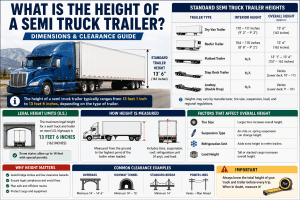
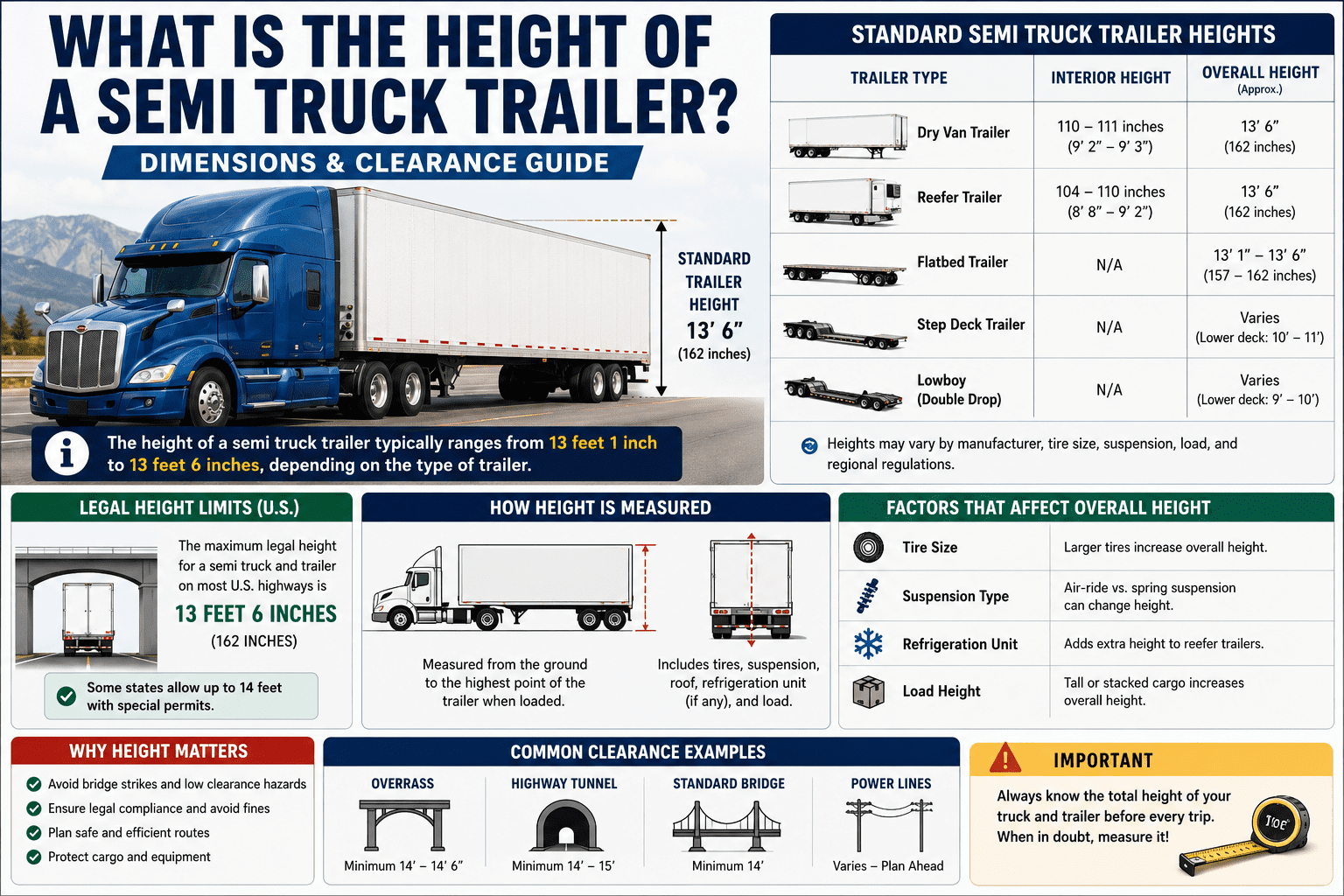
When discussing trailer height, there are typically two measurements:
Exterior Height
The total height measured from the ground to the highest point of the trailer.
Interior Height
The usable vertical cargo space inside the trailer.
Both dimensions are important for freight planning and transportation operations.
Standard Height of a Semi Truck Trailer
The most common trailer used in North America is the dry van trailer.
Standard Dry Van Trailer Height
Typical exterior height:
- 13 feet 6 inches (13’6″)
- Approximately 4.11 meters
Typical interior height:
- 108–110 inches
- Approximately 9 feet
This height allows trailers to operate legally on most highways while maximizing cargo capacity.
Why 13 Feet 6 Inches Is Important
The 13’6″ height has become the industry standard because it complies with most highway bridge clearances across North America.
Benefits include:
- Legal operation on major highways
- Reduced permit requirements
- Improved route flexibility
- Maximum cargo capacity
Many transportation routes are specifically designed around this standard height.
Interior Height of a Dry Van Trailer
While exterior height is generally 13’6″, interior cargo space is slightly less due to:
- Floor thickness
- Roof structure
- Cross members
- Insulation
Typical dry van interior height:
| Trailer Type | Interior Height |
|---|---|
| Standard Dry Van | 108–110 inches |
| High Cube Trailer | Up to 114 inches |
| Reefer Trailer | 96–105 inches |
Height of a 53-Foot Trailer
A standard 53-foot trailer typically measures:
Exterior
- 13 feet 6 inches
Interior
- Approximately 110 inches
The length of the trailer does not significantly affect overall height.
Height of a 48-Foot Trailer
Most 48-foot trailers share similar height specifications:
Exterior
- 13 feet 6 inches
Interior
- 108–110 inches
These trailers remain common throughout North America.
Refrigerated Trailer (Reefer) Height
Refrigerated trailers require insulated walls, floors, and ceilings.
Exterior Height
- 13 feet 6 inches
Interior Height
- 96–105 inches
The refrigeration equipment reduces usable interior cargo space.
Common Uses
- Food transportation
- Pharmaceuticals
- Temperature-sensitive freight
Flatbed Trailer Height
Flatbed trailers differ significantly because they lack walls and a roof.
Deck Height
Typical deck height:
- 58–62 inches
Since flatbeds are open, cargo height determines total transport height.
Advantages
- Transport taller cargo
- Easier loading
- Oversized freight capability
Step Deck Trailer Height
Step deck trailers feature two deck levels.
Upper Deck Height
Approximately:
- 58–60 inches
Lower Deck Height
Approximately:
- 38–42 inches
This design allows taller cargo without exceeding legal height limits.
Common Cargo
- Construction equipment
- Industrial machinery
- Agricultural equipment
Lowboy Trailer Height
Lowboy trailers provide the lowest deck height among common trailers.
Deck Height
Typically:
- 18–24 inches
Benefits
- Maximum cargo height capacity
- Heavy equipment transport
- Oversized freight movement
Lowboys are commonly used for:
- Excavators
- Bulldozers
- Cranes
- Mining equipment
Legal Height Limits for Semi Trailers
Most states and provinces follow similar height regulations.
Standard Maximum Height
- 13 feet 6 inches
This is generally accepted without requiring special permits.
Oversized Loads
Loads exceeding legal height often require:
- Permits
- Route planning
- Escort vehicles
- Utility coordination
Requirements vary by jurisdiction.
Bridge Clearance Considerations
Bridge strikes are among the most serious transportation accidents.
Why Clearance Matters
An over-height load can cause:
- Property damage
- Traffic disruptions
- Injury risks
- Expensive repairs
Professional carriers always verify clearance before transport.
How to Calculate Total Transport Height
To determine transport height:
Formula
Trailer Deck Height + Cargo Height = Total Height
Example:
- Flatbed deck height: 60 inches
- Cargo height: 96 inches
Total height:
- 156 inches
- 13 feet
Always measure carefully before transport.
High Cube Trailers
Some specialized trailers provide additional cargo height.
Interior Height
Up to:
- 114 inches
Advantages
- Increased cargo volume
- Better pallet stacking
- Improved shipping efficiency
These trailers are often used in high-volume logistics operations.
Industries That Depend on Trailer Height
Manufacturing
Industrial equipment and machinery.
Construction
Heavy equipment transportation.
Agriculture
Farm machinery and large implements.
Retail Distribution
Palletized consumer goods.
Energy Sector
Generators, transformers, and large components.
Height Restrictions Around the World
United States
Typical legal maximum:
- 13 feet 6 inches
Canada
Similar regulations apply in most provinces.
Europe
Many countries have lower limits, commonly:
- 4 meters (13.1 feet)
International transportation requires careful planning to ensure compliance.
Factors Affecting Trailer Height
Several variables impact overall trailer dimensions.
Suspension Type
Air-ride suspensions can slightly affect ride height.
Tire Size
Larger tires increase overall height.
Cargo Placement
Improper loading may increase transport height.
Trailer Design
Different trailer models offer varying deck heights.
Common Mistakes When Measuring Trailer Height
Guessing Dimensions
Always use actual measurements.
Ignoring Cargo Attachments
Equipment mounted on top may exceed limits.
Forgetting Suspension Changes
Suspension settings can alter height.
Overlooking Route Restrictions
Some roads have lower clearances than highways.
Tips for Managing Over-Height Loads
Conduct Route Surveys
Identify clearance issues before transport.
Obtain Necessary Permits
Follow all regulatory requirements.
Use Specialized Trailers
Step decks and lowboys help reduce total height.
Measure Multiple Times
Verification prevents costly mistakes.
Future Trends in Trailer Design
Modern trailer manufacturers continue improving efficiency through:
Lightweight Materials
Increase payload capacity.
Enhanced Aerodynamics
Improve fuel efficiency.
Smart Monitoring Systems
Track load dimensions in real time.
Advanced Suspension Technology
Improve safety and cargo protection.
These innovations support safer and more efficient freight transportation.
Conclusion
The standard height of a semi truck trailer is typically 13 feet 6 inches, making it suitable for legal highway operation throughout most of North America. Interior heights generally range from 108 to 110 inches, depending on trailer type and design.
Understanding trailer height is essential for route planning, cargo loading, legal compliance, and transportation safety. Whether using a dry van, reefer, flatbed, step deck, or lowboy trailer, accurate height calculations help prevent costly delays and ensure smooth freight operations.
Frequently Asked Questions
What is the standard height of a semi truck trailer?
Most standard semi trailers are 13 feet 6 inches tall externally.
What is the interior height of a dry van trailer?
Typical interior height ranges from 108 to 110 inches.
Why are most trailers 13’6″ tall?
This height maximizes cargo capacity while remaining legal on most highways.
How tall is a 53-foot trailer?
A standard 53-foot trailer is generally 13 feet 6 inches tall.
Are reefer trailers shorter inside?
Yes. Insulation and refrigeration systems reduce interior height.
What trailer allows the tallest cargo?
Lowboy trailers typically allow the tallest cargo while remaining within legal limits.
What happens if a load exceeds legal height?
Special permits, route planning, and escort requirements may apply.
How do I calculate total transport height?
Add trailer deck height to cargo height.
What is the legal maximum trailer height in the United States?
In most cases, 13 feet 6 inches is the standard legal height.
Why is trailer height important?
It affects route planning, bridge clearance, safety, legal compliance, and cargo capacity.