To place the focus keyword at the beginning and improve SEO, use this version:
Why is a tractor trailer called a semi? This is a common question among truck enthusiasts, logistics professionals, and everyday drivers. If you’ve ever driven on a highway, you’ve likely seen massive trucks transporting goods across the country. These vehicles are commonly called semi-trucks, tractor trailers, 18-wheelers, or simply semis. While many people use these terms interchangeably, few understand the true origin of the word “semi.”
Many people assume the term refers to the truck being only “half” of something, but the explanation is more technical and closely tied to the trailer’s design. Understanding why a tractor trailer is called a semi provides valuable insight into how modern freight transportation evolved and why semi-trucks remain the backbone of global logistics.
In this guide, we’ll explore the history, engineering, terminology, and fascinating facts behind the name “semi,” along with the key differences between semi-trailers and full trailers.
What Is a Semi Truck?
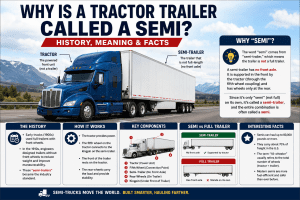
A semi truck is a combination vehicle consisting of two primary components:
The Tractor
The tractor is the powered unit that contains:
- Engine
- Driver’s cab
- Fuel tanks
- Steering system
- Transmission
- Drive axles
Its purpose is to pull the trailer.
The Semi-Trailer
The semi-trailer is the cargo-carrying portion of the vehicle.
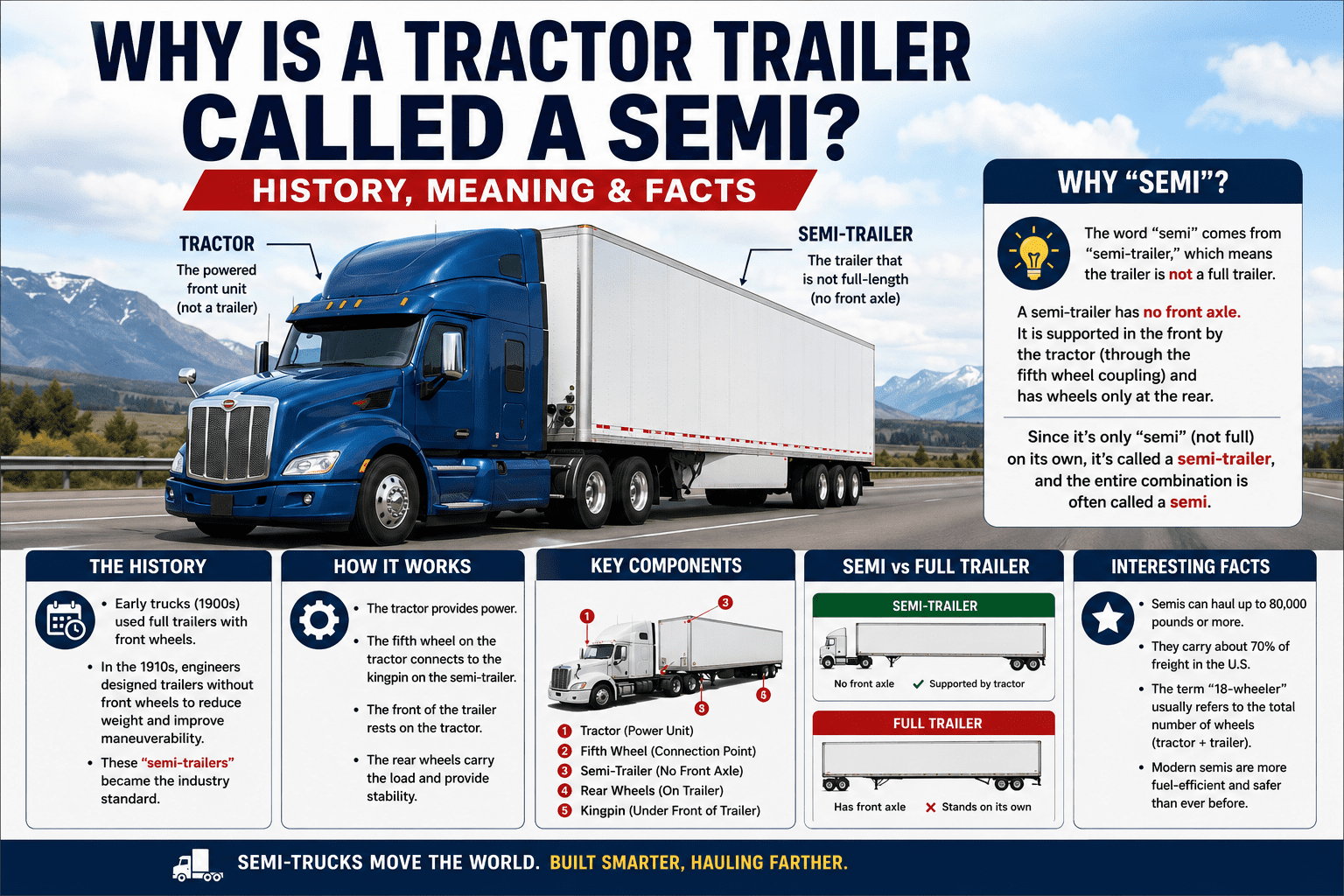
Unlike a full trailer, a semi-trailer cannot stand entirely on its own when disconnected from the tractor because part of its weight relies on support from the tractor.
This characteristic is the key reason behind the term “semi.”
Why Is It Called a Semi-Trailer?
The term “semi-trailer” originates from the trailer’s structural design.
A Full Trailer
A full trailer has:
- Front axle
- Rear axle
- Independent support system
A full trailer can stand completely on its own without being attached to another vehicle.
A Semi-Trailer
A semi-trailer has:
- Rear axle assembly
- Landing gear for parking
- Front portion supported by the tractor
Because only part of the trailer supports itself, it is considered a semi-trailer rather than a full trailer.
The word “semi” means partially or not fully independent, which accurately describes the trailer design.
How a Semi-Trailer Supports Its Weight
One of the defining characteristics of a semi-trailer is weight distribution.
Connected Configuration
When attached:
- The tractor supports a significant portion of the trailer’s weight.
- Weight transfers through the fifth wheel.
- The combination vehicle operates as a single unit.
Disconnected Configuration
When detached:
- Landing gear supports the front.
- Rear axles support the back.
- The trailer remains stationary but is not designed for independent transportation.
This shared support system distinguishes a semi-trailer from other trailer designs.
The Role of the Fifth Wheel
The fifth wheel is one of the most important components of a tractor trailer.
What Is a Fifth Wheel?
A fifth wheel is a coupling device mounted on the tractor.
Functions include:
- Connecting tractor and trailer
- Supporting trailer weight
- Allowing articulation during turns
- Providing stability during transport
Without the fifth wheel, the semi-trailer could not function properly.
The History of the Semi-Trailer
The origins of semi-trailers date back to the early 20th century.
Early Freight Transportation
Before semi-trailers became common, freight was transported using:
- Horse-drawn wagons
- Railroads
- Full trailers
As industrialization increased, demand for more efficient transportation grew rapidly.
The Rise of Motorized Freight
In the early 1900s:
- Truck technology improved.
- Road infrastructure expanded.
- Businesses needed flexible transportation.
Engineers developed semi-trailers as a way to maximize cargo capacity while reducing vehicle weight.
The design proved highly effective and quickly gained popularity.
How Semi-Trailers Revolutionized Logistics
The introduction of semi-trailers transformed freight transportation.
Increased Cargo Capacity
Semi-trailers could carry significantly larger loads.
Improved Maneuverability
The articulated design allowed easier turning than many full trailer configurations.
Better Weight Distribution
Shared weight improved vehicle efficiency.
Reduced Costs
Businesses could transport more cargo using fewer resources.
These advantages helped establish semi-trailers as the industry standard.
Why People Call It a Semi Truck
Technically, the trailer is the “semi” component.
However, over time, people began referring to the entire vehicle combination as a:
- Semi truck
- Semi
- Tractor trailer
Although not technically precise, the term became widely accepted.
Today, “semi truck” is one of the most common names used throughout North America.
Different Names for Semi Trucks
Depending on location and industry, semi-trucks may be called:
Tractor Trailer
Refers to both the tractor and trailer combination.
Semi Truck
Most common term in North America.
18-Wheeler
Named after the typical number of wheels.
Big Rig
Popular term used by truck drivers.
Articulated Truck
Common in some international markets.
Despite the different names, they generally refer to the same vehicle type.
Semi-Trailer vs Full Trailer
Many people confuse semi-trailers and full trailers.
Semi-Trailer
- Supported partly by tractor
- Uses fifth wheel connection
- Most common freight trailer
Full Trailer
- Supports itself entirely
- Front and rear axles
- Can be towed without supporting weight on the towing vehicle
Understanding this difference explains the origin of the term “semi.”
Components of a Semi Truck
Modern tractor trailers consist of several major systems.
Engine
Provides power for transportation.
Transmission
Transfers power to the drive wheels.
Fifth Wheel
Connects tractor and trailer.
Trailer Axles
Support cargo weight.
Landing Gear
Supports the trailer when parked.
Air Brake System
Provides stopping power.
Suspension
Improves ride quality and cargo protection.
Each component plays a critical role in safe operation.
Why Semi Trucks Dominate Freight Transportation
Semi-trucks remain the preferred transportation solution because they offer:
Flexibility
Can serve almost any location accessible by road.
High Capacity
Transport large amounts of cargo efficiently.
Cost Effectiveness
Lower transportation costs per unit of freight.
Scalability
Trailers can be swapped quickly.
Reliability
Modern trucks operate efficiently over long distances.
These benefits make semi-trucks essential to global commerce.
Industries That Depend on Semi Trucks
Virtually every major industry relies on semi-trailer transportation.
Retail
Consumer products and inventory distribution.
Manufacturing
Raw materials and finished goods.
Agriculture
Farm products and equipment.
Construction
Building materials and machinery.
Energy
Industrial equipment and infrastructure components.
Without semi-trucks, modern supply chains would struggle to function efficiently.
Interesting Facts About Semi Trucks
Freight Volume
Most freight in North America spends at least part of its journey on a semi-truck.
Cargo Capacity
A standard 53-foot trailer can transport tens of thousands of pounds of cargo.
Mileage
Long-haul trucks may travel more than 100,000 miles annually.
Economic Impact
The trucking industry plays a vital role in national economies worldwide.
Common Misconceptions About the Term “Semi”
Myth 1: It Means Half a Truck
False.
The term refers to the trailer’s design, not the size of the vehicle.
Myth 2: The Tractor Is the Semi
Technically incorrect.
The trailer is the semi-trailer, although common usage applies the term to the entire vehicle.
Myth 3: All Freight Trailers Are Semi-Trailers
Not true.
Full trailers and specialized trailer designs also exist.
The Future of Semi Trucks
The transportation industry continues evolving through:
Electric Trucks
Reducing emissions.
Autonomous Driving Technology
Improving efficiency and safety.
Smart Logistics Systems
Optimizing freight operations.
Advanced Aerodynamics
Reducing fuel consumption.
Despite technological advancements, the semi-trailer design remains highly effective and continues to dominate freight transportation.
Conclusion
A tractor trailer is called a semi because the trailer itself is a semi-trailer, meaning it is only partially supported by its own structure and relies on the tractor for support during transportation. Unlike a full trailer, a semi-trailer transfers a portion of its weight to the tractor through the fifth wheel connection.
This innovative design revolutionized freight transportation by improving cargo capacity, maneuverability, and efficiency. Today, semi-trucks are an essential part of global supply chains, moving goods across cities, countries, and continents while supporting countless industries.
Frequently Asked Questions
Why is a semi truck called a semi?
It is called a semi because the trailer is a semi-trailer that depends partly on the tractor for support.
What is the difference between a semi-trailer and a full trailer?
A semi-trailer relies on the tractor for support, while a full trailer supports itself entirely with front and rear axles.
Is the truck or trailer the “semi”?
Technically, the trailer is the semi-trailer, but the term is commonly used for the entire vehicle.
Why does a semi-trailer need a fifth wheel?
The fifth wheel connects the tractor and trailer while supporting part of the trailer’s weight.
What does “tractor trailer” mean?
It refers to the combination of the tractor unit and semi-trailer.
Why are semi-trucks important?
They transport a large percentage of goods and play a critical role in supply chains and commerce.
Are all 18-wheelers semi-trucks?
Most 18-wheelers are semi-truck combinations consisting of a tractor and semi-trailer.
Can a semi-trailer stand alone?
Only when supported by its landing gear; it is not designed for independent movement.
When were semi-trailers invented?
They became popular during the early 20th century as trucking technology evolved.
What industries use semi-trucks?
Retail, manufacturing, agriculture, construction, energy, logistics, and many others rely heavily on semi-trailer transportation.