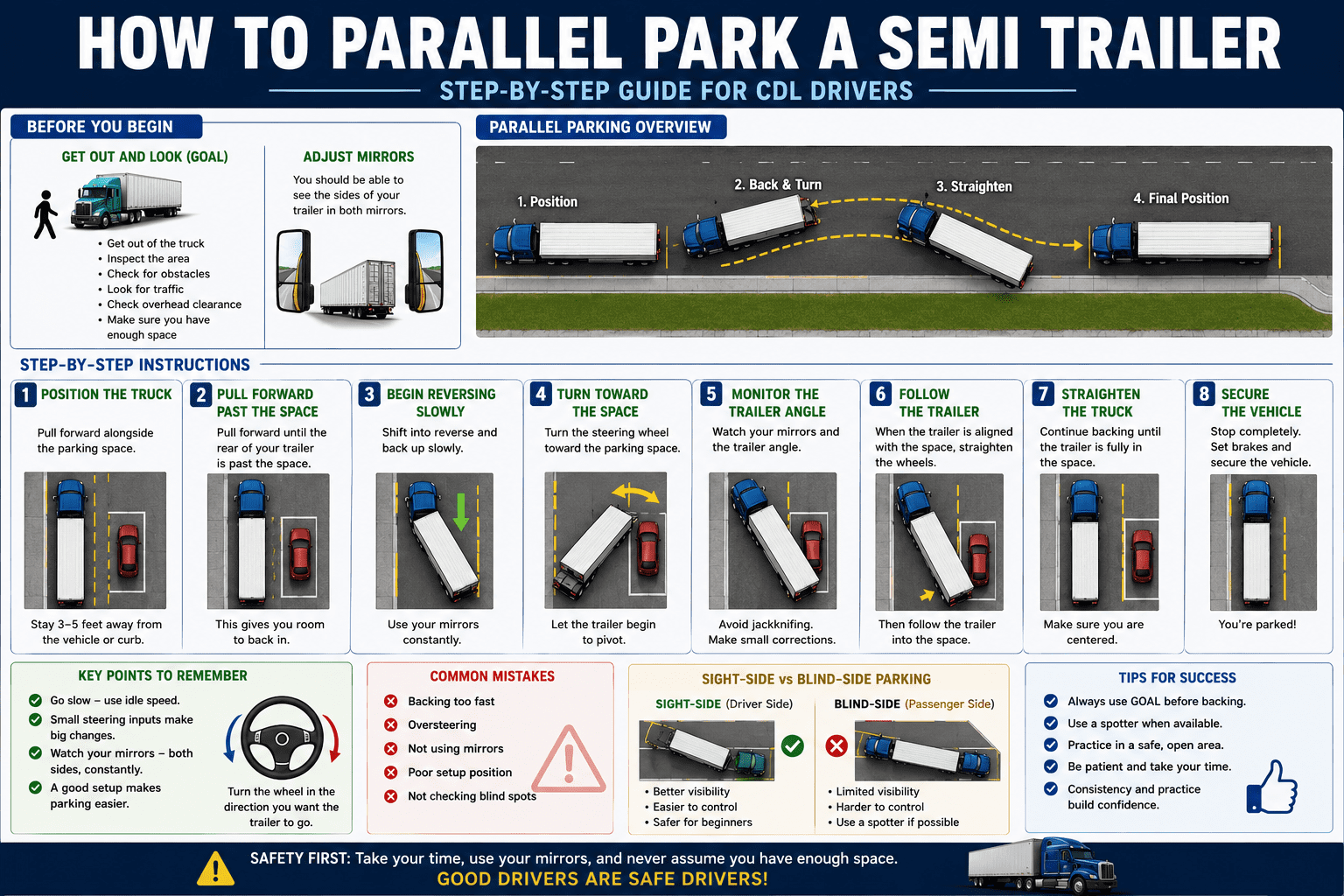
Parallel parking a semi trailer is one of the most challenging maneuvers for new truck drivers. Whether you are preparing for a CDL skills test, parking at a truck stop, or maneuvering in a tight urban area, mastering parallel parking is essential for safe and efficient truck operation.
Unlike a passenger vehicle, a semi truck and trailer combination pivots at the fifth wheel, requiring drivers to carefully control trailer movement while maintaining awareness of surrounding obstacles.
This guide explains how to parallel park a semi trailer using proven techniques taught in commercial driver training programs.
What Is Semi Trailer Parallel Parking?
Parallel parking a semi trailer involves backing the truck and trailer into a parking space that runs parallel to a curb, roadway, or line of parked vehicles.
The maneuver requires:
- Proper setup
- Controlled backing
- Mirror monitoring
- Precise steering inputs
- Trailer angle management
Many CDL testing facilities include parallel parking as part of the skills examination.
Before You Begin
Get Out and Look (GOAL)
Before attempting any backing maneuver:
- Exit the truck.
- Inspect the parking area.
- Identify obstacles.
- Check overhead clearance.
- Locate curbs and boundaries.
- Confirm available space.
Professional drivers use the GOAL method whenever visibility is limited.
Adjust Mirrors Properly
Ensure you can clearly see:
- Trailer sides
- Rear trailer corners
- Parking boundaries
- Adjacent vehicles
Mirror visibility is critical throughout the maneuver.
Step 1: Position the Truck
Pull forward alongside the parking space.
Maintain:
- Approximately 3–5 feet of clearance from the parked vehicle or boundary.
- Trailer aligned parallel to the target space.
Proper setup greatly simplifies the parking process.
Step 2: Pull Forward Past the Space
Move forward until the rear of your trailer passes the parking area.
This creates room for the trailer to swing into the space during backing.
Step 3: Begin Reversing Slowly
Shift into reverse and release the clutch or brake slowly.
Maintain idle speed whenever possible.
Backing slowly provides maximum control and reaction time.
Step 4: Turn the Steering Wheel Toward the Parking Space
As the truck begins reversing:
- Turn the steering wheel toward the parking space.
- Allow the trailer to begin pivoting.
Watch the trailer closely in your mirrors.
The goal is to create a controlled angle between the tractor and trailer.
Step 5: Monitor the Trailer Angle
As the trailer enters the space:
- Continue checking both mirrors.
- Avoid excessive trailer angles.
- Prevent jackknifing.
Small corrections are more effective than large steering movements.
Step 6: Follow the Trailer
Once the trailer is aligned with the parking space:
- Counter-steer.
- Follow the trailer with the tractor.
- Reduce the angle between tractor and trailer.
This helps straighten the combination.
Step 7: Straighten the Truck
Continue backing slowly until:
- Trailer is fully inside the space.
- Tractor aligns with the trailer.
- Vehicle is centered between boundaries.
Make minor adjustments as necessary.
Step 8: Secure the Vehicle
After parking:
- Stop completely.
- Apply parking brakes.
- Place transmission in the appropriate position.
- Perform a final visual check.
The maneuver is complete once the truck is safely positioned.
Parallel Parking Techniques
Sight-Side Parallel Parking
Parking on the driver’s side provides better visibility.
Advantages:
- Easier trailer control
- Better mirror visibility
- Reduced accident risk
Most drivers prefer sight-side parking whenever possible.
Blind-Side Parallel Parking
Parking on the passenger side is more difficult because visibility is limited.
Best practices include:
- Use GOAL frequently.
- Back extremely slowly.
- Make small corrections.
- Use a spotter when available.
Common Mistakes
Backing Too Fast
Speed reduces control and increases collision risk.
Oversteering
Large steering inputs often cause excessive trailer angles.
Ignoring Mirror Checks
Drivers should constantly scan both mirrors throughout the maneuver.
Poor Setup
Many parking problems begin with improper positioning before backing.
Not Using GOAL
Failing to inspect the area can lead to preventable accidents.
CDL Parallel Parking Test Tips
If you are preparing for a CDL skills test:
- Practice setup repeatedly.
- Use reference points consistently.
- Focus on trailer position.
- Back slowly.
- Avoid unnecessary corrections.
- Use all available pull-ups if permitted.
Consistency is often more important than speed.
Safety Tips for Parallel Parking a Semi Trailer
- Always inspect the area first.
- Use mirrors continuously.
- Back at idle speed.
- Stop immediately if visibility is lost.
- Use a spotter when available.
- Never rush the maneuver.
- Prioritize safety over speed.
Professional drivers understand that careful parking prevents costly accidents and vehicle damage.
Frequently Asked Questions
Is parallel parking a semi trailer difficult?
It can be challenging for beginners, but regular practice makes the maneuver much easier.
Do CDL tests include parallel parking?
Many CDL skills tests require some form of parallel parking demonstration.
What is the hardest part of parallel parking a semi trailer?
Managing trailer angle and avoiding oversteering are often the most difficult aspects.
Should I use a spotter?
Yes. Whenever available, a spotter can significantly improve safety and accuracy.
Conclusion
Learning how to parallel park a semi trailer requires patience, proper setup, and consistent practice. By backing slowly, monitoring mirrors continuously, controlling trailer angles, and using the GOAL method, drivers can perform safe and accurate parallel parking maneuvers in a variety of real-world situations. Mastering this skill improves confidence, enhances safety, and helps prepare drivers for both CDL testing and professional trucking operations.