Learning how to back a semi trailer is one of the most important skills every commercial truck driver must master. Whether you are parking at a truck stop, backing into a loading dock, or performing a CDL backing maneuver, proper trailer control is essential for safety and efficiency.
Many new drivers find backing a semi trailer challenging because the trailer moves in the opposite direction of the steering wheel. However, with proper technique and consistent practice, backing can become one of the most controlled and predictable driving skills.
This guide explains how to back a semi trailer safely and effectively using proven industry techniques.
Why Backing a Semi Trailer Is Challenging
Unlike a passenger vehicle, a tractor-trailer combination pivots at the fifth wheel.
When reversing:
- Small steering inputs create large trailer movements.
- Trailer reactions occur slowly at first.
- Oversteering can quickly cause a jackknife situation.
- Limited visibility increases risk.
Understanding trailer movement is the first step toward becoming a confident truck driver.
Before You Start Backing
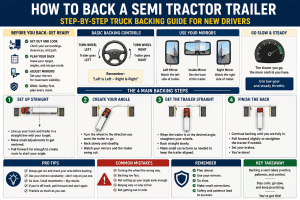
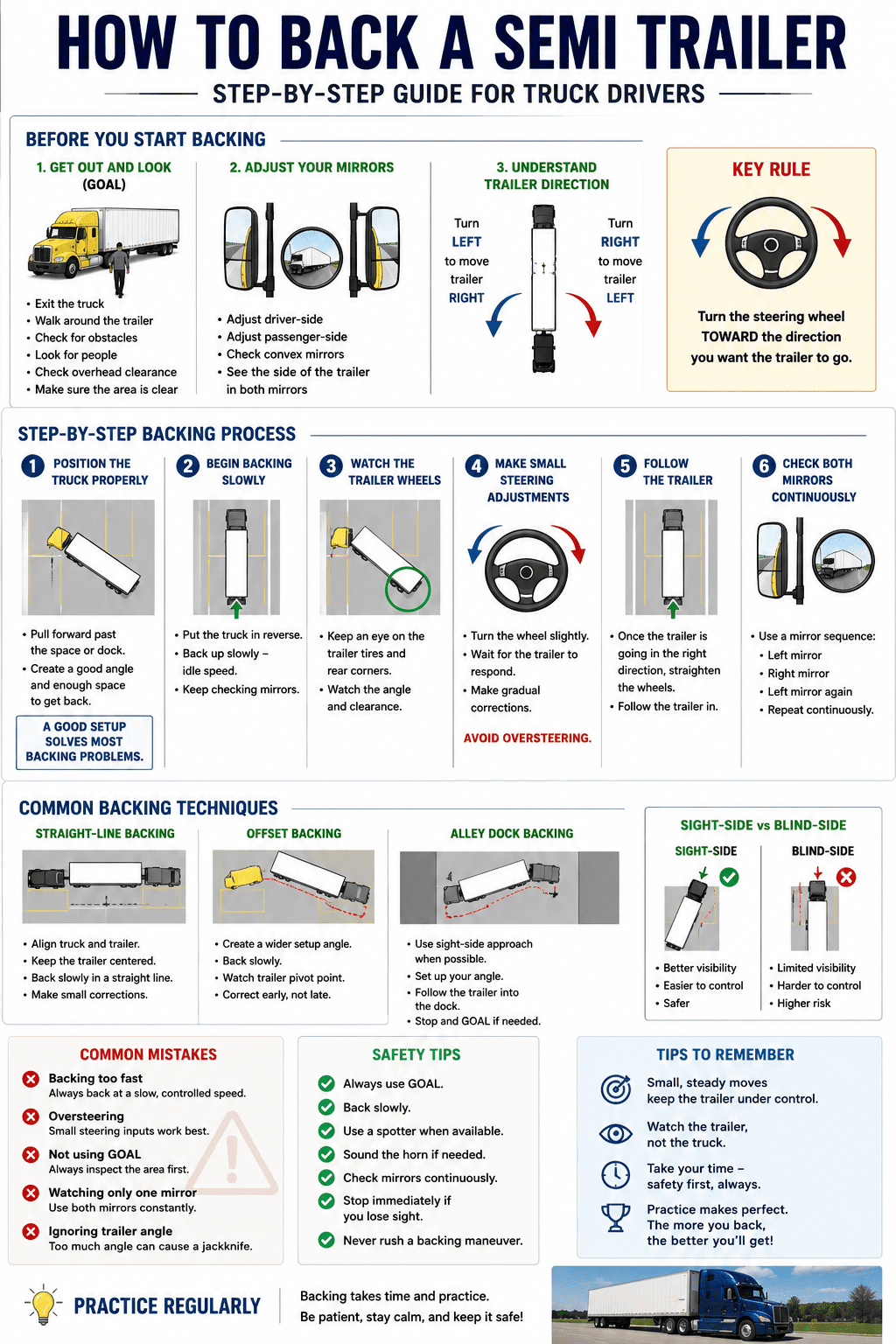
Get Out and Look (GOAL)
Professional drivers always follow the GOAL method.
Before backing:
- Exit the truck.
- Walk around the trailer.
- Check for obstacles.
- Locate pedestrians.
- Identify overhead hazards.
- Verify dock alignment.
Many accidents can be prevented by simply inspecting the area first.
Adjust Your Mirrors
Proper mirror positioning helps maintain trailer visibility.
Check:
- Driver-side mirror
- Passenger-side mirror
- Convex mirrors
- Hood mirrors (if equipped)
Your trailer should remain visible throughout the backing maneuver.
Understanding Trailer Direction
A simple rule to remember:
Turn the steering wheel toward the problem.
When reversing:
- Steering left moves the trailer right.
- Steering right moves the trailer left.
Small steering corrections produce smoother trailer movement than large steering inputs.
Step 1: Position the Truck Properly
Before backing:
- Pull forward beyond the parking space or dock.
- Create sufficient turning space.
- Align the trailer for a controlled entry.
Good setup often determines whether the backing maneuver will be successful.
Professional drivers frequently say:
“A good setup solves most backing problems.”
Step 2: Begin Backing Slowly
Place the truck in reverse and begin moving slowly.
Maintain:
- Idle speed whenever possible
- Constant mirror checks
- Full awareness of trailer position
Backing too quickly reduces reaction time and increases accident risk.
Step 3: Watch the Trailer Wheels
Focus on the trailer tires and rear corners.
Observe:
- Trailer angle
- Wheel path
- Clearance from obstacles
Monitoring trailer wheels helps prevent collisions with curbs, vehicles, and loading docks.
Step 4: Make Small Steering Adjustments
Avoid aggressive steering movements.
Instead:
- Turn the wheel slightly.
- Wait for trailer response.
- Make gradual corrections.
Overcorrection is one of the most common mistakes made by inexperienced drivers.
Step 5: Follow the Trailer
Once the trailer begins moving toward the desired path:
- Straighten the steering wheel.
- Follow the trailer with the tractor.
- Keep the trailer aligned.
This technique helps prevent excessive trailer angles and jackknifing.
Step 6: Continuously Check Both Mirrors
Professional drivers constantly scan mirrors.
Use a mirror sequence:
- Driver-side mirror
- Passenger-side mirror
- Driver-side mirror again
This continuous scanning helps maintain control and situational awareness.
Straight-Line Backing Technique
Straight-line backing is the foundation of all trailer backing skills.
Steps:
- Align truck and trailer.
- Center trailer between reference points.
- Reverse slowly.
- Make small steering corrections.
- Maintain alignment.
This maneuver is commonly required during CDL training and testing.
Offset Backing Technique
Offset backing involves moving the trailer from one lane into another.
Key tips:
- Create a wider setup angle.
- Move slowly.
- Watch trailer pivot points.
- Correct early rather than late.
Alley Dock Backing
Alley docking is one of the most advanced backing maneuvers.
Best practices:
- Use a sight-side approach whenever possible.
- Set up a controlled trailer angle.
- Follow the trailer into the dock.
- Stop and GOAL if uncertain.
Patience is critical during dock backing operations.
Blind-Side Backing vs Sight-Side Backing
Sight-Side Backing
Driver backs toward the driver’s side.
Advantages:
- Better visibility
- Easier trailer control
- Reduced accident risk
Blind-Side Backing
Driver backs toward the passenger side.
Challenges:
- Limited visibility
- Increased risk of collision
- More difficult steering corrections
Whenever possible, choose sight-side backing.
Common Backing Mistakes
Backing Too Fast
Slow speed provides maximum control.
Oversteering
Large steering inputs often cause trailer instability.
Not Using GOAL
Failure to inspect the area increases accident risk.
Watching Only One Mirror
Both mirrors must be monitored continuously.
Ignoring Trailer Angle
Excessive trailer angles can quickly lead to jackknifing.
Safety Tips for Backing a Semi Trailer
- Always use GOAL.
- Back slowly.
- Use a spotter when available.
- Sound the horn if necessary.
- Check mirrors continuously.
- Stop immediately if visibility is lost.
- Never rush a backing maneuver.
Professional drivers understand that safety is more important than speed.
How Long Does It Take to Learn?
Most new CDL drivers become comfortable with basic backing techniques after several weeks of practice.
Mastering:
- Straight-line backing
- Offset backing
- Alley docking
- Parallel parking
may take several months of real-world driving experience.
Consistent practice is the key to developing confidence and precision.
Conclusion
Learning how to back a semi trailer requires patience, practice, and proper technique. By using the GOAL method, maintaining slow speeds, making small steering adjustments, and continuously monitoring mirrors, drivers can safely perform backing maneuvers in a variety of situations. Whether backing into a dock, truck stop parking space, or CDL testing area, proper setup and controlled movements are the foundations of successful trailer backing.