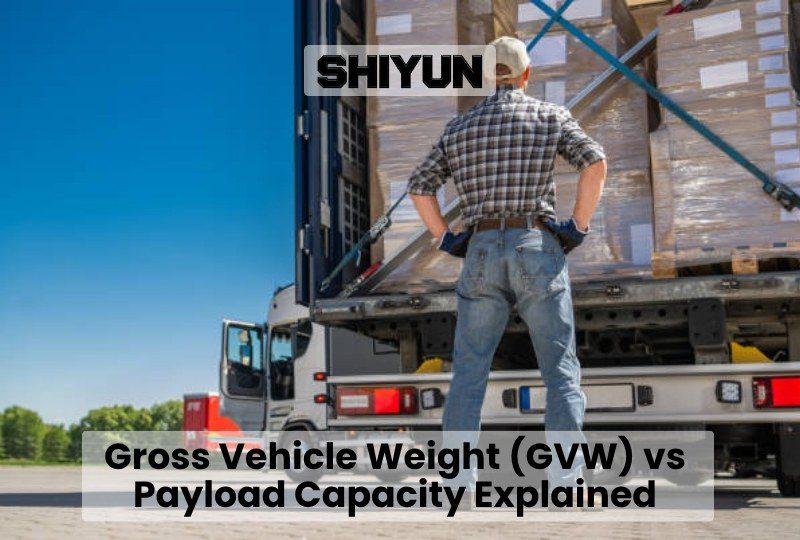
If you are buying or operating a heavy-duty trailer, two numbers matter more than any spec sheet detail: gross vehicle weight and payload capacity. Confusing the two is one of the most common mistakes fleet buyers make, and it can lead to overloading, axle damage, or fines at a weighbridge. I will break down what each term means, how they relate, and how weight limits work under China’s GB 1589 standard.
What Is Gross Vehicle Weight (GVW)?
Gross vehicle weight is the count of how much weight a trailer holds once it is fully loaded. It includes the tare weight of the trailer itself, plus the cargo, fuel, and any mounted equipment. In simple terms, GVW is everything the axles and tires have to support at once.
Gross vehicle weight rating (GVWR) is a related but different figure. GVWR is the maximum GVW the manufacturer certifies as safe for that trailer, based on its frame strength, axle rating, suspension, and braking system. GVW is what the trailer actually weighs on a given trip. GVWR is the ceiling it must never cross.
What Is Payload Capacity?
Payload capacity is the maximum weight of cargo a trailer can carry, on top of its own tare weight. It is calculated as:
Payload Capacity = GVWR − Tare Weight
Tare weight, also called curb weight or unladen weight, is how much the trailer weighs empty. If a flatbed trailer has a GVWR of 40 tons and a tare weight of 8 tons, its payload capacity is 32 tons. That figure tells you how much steel, machinery, or containerized freight you can legally and safely load.
Comparing GVW vs Payload Capacity
The distinction is straightforward once you separate the two questions each number answers:
- GVW tells you how heavy the whole loaded trailer is right now
- Payload capacity tells you how much cargo weight you are allowed to add
A trailer’s GVW should never exceed its GVWR. If it does, the trailer is overloaded, even if the cargo itself seems reasonable. This is why payload capacity, not just trailer size, should guide your purchase decision. A longer deck does not always mean a higher payload. Axle configuration and steel grade matter just as much.
How Axle Configuration Affects Payload
Payload capacity is directly tied to the number and rating of axles. More axles spread the load across more contact points, which increases the legal GVWR without exceeding axle load limits. This is why heavy-duty semi-trailers built for machinery transport, wind blades, or modular cargo often use three, four, or more axle lines with FUWA, BPW, or JOST axle units.
Axle spacing, tire rating, and suspension type (mechanical or hydraulic leveling) all factor into how much total weight a trailer can carry safely. Buyers sourcing for EPC projects or heavy equipment logistics should always request the axle load breakdown, not just the headline payload figure.
What is Chinese Weight Standards GB 1589-2016?
For trailers built and exported from China, gross vehicle weight and axle load limits are governed by GB 1589-2016, the national standard for dimensions, axle load, and mass limits for motor vehicles, trailers, and combination vehicles. This standard was released in 2016 by China’s national quality supervision and standardization authorities, replacing the earlier GB 1589-2004 version.
Under this framework, semi-trailer and tractor combinations are subject to defined axle count and gross combination mass limits, with tighter limits for two-axle configurations and higher allowances for three-axle and multi-axle setups. Chinese regulations permit articulated vehicle combinations up to roughly 49 tonnes gross weight, among the higher limits seen across regional freight corridors.
For international buyers, this matters in two ways. First, a trailer engineered to GB 1589 axle load rules may carry a different rated payload than an equivalent trailer built to a different country’s road transport regulations. Second, buyers exporting to markets with their own axle weight limits should confirm both the manufacturer’s design rating and the destination country’s legal limits before finalizing an order.
Why This Matters for Fleet and EPC Buyers
Getting GVW and payload capacity right affects more than compliance. Overloading accelerates tire wear, stresses the frame and suspension, increases stopping distance, and shortens the working life of the trailer. Underestimating payload, on the other hand, means paying for more trailer capacity than the cargo actually needs.
Before ordering a lowbed, flatbed, or skeleton trailer, buyers should confirm:
- The trailer’s tare weight and GVWR from the manufacturer’s spec sheet
- Axle count, axle rating, and suspension type
- Whether the rated payload accounts for typical route conditions, not just theoretical maximums
- Compliance with both the country of manufacture’s standards and the destination market’s road transport rules
At Shiyun Trailer, every semi-trailer under the GIRDER TRAILER is engineered with a clearly rated payload capacity, matched to axle configuration and steel specification, so buyers can plan loads with confidence from day one.
Final Thoughts
Gross vehicle weight and payload capacity are two sides of the same equation. GVW is what the trailer weighs when loaded. Payload capacity is how much cargo it is rated to carry. Understanding both, along with how standards like GB 1589 shape axle and weight limits, helps buyers select a trailer that matches their cargo, route, and compliance requirements without overspending or overloading.