Introduction
How does a semi trailer hitch work is a key question in the trucking and logistics industry because the hitch system is what physically connects a semi trailer to a tractor unit. Without a proper hitch mechanism, the safe transport of heavy freight would not be possible.
Unlike standard pickup truck hitches that use ball-and-receiver systems, semi trailers use a specialized fifth-wheel coupling system designed to handle extreme weight loads, often exceeding 80,000 pounds. This system ensures stability, controlled movement, and safe weight distribution during long-distance transport.
In this guide, we will break down exactly how a semi trailer hitch works, its components, how it locks and releases, and why it is essential for modern freight transportation systems.
What is a semi trailer hitch system?
A semi trailer hitch system is a heavy-duty coupling mechanism that connects a tractor unit to a semi trailer.
Fifth-wheel coupling is the standard system used in commercial trucking.
It is designed for:
- Heavy freight transport
- Long-distance trucking
- High-load stability
- Flexible trailer movement
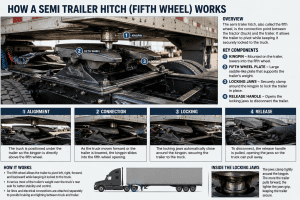
Main components of a semi trailer hitch
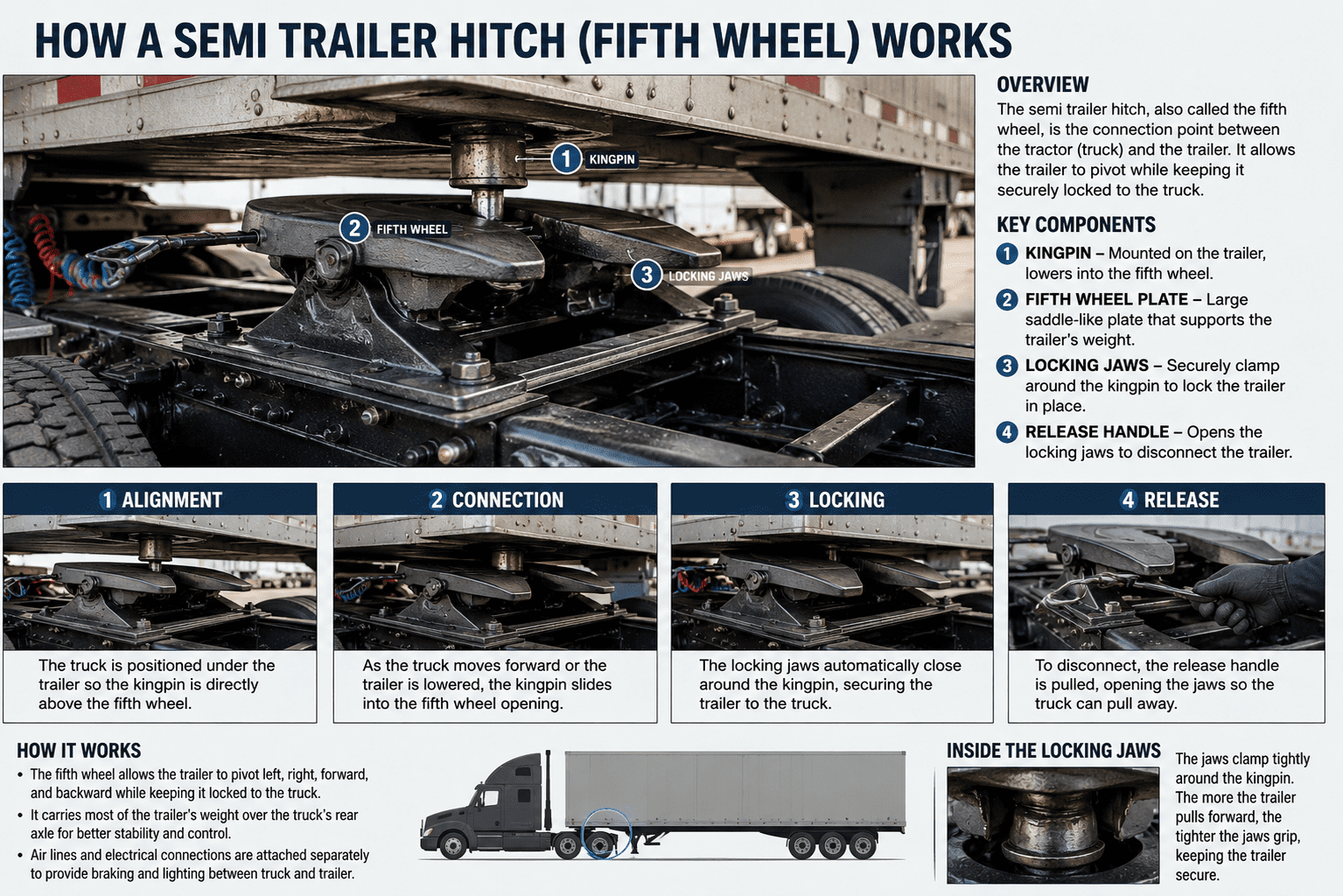
To understand how does a semi trailer hitch work, you must know its core parts:
1. Fifth-Wheel Plate
Mounted on the tractor unit, acts as the main connection base.
2. Kingpin
A steel pin attached to the trailer that locks into the hitch.
3. Locking Jaws
Secure the kingpin in place during towing.
4. Release Handle
Used to disconnect the trailer.
5. Sliding Mount (optional)
Allows weight adjustment for axle balance.
How does a semi trailer hitch work – Step-by-step process
Step 1: Truck positioning
The tractor reverses under the trailer.
Step 2: Alignment
The kingpin aligns with the fifth-wheel plate opening.
Step 3: Connection
The kingpin enters the locking jaws.
Step 4: Locking mechanism
Jaws automatically close around the kingpin.
Step 5: Safety lock engagement
A secondary lock prevents accidental release.
Step 6: Weight transfer
Trailer weight is distributed onto the tractor’s drive axle.
Step 7: Ready for movement
The system allows pivoting for turning and road movement.
How weight distribution works in a fifth-wheel hitch
The hitch does more than connect—it distributes weight.
Key functions:
- Transfers trailer load to tractor frame
- Improves vehicle stability
- Reduces trailer sway
- Ensures balanced axle pressure
This makes long-distance transport safe and efficient.
Safety features of semi trailer hitches
1. Locking jaw system
Prevents accidental detachment.
2. Secondary safety latch
Acts as backup locking mechanism.
3. Kingpin reinforcement
Prevents structural failure under heavy load.
4. Visual inspection indicators
Helps drivers confirm proper locking.
Types of semi trailer hitch systems
1. Fixed fifth-wheel hitch
- Permanent installation
- Common in standard tractors
2. Sliding fifth-wheel hitch
- Adjustable positioning
- Helps balance axle weight
3. Air-release hitch (advanced models)
- Uses air pressure for locking/unlocking
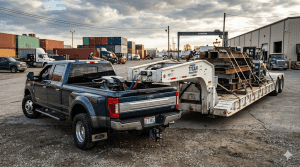
Why semi trailers do not use regular pickup hitches
| Feature | Semi Trailer Hitch | Pickup Hitch |
|---|---|---|
| Load capacity | Extremely high | Limited |
| Connection type | Kingpin & fifth-wheel | Ball hitch |
| Stability | Very high | Moderate |
| Use case | Commercial freight | Light towing |
Regular pickup hitches cannot handle the structural load of semi trailers.
Advantages of fifth-wheel hitch systems
- High load capacity
- Strong mechanical locking
- Improved road stability
- Better weight distribution
- Smooth turning capability
Common hitch problems
1. Improper locking
Can cause trailer detachment risk
2. Wear on kingpin
Reduces safety over time
3. Lack of lubrication
Causes friction damage
4. Misalignment
Prevents proper coupling
Maintenance tips for semi trailer hitches
- Regular lubrication of fifth-wheel plate
- Inspect kingpin for wear
- Check locking jaw function
- Clean debris before coupling
- Test safety lock before driving
Real-world applications of hitch systems
Semi trailer hitches are essential in:
- Freight logistics
- Container transport
- Construction hauling
- Industrial supply chains
- Long-distance trucking operations
Future of semi trailer hitch technology
Future innovations include:
- Automated coupling systems
- Sensor-based lock verification
- Smart weight distribution systems
- AI-assisted trailer alignment
- Remote hitch monitoring systems
These technologies will improve safety and reduce human error.
Conclusion
Understanding how does a semi trailer hitch work is essential for anyone involved in trucking or logistics. The fifth-wheel coupling system provides a strong, stable, and flexible connection between tractor and trailer, allowing safe transportation of extremely heavy loads.
With its locking jaws, kingpin design, and advanced weight distribution system, the semi trailer hitch is one of the most important engineering innovations in modern freight transport.
FAQ Section
1. How does a semi trailer hitch work?
It uses a fifth-wheel plate and kingpin system that locks the trailer securely to the tractor unit.
2. What is a fifth-wheel hitch?
It is a heavy-duty coupling device used to connect semi trailers to trucks.
3. How does the kingpin work?
The kingpin slides into locking jaws that secure the trailer to the hitch.
4. Can a pickup truck use a semi trailer hitch?
No, pickup trucks are not designed for fifth-wheel semi trailer loads.
5. Is the hitch safe for heavy loads?
Yes, it is engineered for extremely high load capacities.
6. What happens if the hitch fails?
Safety locks and inspections are designed to prevent accidental failure.
7. How often should hitches be maintained?
They should be inspected and lubricated regularly before trips.
8. What is a sliding fifth-wheel hitch?
It allows adjustment of weight distribution across axles.
9. Why is lubrication important?
It prevents wear and ensures smooth coupling movement.
10. What vehicles use fifth-wheel hitches?
Semi trucks, heavy freight tractors, and commercial transport vehicles.