Heavy equipment transport rarely fits on a standard flatbed. Once cargo gets too tall, too wide, or too heavy for normal road limits, operators turn to two main solutions: the lowbed trailer and the modular trailer. Both move oversized loads, but they are built for different jobs, and picking the wrong one can cost time, money, and permits.
This guide breaks down what separates a lowbed trailer from a modular trailer, how each is configured, and which one makes sense for your project.
What Is a Lowbed Trailer
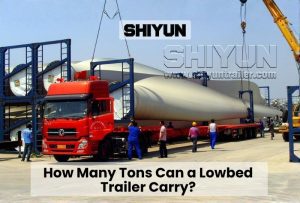
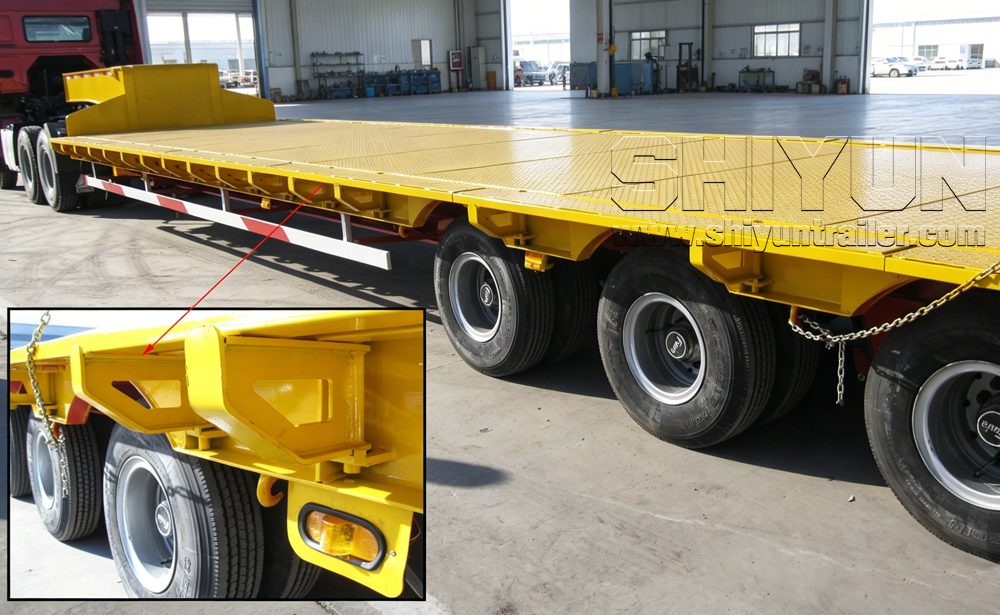
A lowbed trailer, also called a lowboy or low loader, is a semi-trailer with a deck height close to the ground, usually between 400mm and 1200mm. That low deck gives extra vertical clearance for tall cargo like excavators, bulldozers, wind turbine components, and other construction machinery that would exceed height limits on a standard flatbed.
Lowbed trailers come in several configurations:
- Fixed or non-extendable lowbed, the standard type for construction machinery
- Extendable lowbed, with a telescoping frame for long cargo such as pipes or wind blades
- Detachable gooseneck (RGN) lowbed, where the front section detaches so equipment can drive straight onto the deck
- Multi-axle lowbed, ranging from 2 to 10 axles depending on the load
Most lowbed trailers carry loads between 20 and 200 tons, with axle count and frame strength scaled to the weight. A fixed number of axle lines and a gooseneck connection to the tractor unit make the lowbed a semi-permanent, purpose-built structure.
What Is a Modular Trailer
A modular trailer, sometimes called a hydraulic modular trailer or module trailer, is built from individual axle line sections that can be added, removed, or coupled side by side and end to end. Instead of one fixed frame, the modular system lets operators assemble a custom platform sized to the actual cargo.
Each axle line typically carries its own steering, suspension, and load sensors, and lines can be linked together to form wider or longer combinations as needed. This is what allows a modular trailer to carry loads that a standard lowbed simply cannot handle, such as transformers, reactor vessels, bridge girders, and offshore modules.
The self-propelled modular transporter, or SPMT, is the powered version of this concept. It adds its own hydraulic power pack and drive system to each axle line, so the whole platform moves independently without a separate tractor unit. SPMTs are common in shipyards, petrochemical plants, and bridge construction where precise, low-speed maneuvering matters more than highway travel.
Key Differences Between Lowbed and Modular Trailers
Structure. A lowbed trailer has a fixed frame with a set number of axles. A modular trailer is built from separate, connectable sections that change configuration project by project.
Load capacity. Standard lowbed trailers typically top out around 100 to 200 tons. Modular trailers, especially when multiple axle lines are coupled together, can move loads well into the thousands of tons, which is why they are the standard choice for industrial and offshore project cargo.
Steering and maneuverability. Lowbed trailers rely on the tractor unit for steering, with some rear axles that steer to follow the turn. Modular trailers use independently controlled axle lines, often with full 360-degree steering on each line, giving them the ability to move sideways, pivot in place, or crab-steer around tight job sites.
Setup and operation. A lowbed trailer connects to a tractor and is ready to load. A modular trailer, particularly an SPMT, needs engineering input to configure the right number of axle lines, calculate weight distribution, and plan the route, since it is built to match a specific cargo rather than general hauling.
Typical cargo. Lowbed trailers handle construction machinery, generators, and mid-size industrial equipment. Modular trailers and SPMTs handle project cargo like power plant modules, ship sections, offshore platform components, and bridge spans.
Cost and flexibility. Lowbed trailers are more affordable and practical for regular hauling. Modular trailers cost more to operate and require trained crews, but they offer flexibility that no fixed-frame trailer can match for extreme loads.
Axle Lines and Configuration Explained
In modular trailer terminology, an axle line refers to a row of axles placed side by side under the platform, usually paired in sets of two. A modular trailer combines two, four, six, or eight axle lines depending on the weight and footprint of the cargo. Lines can run end to end for longer loads or side by side for wider ones, and the hydraulic suspension keeps the deck level even when the cargo shifts weight during transport.
Lowbed trailers use a simpler axle group, usually 2 to 6 axles in a fixed dual-line arrangement, mounted directly to the trailer frame. This keeps the design straightforward and easier to maintain compared to a fully modular system.
Load Capacity and GVW Considerations
Gross vehicle weight, or GVW, and axle load limits both play a role in choosing between a lowbed and a modular trailer. In China, axle load and combination weight limits fall under GB 1589-2016, which sets the maximum permitted dimensions and weights for road vehicles including semi-trailers and combination transporters. Any project involving oversized or overweight cargo typically needs a transport permit that accounts for these limits, along with route surveys for bridges and road clearances.
Related Reading: Gross Vehicle Weight (GVW) vs Payload Capacity Explained
A lowbed trailer’s payload is generally fixed by its frame design and axle rating. A modular trailer’s effective payload is more of a moving target since it depends on how many axle lines are coupled together and how the load is distributed across them.
When to Choose a Lowbed Trailer
A lowbed trailer is the right call for standard heavy equipment transport: excavators, wheel loaders, cranes under typical weight thresholds, and similar machinery that needs extra deck clearance but not an engineered transport plan. It is faster to deploy, cheaper to run, and does not require specialized crews.
When to Choose a Modular Trailer
A modular trailer, or an SPMT, becomes necessary once cargo exceeds what a fixed lowbed can carry, or when the load has an irregular shape that needs a custom platform. Shipyards, refineries, power plants, and bridge projects rely on modular systems because the axle line design can be reconfigured for each unique job.
Shiyun Trailer, known under the GIRDER TRAILER brand, build both standard lowbed trailers and modular trailer systems in China compatible with common axle line designs, giving buyers a single source whether the project calls for a straightforward lowboy or a fully engineered modular transport solution.
Compare Lowbed Trailer vs Modular Trailer
| Factor | Lowbed Trailer | Modular Trailer |
|---|---|---|
| Frame | Fixed | Configurable axle lines |
| Typical capacity | 20 to 200 tons | Hundreds to thousands of tons |
| Steering | Tractor plus rear steer axles | Independent per axle line |
| Setup complexity | Low | High, needs engineering |
| Common cargo | Construction machinery | Project cargo, modules, bridge sections |
| Cost | Lower | Higher |
Frequently Asked Questions
Is an SPMT the same as a modular trailer?
An SPMT is a self-powered version of a modular trailer. A standard modular trailer needs a separate tractor unit or power pack to move, while an SPMT has its own hydraulic drive built into each axle line.
Can a modular trailer be used for regular equipment hauling?
It can, but it is not cost-efficient for routine jobs. Modular trailers are designed for loads that exceed what a standard lowbed can safely carry.
What load capacity does a lowbed trailer typically have?
Most lowbed trailers carry between 20 and 200 tons, depending on axle count and frame strength, with heavier configurations available for specialized projects.
Do modular trailers need special permits?
Yes. Given their size and weight, modular trailer moves almost always require oversize or overweight transport permits along with a planned route survey.