How do semi trailer brakes work?
A semi trailer braking system is a heavy-duty mechanism designed to stop large commercial vehicles using compressed air instead of hydraulic fluid.
Air brake system is the foundation of modern trailer braking technology.
It is commonly used in:
- Semi trailers
- Heavy trucks
- Buses
- Industrial transport vehicles
This system ensures consistent braking power even under extreme load conditions.
Main components of semi trailer brakes
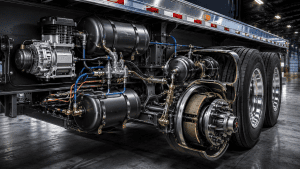
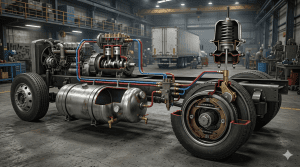
To understand how do semi trailer brakes work, you need to know the key components:
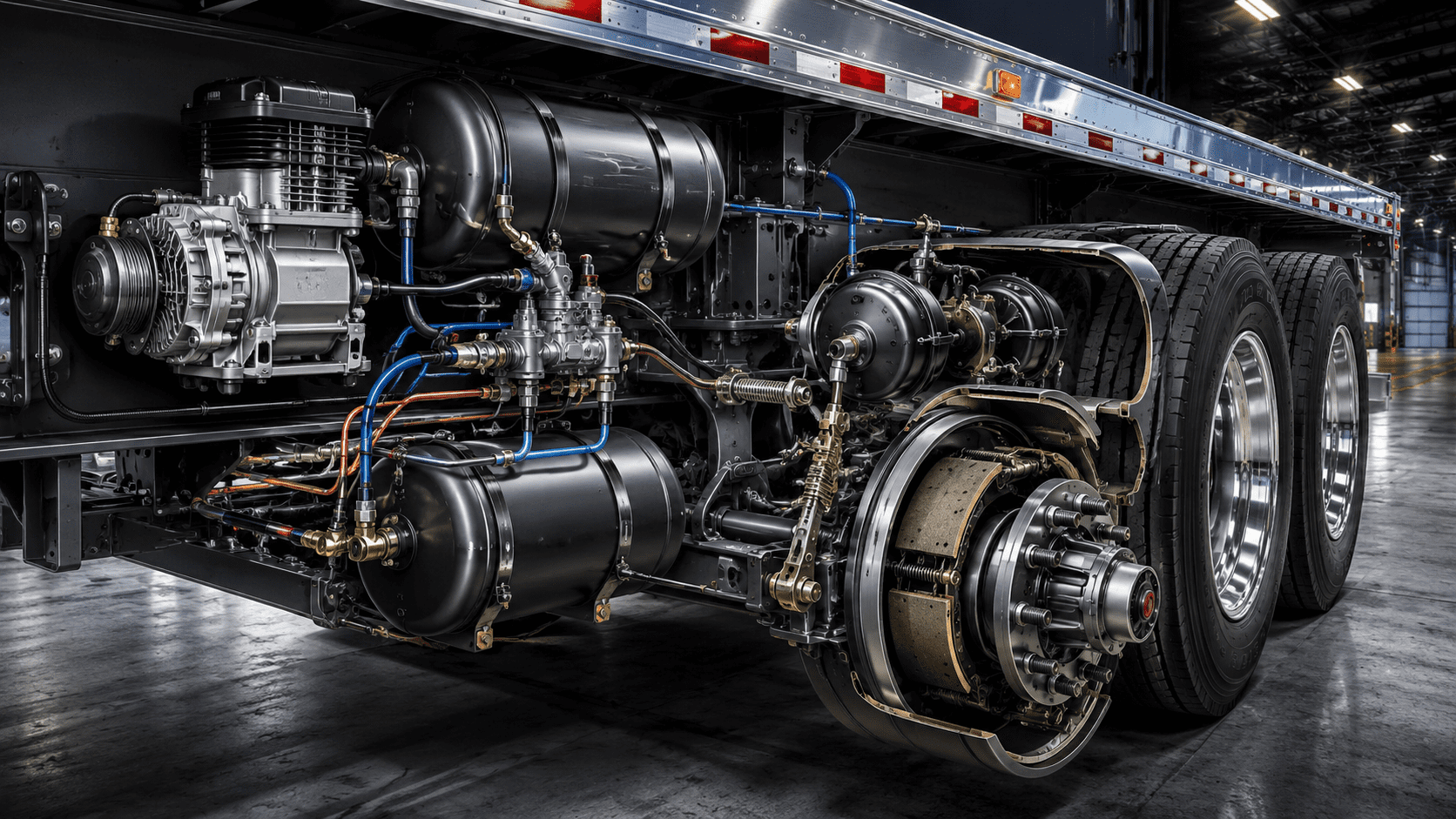
1. Air Compressor
Generates compressed air from the engine.
2. Air Reservoir Tanks
Store pressurized air for braking use.
3. Brake Chambers
Convert air pressure into mechanical force.
4. Slack Adjusters
Transfer motion from chamber to brake shoes.
5. Brake Shoes & Drums
Create friction to stop wheel rotation.
6. Control Valves
Manage airflow distribution.
7. ABS Sensors (if equipped)
Prevent wheel lockup during braking.
How do semi trailer brakes work – Step-by-step process
Step 1: Air generation
The engine powers an air compressor that continuously produces compressed air.
Step 2: Air storage
Air is stored in reservoirs to ensure immediate availability.
Step 3: Brake pedal activation
When the driver presses the brake pedal, a signal valve opens.
Step 4: Air distribution
Air flows through brake lines toward each axle.
Step 5: Brake chamber activation
Air pressure pushes a diaphragm inside the brake chamber.
Step 6: Mechanical force transfer
The diaphragm activates slack adjusters.
Step 7: Friction braking
Brake shoes press against drum surfaces, slowing wheel rotation.
Step 8: Vehicle stops safely
Controlled friction reduces speed and brings the trailer to a stop.
Role of ABS in semi trailer braking systems
Modern trailers often include Anti-lock Braking Systems (ABS).
Benefits of ABS:
- Prevents wheel lock
- Maintains steering control
- Reduces skidding risk
- Improves stability on wet roads
ABS is especially important during emergency braking or downhill travel.
Types of braking systems in semi trailers
1. Service Brakes
Used during normal driving conditions.
2. Spring Parking Brakes
Engage automatically when air pressure is lost.
3. Emergency Brakes
Activate during system failure.
Why semi trailer brakes use air instead of hydraulic systems
| Feature | Air Brakes | Hydraulic Brakes |
|---|---|---|
| Load handling | Very high | Limited |
| Safety | Fail-safe system | No fail-safe |
| Maintenance | Moderate | Low |
| Durability | High | Medium |
| Use case | Heavy trucks | Cars/light vehicles |
Air brakes are essential for heavy freight safety.
Key advantages of semi trailer brakes
- High load control capability
- Automatic emergency safety system
- Long-distance reliability
- Reduced brake fade
- Consistent braking force
Common problems in semi trailer brakes
1. Air leakage
Reduces braking pressure
2. Moisture accumulation
Can freeze and block airflow
3. Worn brake shoes
Reduces stopping efficiency
4. Compressor failure
Causes loss of air supply
5. Valve malfunction
Disrupts air distribution
Maintenance best practices
- Drain air tanks daily
- Inspect brake lines regularly
- Test emergency braking system
- Replace worn brake shoes
- Monitor air pressure gauges
Proper maintenance ensures safety and performance.
Real-world applications of semi trailer brakes
Semi trailer braking systems are used in:
- Freight logistics
- Long-haul trucking
- Construction transport
- Industrial shipping
- Public transport buses
Future of semi trailer brake technology
The future includes:
- Smart electronic braking systems
- AI-assisted braking control
- Automated emergency braking
- Wireless brake monitoring systems
- Integration with autonomous trucks
These innovations improve safety and efficiency.
Conclusion
Understanding how do semi trailer brakes work is essential for anyone involved in transportation or logistics. These systems rely on compressed air, mechanical force transfer, and safety-first engineering to handle extremely heavy loads.
With components like brake chambers, slack adjusters, and ABS systems working together, semi trailer brakes provide reliable stopping power under all conditions. Their fail-safe design makes them one of the most important safety systems in the entire trucking industry.
FAQ Section
1. How do semi trailer brakes work?
They use compressed air to activate brake chambers that push brake shoes against drums to stop the vehicle.
2. What powers semi trailer brakes?
An engine-driven air compressor provides the required air pressure.
3. What happens if air pressure fails?
Spring brakes automatically engage to stop the trailer safely.
4. Do all semi trailers have ABS?
Most modern semi trailers are equipped with ABS for safety and stability.
5. Why are air brakes used in trucks?
Because they handle heavy loads and offer fail-safe operation.
6. What are slack adjusters?
They transfer motion from brake chambers to brake shoes.
7. How often should semi trailer brakes be checked?
They should be inspected before every trip and serviced regularly.
8. Can semi trailer brakes lock up?
Yes, but ABS helps prevent wheel lock during emergency braking.
9. What is brake fade?
Loss of braking efficiency due to excessive heat buildup.
10. Are semi trailer brakes reliable?
Yes, they are highly reliable when properly maintained.