Introduction
How do air brakes work on a semi trailer is a critical question for anyone involved in trucking, logistics, or heavy-duty vehicle operation. Semi trailers carry extremely heavy loads, often exceeding tens of thousands of pounds, which makes standard hydraulic braking systems insufficient and unsafe.
Instead, semi trailers use a specialized air brake system designed to provide reliable, fail-safe stopping power even under extreme conditions. Unlike passenger vehicles that rely on hydraulic fluid, air brakes use compressed air to activate braking mechanisms across multiple axles.
Understanding this system is essential not only for drivers but also for fleet managers, mechanics, and transportation engineers. In this guide, we break down exactly how air brakes work on a semi trailer, their components, benefits, and real-world applications in modern freight transport.
What is an air brake system?
An air brake system is a type of braking mechanism that uses compressed air instead of hydraulic fluid to apply pressure to brake components.
Air brake system is widely used in:
- Semi trailers
- Buses
- Heavy-duty trucks
- Trains (in modified form)
Why air brakes are used:
- Handles heavy loads safely
- Provides consistent braking force
- Works even in long downhill operations
- Includes built-in safety fail mechanisms
Main components of semi trailer air brakes
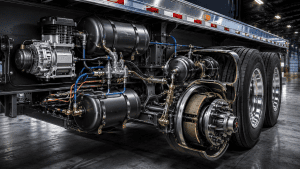
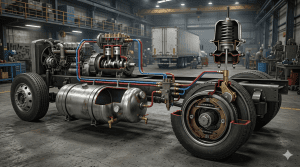
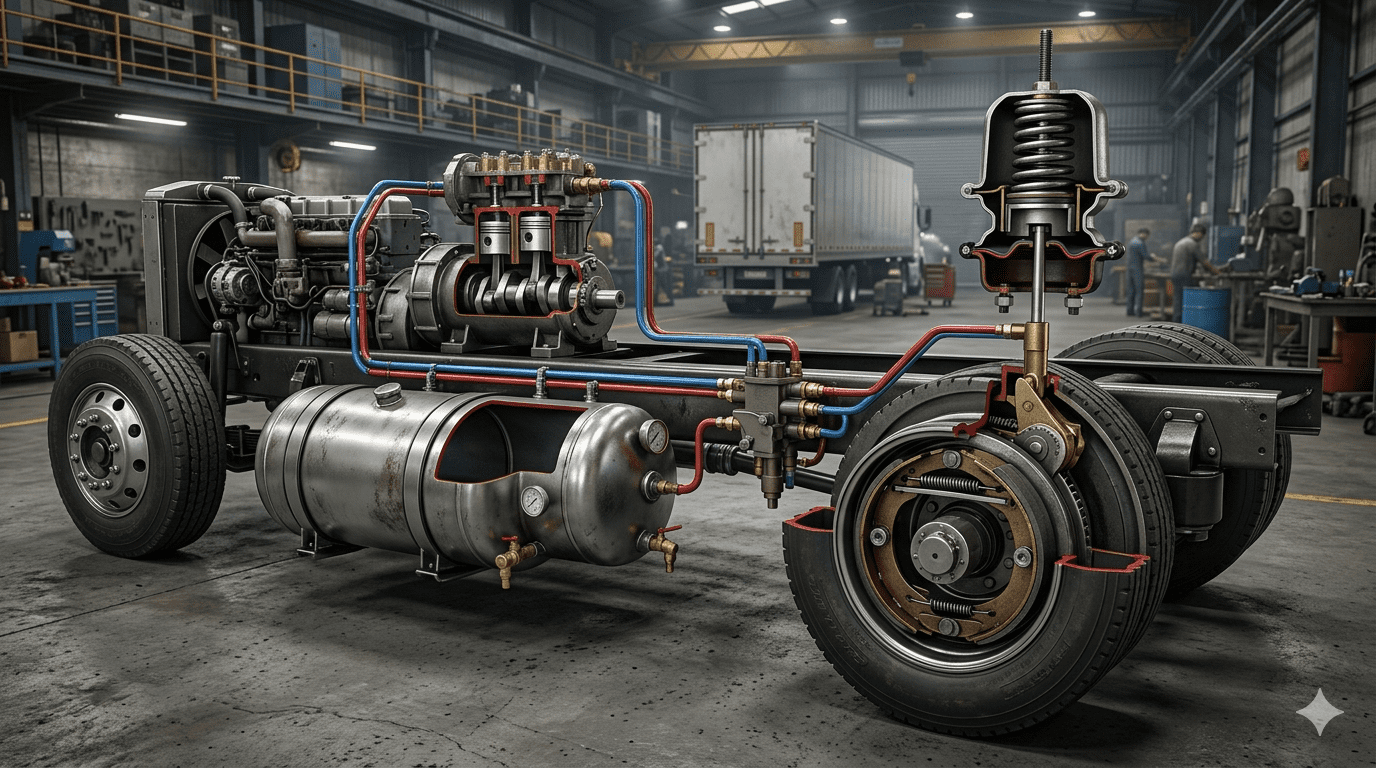
To understand how do air brakes work on a semi trailer, you must first understand its components:
1. Air Compressor
Pumps air into the system and maintains pressure.
2. Air Reservoir Tanks
Store compressed air for braking use.
3. Brake Pedal (Treadle Valve)
Controls the amount of air sent to brakes.
4. Brake Chambers
Convert air pressure into mechanical force.
5. Brake Shoes & Drums
Create friction to stop the wheels.
6. Air Lines & Valves
Control air flow throughout the system.
How do air brakes work on a semi trailer – Step-by-step process
Here is the full working cycle:
Step 1: Air compression
The engine-powered compressor generates compressed air and stores it in tanks.
Step 2: Pressure buildup
Air pressure is continuously maintained within safe operating levels.
Step 3: Driver presses brake pedal
When the driver applies brakes, a valve opens.
Step 4: Air release to brake chambers
Compressed air flows into brake chambers on each axle.
Step 5: Mechanical force activation
Air pressure pushes a diaphragm inside the chamber.
Step 6: Brake application
This force activates brake shoes, pressing them against drum surfaces.
Step 7: Vehicle slows down or stops
Friction between shoes and drums slows wheel rotation.
Fail-safe design of air brakes
One of the most important features of semi trailer brakes is safety.
How fail-safe works:
- If air pressure drops → brakes automatically engage
- Spring brakes activate during emergencies
- Prevents runaway trailer situations
This design ensures that loss of air does not mean loss of braking power.
Types of brakes in a semi trailer system
1. Service Brakes
Used during normal driving conditions.
2. Parking Brakes
Spring-activated system that holds vehicle stationary.
3. Emergency Brakes
Automatically engage when air pressure is lost.
Why semi trailers use air brakes instead of hydraulic brakes
| Feature | Air Brakes | Hydraulic Brakes |
|---|---|---|
| Load capacity | Very high | Limited |
| Safety system | Fail-safe | Not fail-safe |
| Maintenance | Moderate | Lower |
| Heat resistance | Excellent | Moderate |
| Usage | Heavy vehicles | Cars, light trucks |
Air brakes are preferred because they maintain consistent performance under extreme weight conditions.
Advantages of air brakes in semi trailers
- Reliable under heavy load
- Automatic emergency braking system
- Long-distance durability
- Better heat resistance
- Reduced brake fade risk
Common issues in air brake systems
Even though reliable, air brakes may face problems:
1. Air leaks
Reduce braking efficiency
2. Moisture buildup
Can freeze in cold conditions
3. Compressor failure
Leads to loss of air pressure
4. Worn brake shoes
Reduces stopping power
5. Valve malfunction
Affects air distribution
Maintenance tips for air brake systems
- Regularly inspect air lines
- Drain air tanks daily
- Check compressor performance
- Replace worn brake shoes
- Test emergency braking system
Proper maintenance ensures safety and system longevity.
Real-world applications of air brakes
Air brakes are essential in:
- Freight transportation
- Long-haul trucking
- Construction equipment hauling
- Public buses
- Industrial logistics
Future of air brake technology
The trucking industry is evolving with:
- Electronic brake monitoring systems
- Smart sensor-based diagnostics
- Automatic emergency braking (AEB)
- Integration with autonomous trucks
These innovations will make air brake systems even safer and more efficient.
Conclusion
Understanding how do air brakes work on a semi trailer is essential for safe and efficient heavy-duty transport operations. Air brake systems use compressed air instead of hydraulic fluid, making them ideal for controlling large, heavy vehicles.
Their fail-safe design, multi-stage braking process, and durability make them the backbone of modern freight transportation. While they require regular maintenance, their safety and reliability far exceed traditional braking systems.
FAQ Section
1. How do air brakes work on a semi trailer?
Air brakes use compressed air to activate brake chambers, which push brake shoes against drums to stop the vehicle.
2. What happens if air pressure fails?
Spring brakes automatically engage to safely stop the trailer.
3. Why do semi trailers use air brakes?
Because they handle heavy loads and provide fail-safe braking under extreme conditions.
4. What are the main parts of an air brake system?
Compressor, air tanks, brake chambers, valves, and brake shoes.
5. Are air brakes better than hydraulic brakes?
Yes, for heavy vehicles, because they handle higher loads and include safety backups.
6. Do air brakes wear out quickly?
No, but components like brake shoes require regular maintenance.
7. What is the role of the compressor?
It generates and maintains compressed air for the braking system.
8. Can air brakes freeze in winter?
Yes, moisture in the system can freeze if not drained properly.
9. How often should air brakes be serviced?
Regular inspections should be done daily, with full maintenance scheduled periodically.
10. What vehicles use air brakes?
Semi trailers, buses, and heavy-duty trucks.