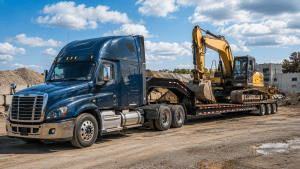
Learning how to draw a semi truck and trailer is a fun way to improve your drawing skills while creating one of the most recognizable vehicles on the road. Semi trucks are commonly used for transporting goods across long distances and feature a powerful tractor unit connected to a large trailer.
Whether you are a beginner, student, artist, or truck enthusiast, this step-by-step guide will help you draw a realistic semi truck and trailer using simple shapes and easy techniques.
What Is a Semi Truck and Trailer?
A semi truck consists of two main parts:
- The tractor (truck cab)
- The trailer
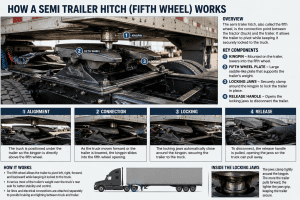
The tractor contains the engine, driver’s cab, and front wheels, while the trailer carries cargo and connects to the truck through a fifth-wheel coupling.
Before starting your drawing, it’s helpful to understand the basic structure of the vehicle.
Drawing Supplies You’ll Need
Gather the following materials:
- Pencil
- Eraser
- Ruler
- Drawing paper
- Fine liner or marker
- Colored pencils (optional)
Using a ruler can help create straight lines and improve overall proportions.
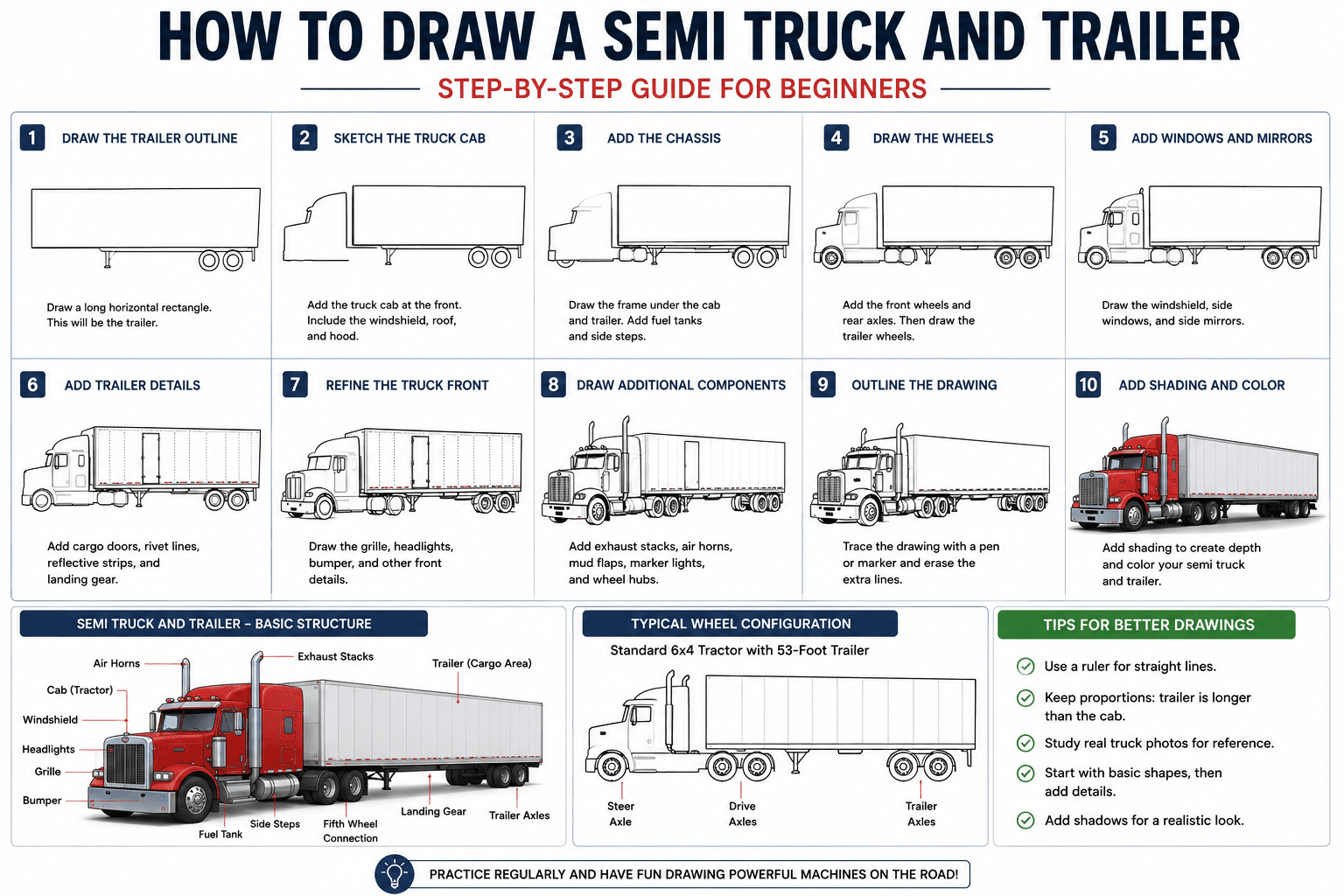
Step 1: Draw the Trailer Outline
Begin by drawing a long horizontal rectangle.
This rectangle will form the cargo trailer.
Tips:
- Make the trailer longer than it is tall.
- Keep the lines straight.
- Leave enough space at the front for the truck cab.
At this stage, focus only on the basic shape.
Step 2: Sketch the Truck Cab
Draw a smaller rectangular shape at the front of the trailer.
Next:
- Add a sloped windshield.
- Create the roofline.
- Draw the hood section.
The cab should be noticeably shorter than the trailer.
Step 3: Add the Chassis
Draw a horizontal line underneath the cab and trailer.
This line represents the truck frame.
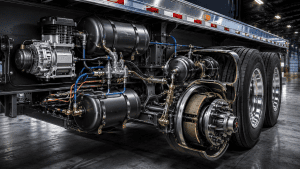
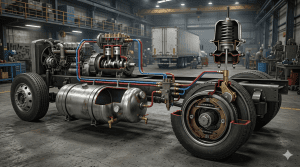
Add structural details such as:
- Fuel tanks
- Side steps
- Frame supports
These details help make the drawing more realistic.
Step 4: Draw the Wheels
A standard semi truck usually has:
- Two front wheels
- Multiple rear axles
- Trailer wheels
Draw circles for each tire.
Make sure:
- Wheels are evenly spaced.
- Rear axles appear grouped together.
- Tire sizes remain consistent.
Step 5: Add Windows and Mirrors
Draw:
- Side windows
- Windshield
- Door outline
- Side mirrors
These small details bring the truck to life and improve realism.
Step 6: Add Trailer Details
Enhance the trailer by including:
- Cargo doors
- Rivet lines
- Reflective strips
- Side rails
- Landing gear supports
These features are commonly found on real freight trailers.
Step 7: Refine the Truck Front
Add:
- Headlights
- Grille
- Bumper
- Air intakes
These details define the truck’s appearance and make it more recognizable.
Step 8: Draw Additional Components
For a more realistic semi truck drawing, include:
- Exhaust stacks
- Air horns
- Mud flaps
- Marker lights
- Wheel hubs
Professional truck illustrations often include these components.
Step 9: Outline the Drawing
Once satisfied with the sketch:
- Trace important lines with a marker or pen.
- Erase unnecessary construction lines.
- Clean up rough edges.
This creates a polished final drawing.
Step 10: Add Shading and Color
Apply shading around:
- Wheels
- Undercarriage
- Trailer edges
- Cab contours
Color options may include:
- White trailers
- Red, blue, or black truck cabs
- Chrome details
- Black tires
Shading helps create depth and realism.
Common Mistakes to Avoid
Incorrect Proportions
The trailer should be significantly longer than the truck cab.
Uneven Wheels
Keep wheel sizes consistent and aligned.
Missing Perspective
Use slightly angled lines when drawing in perspective.
Overcrowding Details
Start simple and add details gradually.
Tips for Drawing Realistic Semi Trucks
- Use reference photos.
- Study trailer dimensions.
- Practice basic vehicle shapes first.
- Focus on symmetry and proportion.
- Add realistic shadows.
- Use perspective guidelines.
The more you practice, the more accurate your drawings will become.
Why Learn to Draw Semi Trucks?
Drawing semi trucks can help improve:
- Observation skills
- Vehicle illustration techniques
- Perspective drawing
- Mechanical drawing abilities
- Artistic confidence
It is also an excellent exercise for transportation enthusiasts and students interested in commercial vehicles.
Conclusion
Drawing a semi truck and trailer becomes much easier when broken into simple steps. By starting with basic shapes and gradually adding details such as wheels, windows, mirrors, and trailer components, beginners can create accurate and realistic truck illustrations. With practice and patience, you can develop impressive semi truck drawings suitable for art projects, educational work, or personal enjoyment.